
The Chief Justice is clearly worried about the Supreme Court’s legacy.
In last week’s majority 6-3 opinion that declared the administration’s student loan forgiveness program unconstitutional, Chief Justice John Roberts urged those who disagreed with the decision not to disparage the Court because “such misperception would be harmful to this institution and our country.”
I’m afraid that horse is already out of the barn.
As multiple observers noted, Roberts and his five conservative colleagues decided in two recent cases that fake plaintiffs are good plaintiffs, substituting their beliefs for the law. That blame lies with the Court. Respected political scientist Norman Ornstein made it clear that the conservatives “have unilaterally blown up the legitimacy of the Court.”
“Let’s not beat around the bush,” constitutional analyst Ian Millhiser wrote in Vox, the decision in Biden v. Nebraska “is complete and utter nonsense. It rewrites a federal law which explicitly authorizes the loan forgiveness program, and it relies on a fake legal doctrine known as ‘major questions’ which has no basis in any law or any provision of the Constitution.”
Georgetown historian Thomas Zimmer wrote,
America can accept this Supreme Court as legitimate and its rulings as the final word — or it can have true democracy and a functioning state. But not both.
Today’s extremist Supreme Court is no surprise. It is a decades-long project of corrupt sponsors that is right on schedule.

Supreme Inequality: The Supreme Court’s Fifty-Year Battle for a More Unjust America (2020) by Adam Cohen is a devastating and damning argument against today’s Supreme Court and the Republican party’s fifty-year plan to circumvent the Constitution, overturn the gains of the New Deal and Civil Rights eras, and cement inequality into American law and life. Cohen surveys Supreme Court rulings on a variety of topics from poverty, education, and campaign finance to labor, corporations, criminal justice, and democracy itself to expose how little the Court does to protect the rights of the poor and disadvantaged. In fact, since the Nixon era “the Court has, with striking regularity, sided with the rich and powerful against the poor and weak, in virtually every area of the law.”
Cohen shows how President Johnson and the liberal lions of the Court under Chief Justice Earl Warren — a group that was an outlier in the nation’s long history — made a number of tactical mistakes concerning retirement and appointments. That allowed a go-for-the jugular Richard Nixon — with support of complicit Republicans * — to ruthlessly push a justice with lifetime tenure out the door and make four strongly conservative appointments to the high court. He was stopped only when forced to resign in disgrace. Similarly, Senate Majority Leader Mitch McConnell and the Republicans built the current 6-3 constellation as the result “of several questionable – to use a wonderfully euphemistic term — actions” to quote Zimmer again, so that the corrupt, twice impeached, twice indicted Donald Trump could make three appointments that have sealed the Court’s supermajority before he was voted out of office and his coup attempt failed.
Cohen carefully reviews the decisions that case-by-case have undermined America’s rule of law, handing control over to an extremist minority. Even conservatives like Reagan administration Solicitor General Charles Fried are appalled.
[I]t has undermined or overturned precedents that embodied long-standing and difficult compromise settlements of sharply opposed interests and principals. These decisions are not the work of a conservative Court.
The Court’s tilt towards extremism only got worse since the book’s publication. A group of decisions this June made a mockery of settled law, precedent, standing, and the balance-of-power to hand extreme ideologues wins in striking down affirmative action, limiting the rights of LGBTQ+ citizens, allowing minority lawmakers to choose their voters, and curtailing the powers of Congress and the president while introducing power for the Court that is not in the Constitution.
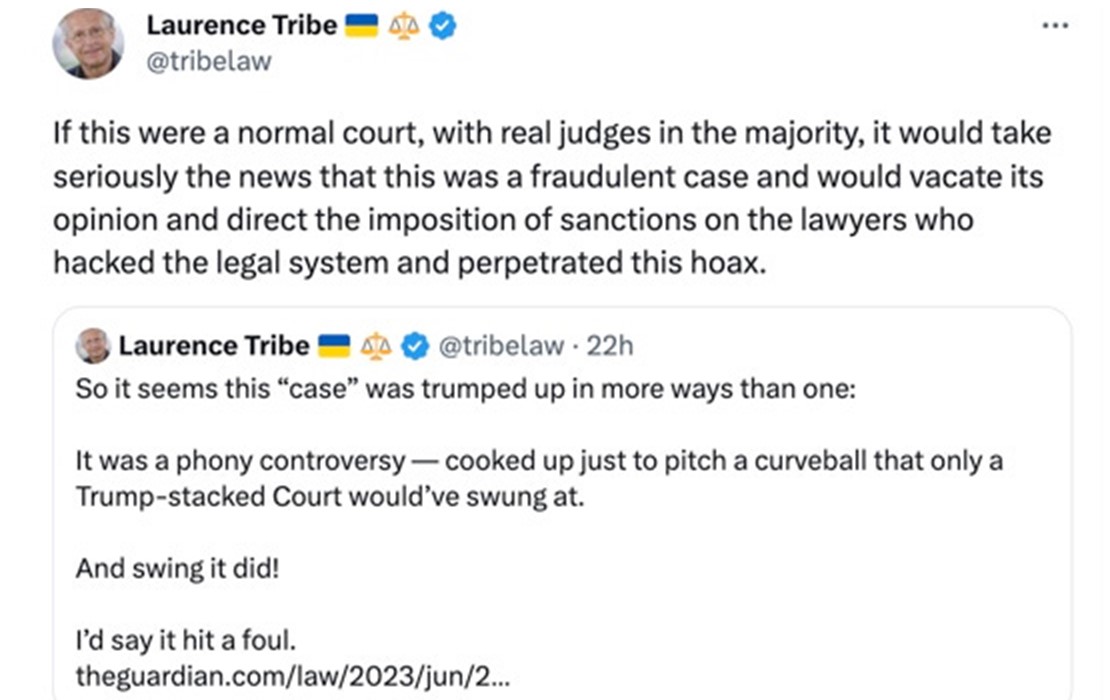
In the Colorado case where the decision discriminates against LGBTQ+ individuals, reporting came out just before the ruling which indicates that the facts of the case were not — how shall we say this — facts. The gay man named Stewart who the plaintiff said contacted her business about a website for a gay marriage turned out to be happily married to a woman for 15 years, had never contacted the website designer, and had no idea he was named by the plaintiff in the suit. Esteemed constitutional scholar Laurence Tribe suggested what should have happened next.
Coupled with last year’s decisions to take away rights from women in the Dobbs decision, put a stranglehold on states’ and cities’ efforts to keep guns off the streets, and further tighten religion’s grip on civil society — not to mention Pro Publica’s recently reported corruption of sitting justices by rich benefactors with business before the Court — we see a stunning set of moves that may finally wake Americans to the devastating harm perpetrated by Roberts and his two most recent predecessors, Warren Burger and William Rehnquist, along with their conservative colleagues.
What happened at the court [long-time Court watcher Linda Greenhouse reiterated] was a power grab of a different sort, driving the law far to the right in service of an agenda that most Americans don’t share.
The Court is pushing America back to the era before the New Deal and working to cut the access of Black and Brown Americans to elite educational institutions and the paths of power. To get there at least three conservative members of the court — Justices Barrett, Kavanaugh and Gorsuch — lied under oath about their acceptance of precedents to gain lifetime appointments. The hypocrisy of the Chief Justice in testifying at his confirmation that he was not a legislator, but a mere umpire calling balls and strikes, seems more appalling with each term.
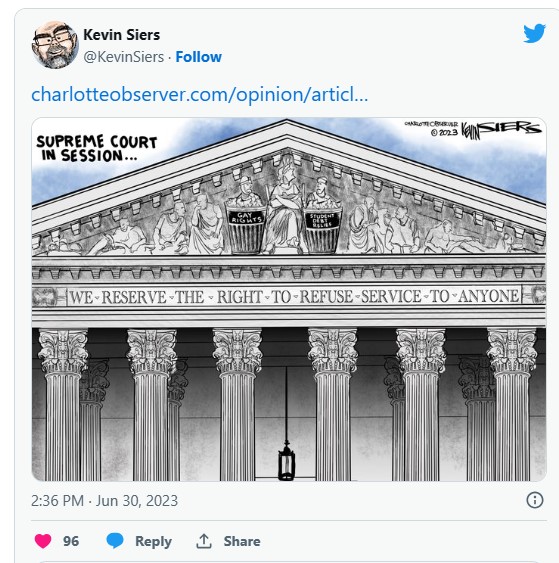
Cohen reported that a mean-spiritedness towards the poor began to appear with the rulings of the Nixon judges. Legal commentators have noted that same callow spirit now permeates the Roberts Court. It goes hand-in-hand with the arrogant and blatant corruption by justices that refuse to allow any ethics rules to grace their hallowed halls, making them a target-rich environment for the nation’s editorial cartoonists.
The three liberal justices on the current Court — all women — are following the path of Justice Thurgood Marshall in writing stinging dissents that point out this head-in-the-sand perspective.
- Justice Sonia Sotomayor wrote in dissent to the Colorado LGBTQ+ case that the First Amendment right to free speech has never before been used to issue a license to discriminate.
- Justice Ketanji Brown Jackson turned back a personal attack from Clarence Thomas by writing that “Justice Thomas’s prolonged attack…responds to a dissent I did not write in order to assail an admissions program that is not the one UNC has crafted.” Then she put the whole mess in clear terms that everyone can understand.
With let-them-eat-cake obliviousness, today, the majority pulls the ripcord and announces ‘colorblindness for all’ by legal fiat. But deeming race irrelevant in law does not make it so in life.

- Justice Elena Kagan may have put it most succinctly in her dissent to Biden.
“…the Court, by deciding this case, exercises authority it does not have. It violates the Constitution.”
The entire enterprise under the leadership of John Roberts is violating major parts of the Constitution.
America just celebrated its independence as a nation where “all men are created equal.” Heather Cox Richardson reminds us that “just as in the 1850s, we are now, once again, facing a rebellion against our founding principle, as a few people seek to reshape America into a nation in which certain people are better than others.”
The men who signed the Declaration of Independence on July 4, 1776, pledged their “Lives, [their] Fortunes and [their] sacred Honor” to defend the idea of human equality. Ever since then, Americans have sacrificed their own fortunes, honor, and even their lives, for that principle. Lincoln reminded Civil War Americans of those sacrifices when he urged the people of his era to “take increased devotion to that cause for which they gave the last full measure of devotion — that we here highly resolve that these dead shall not have died in vain — that this nation, under God, shall have a new birth of freedom—and that government of the people, by the people, for the people, shall not perish from the earth.”
Keeping a democracy is a constant fight. We have to fight and vote again and again like our lives depend upon it. Because they do.
More to come…
DJB
UPDATE: Not to pile on (well, yes, I am piling on) two more respected observers have written about the legitimacy of the Supreme Court, and I wanted to capture their thoughts for future readers. First, respected fighter for democracy Marc Elias wrote for Democracy Docket that John Robert’s Last Word is Not the Final Say in which he points out that Robert’s has been known to disparage his colleagues in dissents when it suits his purpose. And Rebecca Solnit, writing for The Guardian has a call to arms entitled The US supreme court has dismantled our rights but we still believe in them. Now we must fight which — like most Solnit work — is a must-read.
*FBI Director Hoover wiretapped Justice William O. Douglas‘s telephone while House Minority Leader Gerald Ford tried to start impeachment proceedings against Douglas. Ford’s home-state paper said it would take his claims more seriously if it “had greater faith in his objectivity.”
The Weekly Reader links to written works I’ve enjoyed. I hope you find something that makes you laugh, think, or cry.
Image of Supreme Court Building by Mark Thomas from Pixabay
 MORE TO COME...
Pingback: Observations from . . . July 2023 | MORE TO COME...
Pingback: The books I read in July 2023 | MORE TO COME...
Pingback: The 2023 year-end reading list | MORE TO COME...
Pingback: With fear for our democracy | MORE TO COME...
Pingback: Legitimacy lost | MORE TO COME...
Pingback: Grievance, fringe theories, and bad vibes | MORE TO COME...
Pingback: I’m shocked—shocked—to find that gambling is going on in here | MORE TO COME...