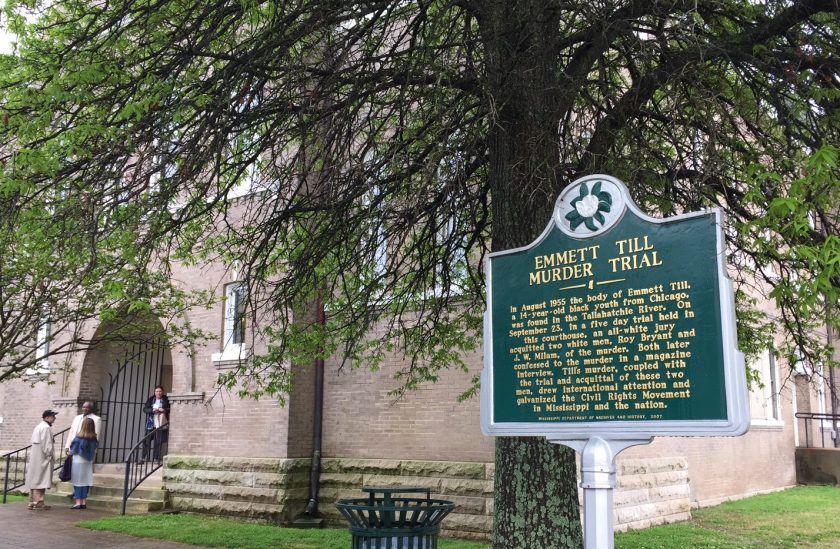
Two days ago, on what would have been Emmett Till’s eighty-second birthday, President Joe Biden established the Emmett Till and Mamie Till-Mobley National Monument. It covers three historic sites in Mississippi and Chicago: the site in Graball Landing, Mississippi, where Till’s body is believed to have been pulled from the Tallahatchie River; the Chicago church where mourners held Till’s funeral; and the courthouse in Sumner, Mississippi, where an all-white jury acquitted Roy Bryant and J.W. Milam.
Vice President Kamala Harris opened an event to mark Biden’s designation of the national monument with what historian Heather Cox Richardson describes as “a searing reminder of what those determined to make the United States a country defined by white supremacy can do.” The Vice President said, “We gather to remember an act of astonishing violence and hate and to honor the courage of those who called upon…our nation to look with open eyes at that horror and to act.”
In August 1955, fourteen-year-old Emmett Till, a Black boy from Chicago, was visiting relatives in a small Mississippi town. After the wife of a white man named Roy Bryant accused the boy of flirting with her, Bryant and his half-brother, J. W. Milam, kidnapped Till, brutally beat him, mutilated him, shot him in the back of the head, and dumped his body in the Tallahatchie River. The county sheriff directed that the body be buried quickly, but his mother insisted that her son’s body be returned to Chicago.
There, she insisted on an open-casket funeral. “Let the world see what I have seen,” she said.
Till’s murder became a symbol of what would happen if men were not called to account for their actions and a rallying cry to make sure such a society of white supremacists could not survive.
I was with a group of National Trust staff and members who visited the Mississippi Delta in 2018. As I wrote at the time, perhaps the most meaningful and moving part of the entire weekend was the 90 minutes we spent at the courthouse in Sumner, where the murderers of young Emmett Till were tried and acquitted in 1955, setting off events that led to the modern Civil Rights movement. Visitors are invited to “engage in the story of Emmett Till, explore your own story, and create a new emerging story with us.”
At its best, memory is a poet and not a historian. But not all recollections are correct, and some are purposefully misleading, including “Lost Cause” memories told by my beloved grandmother and the whitewashed versions of history currently being promoted in places such as Florida.

It is important to bring this past into the present, where we are still grappling with the racism that led to Till’s murder and the murder through lynching of at least 4,000 African Americans from 1877 – 1950. In that restored courthouse, we read aloud an apology from citizens of Tallahatchie County to the family of Emmett Till. One of our National Trust Council members spontaneously used that venue to speak from the heart about his mother’s recollections as a young African American woman in the Delta who was only five years older than Till. This is a historic site that exists to tell the story of Emmett Till in order to move people forward.
You don’t have to be a historian to play a role in the telling of the full American story. I happened to be with attorney Bryan Stevenson — the dynamic founder and head of the Equal Justice Initiative — soon after my visit to Sumner and was reminded of the work we all have to do when he said, “injustice prevails where hopelessness persists.”
If we want to build communities and a nation full of hope, it is important that we set forth a new narrative about the injustices in our lives, past and present. As Richardson wrote last evening on the 75th anniversary of the desegregation of the armed forces by President Harry S. Truman in 1948, the White House statement celebrating that anniversary did more than acknowledge it and praise today’s multicultural military. It recounted the history of Black service members from the American Revolution to the present.
Taken with yesterday’s quite comprehensive history of the 1955 murder of 14-year-old Black child Emmett Till, it seems as if the White House has found a simple way to push back on the whitewashed history taught in places like Florida: making the country’s real history easily available.
Historic sites and national monuments that tell the country’s full story can be good places where we can begin to understand that past, heal our divisions, and move people forward.
More to come…
DJB
 MORE TO COME...
Pingback: Observations from . . . July 2023 | MORE TO COME...
Pingback: The search for hope in history | MORE TO COME...