
Everyone thinks they know the South. No matter the state of birth, political persuasion, musical proclivities, taste for food, or ethnic background, Americans find it an all-too-easy region to typecast. However, having lived my entire sixty-eight years in Southern states as varied as Tennessee, Georgia, Virginia, South Carolina, and Maryland, I easily recognize the South’s many disparate and contradictory pieces.
The South is a region to celebrate and chastise. It is a place to enjoy at the emotional, sensual level and to approach thoughtfully with eyes wide open. It is a part of our collective soul we both love and mourn.
And I agree with many of our keenest observers who suggest that if we want to understand America, we have to both recognize and come to grips with the complexity of the Southern experience, history, and culture. By reframing our understanding of the South, “we gain a more honest rendering of the country.”
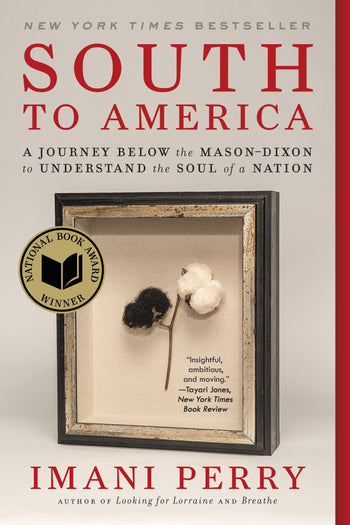
South to America: A Journey Below the Mason-Dixon to Understand the Soul of a Nation (2022) by Imani Perry is one such revelatory journey by a Black daughter of the South, crafted very much in the lineage of Albert Murray’s South to a Very Old Place. A native of Birmingham, Alabama, Perry grew up the daughter of Southern freedom movement leaders of the Civil Rights era and now teaches at Princeton. South to America is not, however, an academic work. Instead, Perry is traveling home to help the reader “tip over from curiosity and integrity” to acts of urgency. To “help the reader dig deep enough to discover the truth.”
Though she has lived in many places, Birmingham is home.
Home, for the Southerner eases into the cracked places like Alaga, thick and dark sugarcane syrup. Woundedness is pro forma; disaster touches everyone, even if only because you caused it. The unregulated emissions gather in your chest. The blood is so deep into the red earth that grief spirals into madness. We Alabamians have the highest rates of mental illness and the lowest rates of medical care. Inside home, terrors happen and repeat. This is what is neatly called trauma. But its facts are never neat … We will tell you about the warmth and charm more easily, but you cannot understand what a remarkable grace they are without the other part. Murderous home, sweet home, old home week, home.
This journey to look at home with fresh eyes begins in the Mid-Atlantic, the land of so many of our origin stories, and winds its way throughout the region. Each page of South to America, which won the 2022 National Book Award for Nonfiction, is written with a “righteous purpose and a stunning pen” — language Perry used to describe the work of her fellow National Book Award finalists in a moving acceptance speech. “I write for my people,” she noted. “I write because we children of the lash-scarred, rope-choked, bullet-ridden, desecrated are still here, standing.” She writes “because I love sentences, and I love freedom more.”
The dream of what the South — and thus America — can be drives Perry’s work. “I believe writing can be a moral instrument if it asks you to do more than read.”
This work is a meditation coming out of the realization that “the consequence of truncating the South and relegating it to a backwards corner is a misapprehension of its power in American history.” She demonstrates that power, both good and evil, in each and every story. Perry is asking us to look at the South’s significance to the nation and then “throw a wrench in the works.”
Perry’s reflections ring true when placed against my life experience. Pearl High School, for example, was a big part of the Nashville of my youth. That institution “nurtured Black children” — many of them friends of Perry and her family — in a fashion that is broad and lasting. I have also seen White people in Nashville who, as Perry describes in one encounter, sneer at “affirmative action.” They do so without realizing that while they “have a meaningful claim against the nation,” their problem is that the “claim is misdirected” when it comes toward Black folk instead of to those who have offered the false promise of Whiteness.
Perry uses her hometown of Birmingham to think about interracial and gay intimacy, and then ties in the region’s famous conservatism.
What makes a secret a secret? It really isn’t who knows — somebody always knows … What makes it a secret is that it cannot be spoken about in a whisper without something breaking. Much of the South’s conservatism is little more than an effort to zone where we place the yearnings that we don’t know what to do with.
Perhaps no Southerner wrote about stranger and more eccentric people and yearnings than Flannery O’Connor. At one point Perry visits Savannah to consider O’Connor’s famous Southern gothic-style work and to assess the recent attention given to the famous author’s bigoted beliefs. Perry admires O’Connor’s work and believes she uniquely understood Southern idiosyncrasy and violence. But Perry despairs at the thought that O’Connor — like Perry a life-long Catholic — had been “such an utter failure when it came to what might be the most basic moral question in the history of this country.” There are ways, she suggests, “to tell difficult stories about who we are that are tender rather than gothic.”
O’Connor — like so many other Southerners — refused to reckon with those yearnings that we don’t know what to do with. The South, notes Perry, has a “strong queer culture and a deep intolerance of any order other than patriarchy.” Because we haven’t learned as a culture and as a nation how to accept a wide variety of perspectives, we continue to fight and hate and shame and kill.
Perry’s look at her native South would not often be described as tender, but she approaches this journey into the nation’s soul with honesty and care and with a look to the future.
“I write for my children … and for their entire generation who deserves so much better than what we’ve offered them. May they succeed where we have failed.”
Amen.
More to come…
DJB
Photo: Trisha Downing on Unsplash
 MORE TO COME...
This is painful to read. Recognizing the pain (and hurt caused), but not knowing what to do with it.
There are no simple answers, but being honest about the problems is a good place to start.
Pingback: Observations from . . . August 2023 | MORE TO COME...
Pingback: The books I read in August 2023 | MORE TO COME...
Pingback: The 2023 year-end reading list | MORE TO COME...