
Christopher Nolen’s stunning new movie Oppenheimer attracted a large crowd to the historic AFI Silver Theatre on Sunday afternoon, August 6th — the 78th anniversary of the 1945 dropping of the atomic bomb by the U.S. on Hiroshima. Today is the anniversary of the dropping of a second atomic bomb, on Nagasaki, at the end of World War II. These seem appropriate times to remember the story of J. Robert Oppenheimer, along with the intertwined memories of our actions on the cities of Hiroshima and Nagasaki.
Oppenheimer of course was the brilliant head of the Manhattan project and the father of the atomic bomb. His story and choices are important to understand. As for the two Japanese cities, John Hersey, the author of the landmark 1946 piece on Hiroshima in The New Yorker, once wrote:
What has kept the world safe from the bomb since 1945 has not been deterrence, in the sense of fear of specific weapons, as much as it’s been memory. The memory of what happened at Hiroshima.
The movie is a complicated piece of storytelling about a complex and flawed genius. It is based on American Prometheus: The Triumph and Tragedy of J. Robert Oppenheimer, the authoritative 2005 biography by Kai Bird and Martin J. Sherwin. Triumph and tragedy, brilliance and errors are all evident throughout Oppenheimer’s story. In the film, Nolen weaves together Oppenheimer’s consequential career and a large cast of characters into a structure that moves back and forth in time to maintain dramatic tension. The New York Times movie critic has an excellent review.
The ensemble cast, beginning with Cillian Murphy as the American theoretical physicist who leads the Los Alamos lab known as the Manhattan Project, is almost uniformly strong. Both female leads — Emily Blunt as Oppenheimer’s boozy yet no-nonsense wife Kitty and Florence Pugh as his “darkly beautiful” first love Jean Tatlock — are extraordinary. Matt Damon as the project’s military head, General Leslie R. Groves, describes his role as a “kindergarten teacher” in that he has to herd a group of brilliant scientists, who cannot always be trusted, toward their goal. Robert Downey Jr. is also strong as Lewis Strauss, an ambitious, behind-the-scenes man consumed with petty grudges who also happens to be the chairman of the Atomic Energy Commission. Strauss and rival physicist Edward Teller end up bringing Oppenheimer down during the fear mongering of the McCarthy era.
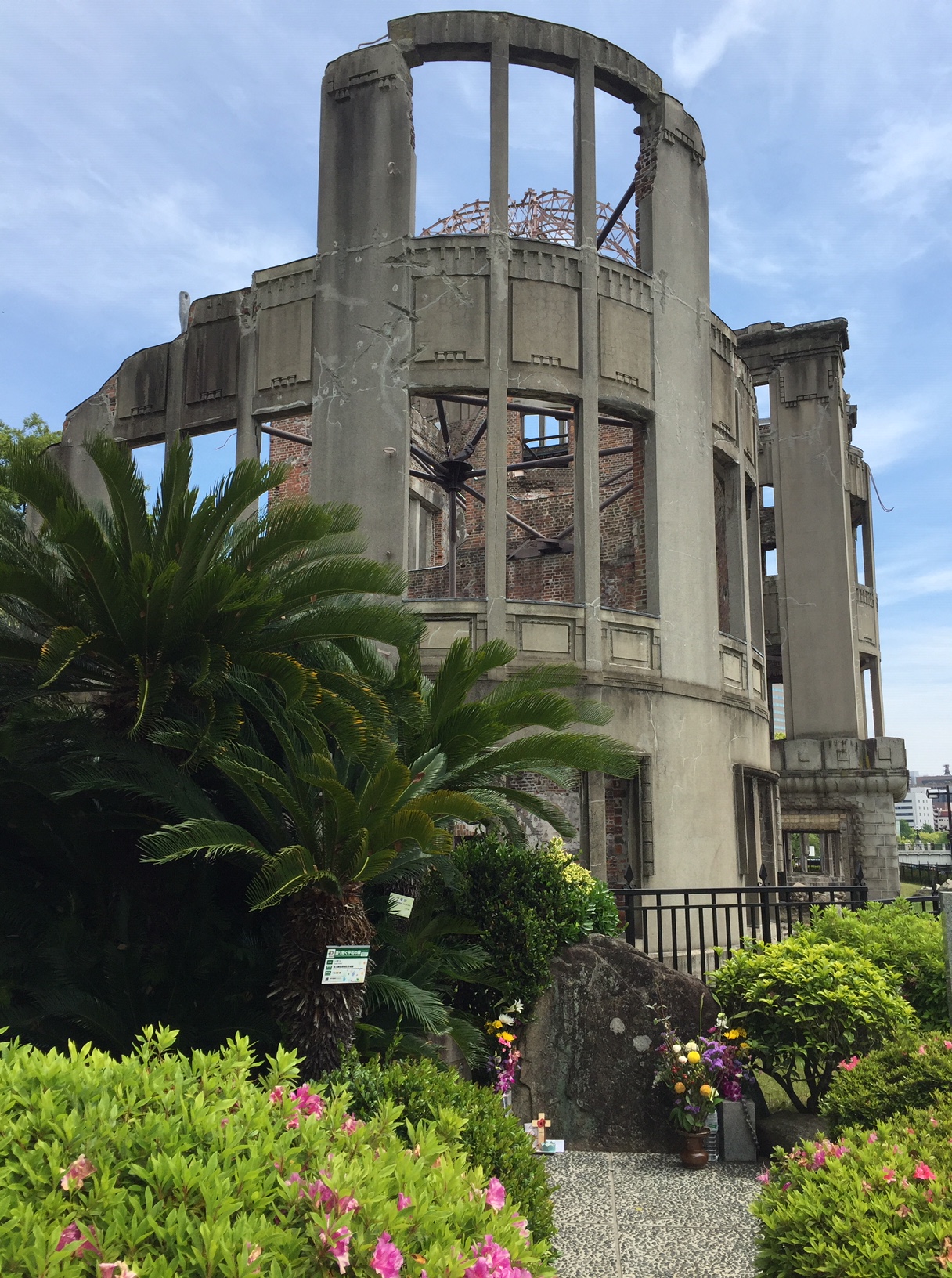
While the movie doesn’t show scenes of the attack on Japan or the havoc and chaos that followed, it is impossible to watch this story and not think of the destruction at Hiroshima and Nagasaki. After a 2019 visit to Hiroshima I wrote about the site and reporting from that era.
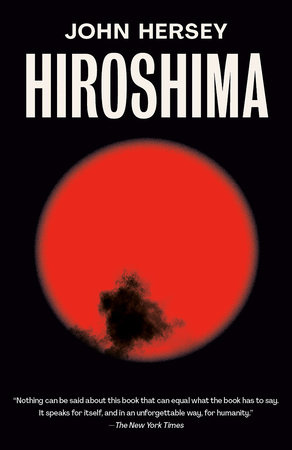
Hiroshima (1946) by John Hersey grew out of the only single-content edition of The New Yorker in the history of that publication. The initial report was serialized in some 70+ newspapers, turned into this book (never out-of-print), produced as a national radio reading, and became a touchstone for the nuclear non-proliferation movement. I bought a copy at the Hiroshima Museum and finished reading it in two nights. An important key to understanding this larger story, Hersey’s reporting was so powerful that it led the U.S. government to revise its narrative about why dropping the bomb was necessary. In Oppenheimer, you can see the military-industrial complex push forward with what they perceive as only a next generation bomb, as opposed to a world-changing weapon of mass destruction.
Oppenheimer was caught right in the middle of that fight. As his biographer Kai Bird wrote in a recent New York Times op-ed, “His forthright dissents against the prevailing view of Washington’s national security establishment earned him powerful political enemies.”
Those who wanted to destroy him set Oppenheimer up during the era of red baiting so that he walked into a kangaroo court where he was stripped of his security clearance and subjected to public humiliation. That piece of the story comes through powerfully in the film. And Bird asserts that Oppenheimer was right to challenge the false charges and — even more importantly — to speak out against a nuclear arms race.
The “Oppenheimer Affair” as it came to be known had a chilling effect on the idea of scientists speaking out as public intellectuals. Bird writes:
Sadly, Oppenheimer’s life story is relevant to our current political predicaments. Oppenheimer was destroyed by a political movement characterized by rank know-nothing, anti-intellectual, xenophobic demagogues. The witch-hunters of that season are the direct ancestors of our current political actors of a certain paranoid style. I’m thinking of Roy Cohn, Senator Joseph McCarthy’s chief counsel, who tried to subpoena Oppenheimer in 1954, only to be warned that this could interfere with the impending security hearing against Oppenheimer. Yes, that Roy Cohn, who taught former President Donald Trump his brash, wholly deranged style of politics. Just recall the former president’s fact-challenged comments on the pandemic or climate change. This is a worldview proudly scornful of science.
As William Faulkner famously wrote, “The past is never dead. It’s not even past.”
After America’s most celebrated scientist was falsely accused and publicly humiliated, the Oppenheimer case sent a warning to all scientists not to stand up in the political arena as public intellectuals. This was the real tragedy of Oppenheimer. What happened to him also damaged our ability as a society to debate honestly about scientific theory — the very foundation of our modern world.
The story of J. Robert Oppenheimer is clearly one of genius, mixed with generous helpings of hubris, error, and tragedy. But when we add in the memories of Hiroshima and Nagasaki along with Oppenheimer’s own calls for nuclear regulation — and pit that against the ongoing war on science by one of our political parties — we should support renewal of the work toward peaceful regulation while we also strive to ensure that America never again gives the nuclear codes to such a morally bereft con man as our disgraced former president. The next time could be catastrophic.
More to come …
DJB
The Weekly Reader links to the works of other writers I’ve enjoyed. I hope you find something that makes you laugh, think, or cry.
Picture of Hiroshima Peace Memorial Garden by DJB
 MORE TO COME...
tried to leave a comment at the end of the essay but it wouldn’t let me.
I am sure that you saw the op-ed NYT (although you don’t note it) written by a Native American and the impact of the tests in Arizona on their sacred land and heritage and people. Another aspect of this tragic story. It’s been interesting to read all the comments and different perspectives.
Margit
Margit Bessenyey Williams, PhD
>
Margit,
Thanks for bringing this up. I didn’t see the op-ed, but I’ve seen a lot about the Native American take on the tests and by extension the movie in my professional social media sites. It is another important part of the story. I just ran into my self-imposed word limit and ran out of space to talk about that aspect, as I wanted to highlight Hiroshima and Nagasaki, which are basically ignored in the movie. Rebecca Solnit – one of my favorite writers and a long-time participant in the nuclear non-proliferation movement – has written a book about this that I also wanted to reference. Too many words! DJB
Margit Bessenyey Williams, PhD
>
Thanks, Margit!
Here are a series of other articles gathered by the history site BUNK about various aspects of the A-bomb project, Oppenheimer, and the assorted fallout: https://www.bunkhistory.org/tags/persons/j-robert-oppenheimer
It’s such a coincidence that you are writing about this. I have now finished day two of three full days in EfM mentor training and we were assigned partners. The person who I was assigned to wanted to share as our T/R (theological reflection which is the core of EfM) the trailer to the Oppenheimer movie.
We did not do very well in the T/R for a variety of reasons, but that is okay as we are here to learn from the others so that we can be better mentors. But I thought of you as we were presenting today, and look forward to reading more about all this.
Margit
Margit Bessenyey Williams, PhD
>
David – Good essay, thanks, and I concur with your take on the relevance of this story to our politics today. Donna and I visited Oak Ridge, TN, earlier this year after she read Atomic Girls. We were very impressed with the scope and secrecy of the Manhattan Project – some 75k Americans lived there! The oral history snippets on exhibit suggest that even after knowing to what their work contributed, workrs remained sadly satisfied that it was necessary to win the war. I share that view. I am no expert on the project and I have not seen the film (I surely will!) but I know some of the important context. By August 1945, we had already moved significant numbers of troops from Europe to the Pacific in preparation for the invasion of Japan. Combat troops in Europe were nearly exhausted – we lost almost as many soldiers in Europe after the Battle the Bulge as we had from D-Day (June 1944) thru the Bulge (Dec 1944). In 1944, Congress seriously considered changing the draft age to 17 – 64, vice 18-27. The thought of transfer to the Pacific was hard on morale in Europe and the public was chafing to at least bring those boys home, the war there having seemingly ended. Military estimates were that the war against Japan would last well into 1947 or longer and cost hundreds of thousands more US casualties. The US was fully mobilized – 16m in uniform, more than 300k dead, all domestic production and consumption subordinated to the war. In these circumstances, and with a potentially war-ending weapon at hand, Truman did the right thing – use it, hopefully get this over, then sort out the consequences. We can both grieve for the innocents lost and be glad he acted as he did. It underscores Sherman’s dictum – war is not glory, war is hell. Our rightful commemorations of WWII milestones like D-Day can be triumphalist and obscure our memory of how hard that war was and how it need not have ended in overwhelming Allied victory. Thanks for your thought-provoking posts! All the best, Paul
Paul, thanks for your thoughtful insights. I agree with your take on how the war would have dragged on perhaps into 1947, and I thought David McCullough did a good job of putting Truman’s choices in context. I actually think Truman did the right thing as well, as the Japanese were probably not going to be swayed to surrender based on a demonstration alone. But as you note, Sherman’s dictum is always correct. I had not heard that about the changing of the draft age, but it certainly rings true with the level of sacrifice that had already been required. One reviewer noted that Oppenheimer believed that mankind is going to keep pushing to find new worlds and new limits, and there is both good and bad in that search. But it will happen. Thanks for reading this and for adding these thoughts to the discussion. Take care, and all the best. DJB
The history newsletter “Bunk” just had a posting on all the commentary – from a historian’s standpoint – about the film. You can find it here: https://www.bunkhistory.org/resources/nolans_oppenheimer_discourse
Pingback: Observations from . . . August 2023 | MORE TO COME...
Pingback: The books I read in August 2023 | MORE TO COME...
Pingback: The 2023 year-end reading list | MORE TO COME...