
Have you ever been in a situation where you’ve just learned about something that the rest of the world has known for years? Where you feel a step or two (or more) behind everyone else?
As I began this year reading crime novels and murder mysteries for the first time in my life, I have this feeling oh, I don’t know … maybe about once a month. But recently I felt really late to the party, when I finally picked up one of the best-known spy novels ever written.
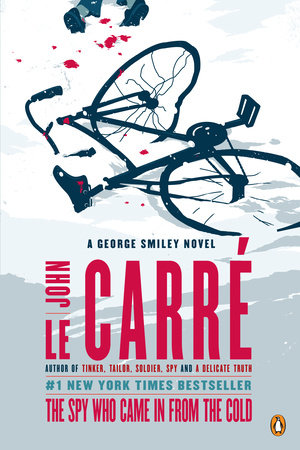
The Spy Who Came in From the Cold (1963) by John le Carré has been described as “the greatest spy novel of all time” written by “the world’s greatest fictional spymaster.” Richard Burton starred as Alec Leamas in the acclaimed 1965 film, with Claire Bloom as his ill-fated lover. I’ve heard the phrase used in the title for many years, so you may ask how I missed this classic until now.
Well, I was just eight years old when the book was published and ten when the film was released. As to why I didn’t pick it up later, just chalk it up to different priorities. But after seeing the book in Alameda’s terrific Books, Inc. on a recent visit, I made a spur of the moment decision that it was time to rectify my cluelessness.
I’m so very glad I did.
Many know the basics of le Carré’s classic of duplicity and espionage. (Spoiler alert for the handful who don’t know the story.) The Cold War is heating up, and the Berlin Wall has just been erected. Alec Leamas, the head of the West Berlin Station for British Intelligence (known as “The Circus”), watches as his last undercover agent is shot down trying to cross that divide by East German sentries. Leamas is recalled to London where a man named Control, who heads up The Circus, tells him that he will be put out to pasture. Yet Control gives Leamas a chance for revenge: he can assume the guise of an embittered ex-agent in order to trap Hans-Dieter Mundt, the deputy director of the East German Intelligence Service.
Le Carré said the “inspiration for the character of Leamas came from a ‘Peter Finch-like figure in a raincoat’ whom he remembered seeing pull out a wad of foreign currencies at London Airport, demanding a large Scotch; an ‘archetypal secret agent figure — exhausted, barely knows what country he’s in, much-travelled, down on his luck.'”
Leamas perfects that down-on-his-luck persona by drinking heavily, becoming surly with colleagues and acquaintances, and missing payments on essentials like food and rent. He becomes the quintessential potential defector. When desperate for money he takes a job at an obscure library where he meets Liz Gold, the young, idealistic secretary of her local branch of the Communist Party of Great Britain. They become friends and then lovers. When he leaves for his final job Leamas asks Control and George Smiley — a career British intelligence officer and another of le Carré’s famous characters — to leave Liz alone.
The well-written story quickly moves to the steps Leamas takes to gain the confidence of the East Germans. The dialogue is interspersed with the agent’s private thoughts, as he helps explain both the motive and plot. Yet his plan to share information quickly in the Netherlands and then return to England is dashed when Leamas finds he is suddenly a wanted man in his own country and he is forced to make the decision to go to East Germany and meet Jens Fiedler, an East German spy and Mundt’s deputy.
“For the first time since it all began,” writes le Carré, “Leamas was frightened.”
Leamas is ultimately called upon to stand as a witness against Mundt in a dramatic courtroom scene. Here Leamas provides information designed to send Mundt to face the firing squad, but there’s a twist. In the end Leamas has a choice to make, one where following his heart may cost him his life.
One reader notes that in the James Bond era, le Carré wrote spy fiction “of a type not previously encountered, especially The Spy Who Came in from the Cold.”
Bleak, prosaic, featuring ordinary people, involved in plots they were ignorant of, manipulated by people toward ends they didn’t understand… It’s easy to see why it proved popular.
Just as Liz comes late to a discovery of the true nature of the Communist Party, I have a similar feeling of later-in-life discovery of something all around me. In the case of The Spy Who Came in from the Cold, better late than never.
More to come …
DJB
To see reviews of the other books in my year of reading dangerously (i.e., mystery novels), click here for January, February, March, April, May, June, and July.
The Weekly Reader links to the works of other writers I’ve enjoyed. I hope you find something that makes you laugh, think, or cry.
Image from Pixabay
 MORE TO COME...
Pingback: Observations from . . . August 2023 | MORE TO COME...
Pingback: The books I read in August 2023 | MORE TO COME...
Pingback: A classic of detective fiction turns 100 | MORE TO COME...
Pingback: The girl with the troubled eyes | MORE TO COME...
Pingback: The 2023 year-end reading list | MORE TO COME...
Pingback: Praise for the independent bookstore | MORE TO COME...
Pingback: Librarian on the run | MORE TO COME...