
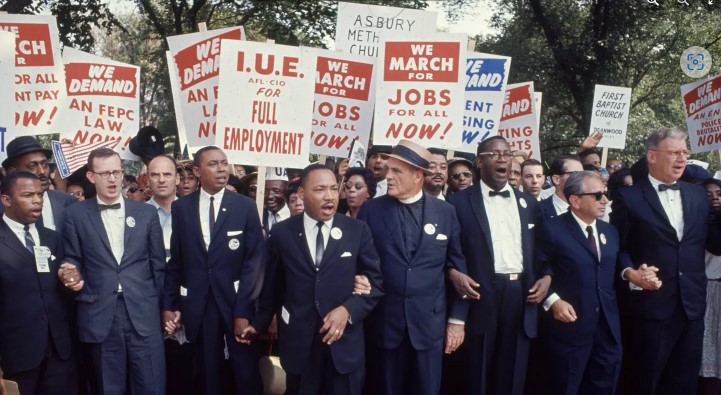
August 28th is the 60th anniversary of the March on Washington for Jobs and Freedom. The 1963 march is remembered today primarily because it was the occasion when the Reverend Dr. Martin Luther King Jr. stood on the steps of the Lincoln Memorial and delivered what became known as the “I Have a Dream” speech.
As I often do on these anniversaries, I turn to our historians for their perspective.
Knowing that others would be attempting to shape their own self-serving narratives about the March, Kevin M. Kruse, Professor of History at Princeton University, wrote that with the anniversary upon us …
… we’re going to be treated to another round of comments from politicians and pundits who think that the entire event was encapsulated by the Only MLK Quote They Know™ and nothing else. I’ve already ranted about this before, on this site and elsewhere, but I’ll say one more time that all of those people need to read the rest of King’s speech, which laid out some stark criticisms of structural racism, police brutality, and endemic poverty, all issues we’re still grappling with today.
Michael Eric Dyson in his 2019 book Tears We Cannot Stop: A Sermon to White America, argues that America has “washed the grit from (King’s) rhetoric” in order to get to a place where he can be seen and admired by the country at large. Yet it was King who said that the country’s race problem “grows out of the … need that some people have to feel superior. A need that some people have to feel … that their white skin ordained them to be first.” Difficult words for many to hear, yet Dr. King “spoke the truth that we have yet to fully acknowledge.”
King, of course, wasn’t the only speaker at the event. Far from it. Here’s a more complete list.
- A. Philip Randolph, socialist labor leader who organized the 1941 March on Washington Movement
- Walter Reuther, president of the United Auto Workers
- Archbishop Patrick O’Doyle, of the Catholic archdiocese of Washington
- Rev. Eugene Carson Blake, National Council of Churches
- Rabbi Joachim Prinz, president of the American Jewish Congress
- Floyd McKissick, on behalf of the Congress of Racial Equality (CORE), read a speech written by James Farmer, who was locked up in a Louisiana jail
- Whitney Young, president of the National Urban League
- Roy Wilkins, president of the NAACP
- Josephine Baker, an American-born Parisian entertainer, civil rights activist, and former agent for the French Resistance
- John Lewis, chair of the Student Nonviolent Coordinating Committee (SNCC)
- Rev. Dr. Martin Luther King, Jr., president of the Southern Christian Leadership Conference
The presence of A. Philip Randolph, who had organized the 1941 March to force Franklin Roosevelt to take action against discrimination in defense industries, “was a reminder of the continuities of activists engaged in a long struggle for black equality.”
The 74-year-old labor leader said. “Look for the enemies of Medicare, of higher minimum wages, of Social Security, of federal aid to education and there you will find the enemy of the Negro, the coalition of Dixiecrats and reactionary Republicans that seek to dominate the Congress.”
Some things never change.
Those Dixiecrats became Republicans, and a large majority of Republicans in public office today are reactionary, still fighting against those programs and more.
Kruse notes that Dr. Prinz, who had been forced to flee Germany in 1937 due to his early opposition to the Nazis, pointed out parallels. “Under the Hitler regime, I learned many things,” he noted. “The most important thing that I learned under those tragic circumstances was that bigotry and hatred are not ‘the most urgent problem.’ The most urgent, the most disgraceful, the most shameful and the most tragic problem is silence. A great people which had created a great civilization had become a nation of silent onlookers. They remained silent in the face of hate, in the face of brutality and in the face of mass murder.”
The March on Washington had implications for many groups beyond Black Americans. Baker — who was called upon at the last minute to fill time while the organizers worked to edit John Lewis’s fiery speech — spoke for two minutes and had the longest speaking role of any woman.
Women were conspicuously absent from the formal program. Anna Arnold Hedgeman, the lone woman on the event’s administrative committee, wrote that women “were not yet adequately included in man’s journey toward humanity.” At an after-meeting of activists, lawyer Pauli Murray delivered remarks criticizing the exclusion of women from the Lincoln Memorial program. “The group reached a consensus that future activism needed to focus on both gender and racial equality, heightening momentum for the women’s empowerment movement to come.”
Rather than a concern about how individuals thought about race, the march focused on economic discrimination and the lack of decent jobs for Black Americans. Historian Heather Cox Richardson writes:
King acknowledged the economic focus of the march when he centered his speech around the idea that Black Americans had received “a promissory note” that had become “a bad check, a check which has come back marked insufficient funds.” “But,” he said, “we refuse to believe that the bank of justice is bankrupt.”
“It’s impossible,” Krause argues, “to take a complex event like the March on Washington, with multiple speeches from a varied lineup of speakers, and boil it down to one single sentence.”
“The message of the March, in the end,” Kruse asserts, “isn’t that we shouldn’t pay attention to race.”
No, the consistent message of the March was that in our present moment — in 1963, but 2023 too — all Americans needed to understand that their fates and fortunes are thoroughly intertwined with those of the most marginalized and powerless in the nation, that they had to work together in common cause and demand their representatives in Washington truly represent their needs and address them directly.
As the Reverend Dr. King’s son Martin Luther King III said on Saturday during a commemoration of the March, the message is about Americans. “It’s about creating a climate for America to fulfill its true promise for all of its citizens.”
More to come …
DJB
UPDATE: Distinguished historian Eric Foner had a timely and important article on the March at 60 in The Nation, which is worth your time.
Images of the March on Washington by Library of Congress from Unsplash.
 MORE TO COME...
Pingback: Observations from . . . August 2023 | MORE TO COME...
Pingback: Letter to the world | MORE TO COME...
Pingback: The next four years will be filled with upheaval and uncertainty . . . just look at our history | MORE TO COME...