
Frames help us see and navigate the world. When we tell stories, we often structure or “frame” them in a way to signal what matters. The Frameworks Institute suggests this framing can be positive, negative, or benign.
Basic questions
Much of what we see today in the world of politics, news, and journalism is negative and divisive. To shift our national and individual conversations toward forward-looking views of what is positive and good, informed citizens need to be aware of the frames we are encountering.
Media critic Dan Froomkin suggests journalists ask themselves: “Whose terms are you using? What requires explanation and what doesn’t? What is normal and what is not?” Those aren’t bad questions for us to ask of our news sources as well.
Examples of framing meant to divide rather than unite
James Fallows writes that most media platforms are not transparent about how they choose frames or why they exist.
The simple reality is this: how a story is presented can matter much more than what the story says.
Fallows makes his point using an instance I happened to highlight several weeks ago. It involved the headline and picture in the Times on the day Donald Trump was first arraigned in federal court.
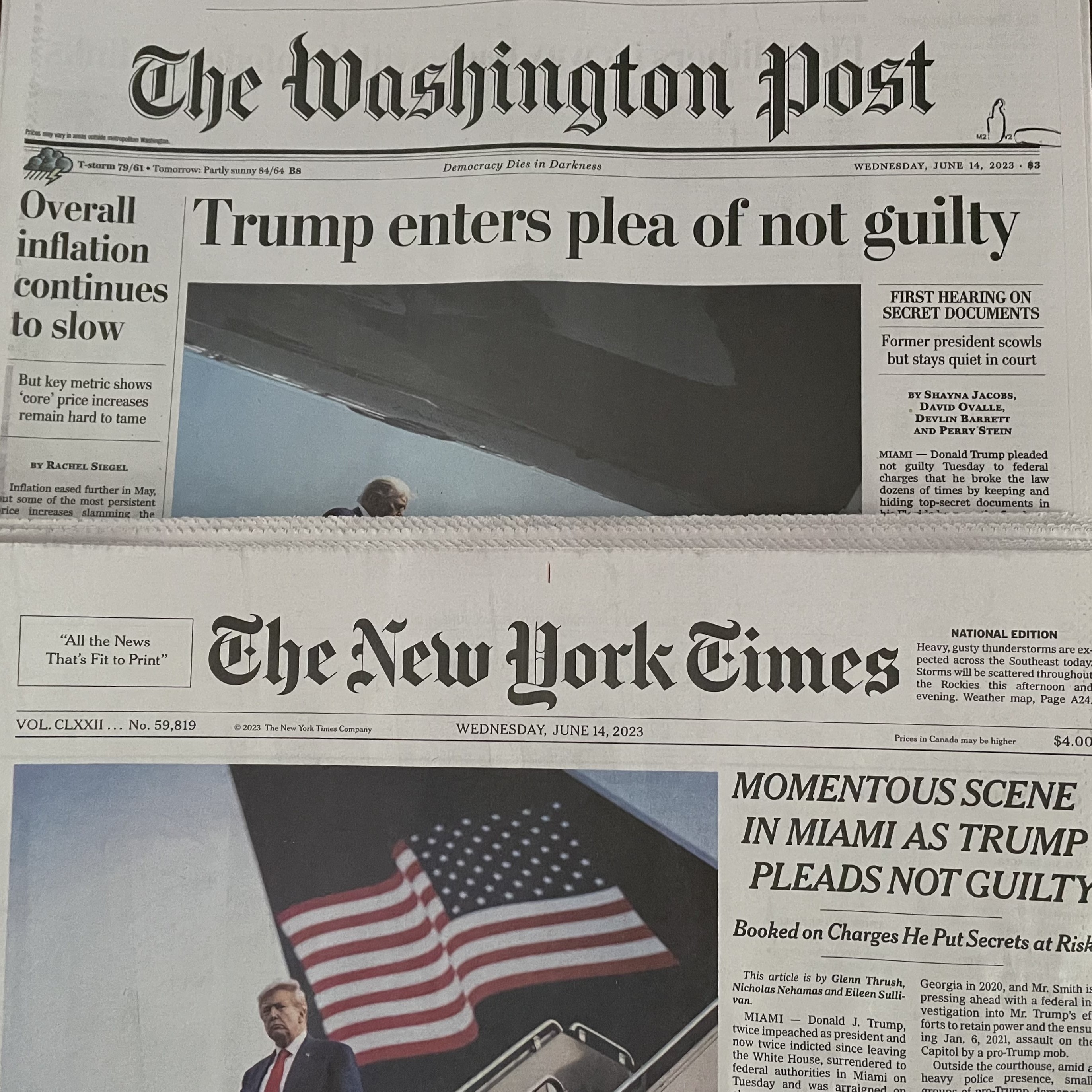
The Times headline was egregious. For those who watched, there clearly wasn’t a “momentous scene” at the arraignment, so why use that term? Did the Times have to include a picture of Trump coming off his private jet with an American flag painted on the tail piece as if it is Air Force One?
“To put it crudely, would Donald Trump himself have chosen any other layout for that front page?” was Fallows’ summation of the headlines and photos of that day.
Fallows focuses on the Times simply because it is the most influential news organization in the country, driving a great deal of other media reporting. He also focuses there because the paper’s use of frames is so relentless that it has spawned parody sites.
You may want to think about your frame if commentators can have this much fun at your expense
There’s a famous Tweet stream from Doug Balloon (an alias) known as the NYT Pitchbot. Balloon tweets out fake but realistic sounding headlines and Twitter posts built on the standing jokes of
- the New York Times tendency to play the framing game of bothsiderism (i.e., both parties do this and they’re all bad); and
- the Times tendency to report that anything that happens can be framed as bad news for Joe Biden and, conversely, good news for Donald Trump.
Here are a few examples:
As the Cascadia Advocate noted,
Doug’s satirical tweets poking at the Times have taken on particular importance during the Biden presidency, owing in part to the Times’ indefensible fixation with relentlessly promoting the Republican Party’s electoral prospects and schemes for taking power. Though the Republican Party has morphed into a political entity that is incompatible with democracy, the Times has inexplicably chosen to regard the party as a legitimate political force and continually award it friendly coverage.
Why can’t the Times say that the economy is strong?
Even though the economy is doing very well, “the downbeat framing continues” at the Times. Fallows provides a few recent examples:

There’s a positive — and I suggest more accurate — way to frame our economic stories. On August 4th, the Washington Post editorial board wrote The economy is in the midst of something wonderful (and unexpected). That something wonderful was a “workforce boom.”
That isn’t so hard.
When politicians try to frame an issue but won’t provide a straight answer, be VERY suspect
Former Maryland Gov. Larry Hogan was on Face the Nation recently and spent a great deal of time talking about the potential Third Party group No Labels. Hogan kept pushing the idea that President Biden and his policies were terrible. That’s a misleading frame, because President Biden’s policies are popular with a growing majority of Americans. Their framing also ignores the fact that the polling shows that President Biden is very popular among Democrats, with an 83% favorable, 10% unfavorable rating. But the media has forgotten that Democratic voters matter. As Heather Cox Richardson writes,
We are still getting endless stories about the Republican voter. But who are the Democratic voters? What do they want? They are, after all, a majority.
Also, Hogan refused to say who was funding the No Labels group. That lack of transparency should be a big red flag to journalists and the public. As progressive journalist Markos Moulitsas pointed out on a similar segment on Meet the Press, No Labels is “creating this idea that there’s a mythical unicorn creature that will agree with these people who want something” besides Biden/Trump. It’s a frame we shouldn’t accept.
It isn’t just the headline writers and editors who use bad frames
Reporters also play a key role in this effort. Dan Froomkin was incredulous at the lede by the Chief White House Correspondent at the Times after Donald Trump’s fourth indictment. Peter Baker began with: “Another grand jury, another indictment,” followed closely by, “The novelty of a former leader of the United States being called a felon has somehow worn off.”
Peter Baker is bored. The chief White House correspondent for the most influential news organization in the world is wearily unimpressed with all these charges against the president … To anyone who cares one whit about accountability, or democracy, there is nothing remotely routine about what’s happening, and not a damn thing has worn off.
In fact, Trump’s (first) impeachment bored him, too! … This man needs a new job.
What’s missing from the bad framing and much of the coverage about the former president is this: “Trump’s lawbreaking was so blatant, so inexcusable, so dangerous, that DOJ had no choice but to indict.” He incited a riot to overturn our election and then to top it off stole our nuclear secrets.
This shouldn’t be so difficult.
Frame the choices in a realistic way
Social Security and Medicare are beloved by many Americans, yet Republicans (most recently Chris Christie) regularly tell us that both programs will soon be bankrupt. That’s absurd in many respects.
What gets left out of the framing by the right is that our federal budget is made up of choices. And the politicians have decided that cutting the ever-growing levels of funding for the military-industrial complex should never be on the table. That’s a choice that affects every other priority.
How can we frame things in a way that unites rather than divides?
Fallows lets us see how the Times framed a recent NATO summit and then offers an alternative:
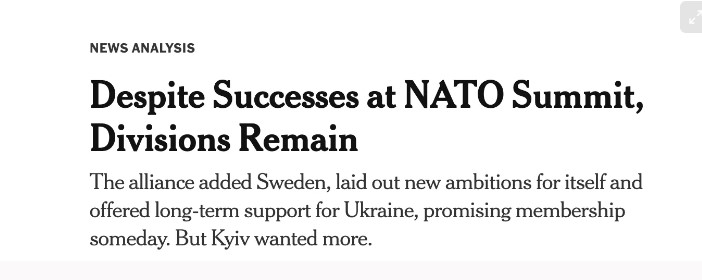
As someone noted on Twitter, suppose this headline had been reversed: “Despite Divisions, Successes at NATO Summit.” That would convey a quite different message — and, as it happens, would be more in keeping with the story itself.
We have the power to set the story in a way that unites and to reject false frames that divide. Richardson wrote in a recent newsletter, “It would be a shame if the growing legal troubles of the Trump conspirators overshadow the work of the Biden administration on the global stage this week as it seeks to counter the power and influence of China.” She then proceeded to devote the vast majority of her daily newsletter to the background history for the daily news, the work of the administration to reset American prestige abroad, and the implications of President Biden and Vice President Harris’s actions on Americans and the world.
Democracy counts on citizens knowing the facts … not just a false frame.
More to come …
DJB
Images by bluemoonjools, Kerttu and Marcelo from Pixabay
UPDATE: Peter Baker of the NYT continues to demonstrate how much he doesn’t get what’s at stake in this moment. Here’s an update from progressive journalist Laura Clawson:
House Republicans are engaging in a completely partisan, evidence-free impeachment inquiry—but Peter Baker of The New York Times wants to talk about how the White House is treating this as a political issue. And just to get this out of the way right off the bat, the paragraph count before Baker acknowledges that Republicans have no evidence against Biden is seven.
In paragraph eight, he gets around to, “The Republican investigation so far has not produced concrete evidence of a crime by the president, as even some Republicans have conceded.” Even there, the implication is that the Republican investigation has produced some evidence, and they just need to make it concrete. In reality, the Republican investigation has produced no evidence that the president has engaged in any misconduct, let alone a crime.
 MORE TO COME...
Pingback: Observations from . . . September 2023 | MORE TO COME...
Pingback: When The New York Times came calling | MORE TO COME...
Pingback: It’s up to us | MORE TO COME...