
A good story can be a “titillating and very dangerous thing.”
Personal adventures — especially of the monumental variety — can lead to bad history. One well-known example comes from Norwegian ethnologist Thor Heyerdahl, whose 1947 Kon Tiki raft expedition captured the world’s attention and advanced his belief that “long before Columbus, early ocean travelers — tall, fair-skinned, redheaded Vikings much like himself — spread human culture to the most remote corners of the earth by drifting with the currents. Academics scoffed, and the 1976 voyage of the Hōkūleʻa resolved the debate. Micronesian navigator Pius “Mau” Piailug “demonstrated his profound skill for reading the night sky and the ocean swells and safely guided the massive ocean-going canoe from Hawaii to Tahiti.”
With that cautionary tale in mind, I approached the story of a more recent expedition with some apprehension.
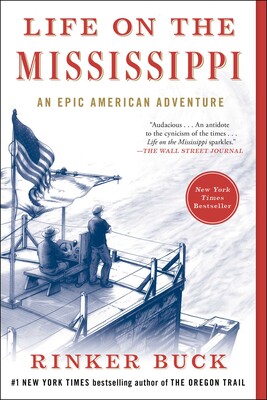
Life on the Mississippi: An Epic American Adventure (2022) by Rinker Buck tells of the author’s 2016 quest to take a flatboat from Pittsburgh to New Orleans, recreating the approximate route traveled by a young Abraham Lincoln and millions of other Americans of that day. Buck undertakes this adventure to set the history straight, but in the process, he learned a great deal about himself, our country, and human nature.
When Americans think of pioneers, settlers in wagon trains heading west usually come to mind. Yet the role of the flatboat in our country’s evolution is far more significant than most realize. “Between 1800 and 1840, millions of farmers, merchants, and teenage adventurers embarked from states like Pennsylvania and Virginia on flatboats headed beyond the Appalachians to Kentucky, Mississippi, and Louisiana.” In this case, Buck gets the history right, using the vessel he built to illuminate that story for the many who have only a cursory sense of how our country grew.
The trans-Mississippi flatboat experience that began right after the Revolutionary War led to the expansive and complex American economy. It was built by farmers and others who didn’t have much in the way of book skills, but they nonetheless found the wherewithal to complete their task within themselves. Once they arrived at their destinations,
… settler families repurposed the wood from their boats to build their first cabins in the wilderness; cargo boats were broken apart and sold to build the boomtowns along the water route … In the present day, America’s inland rivers are a superhighway dominated by leviathan barges — carrying $80 billion of cargo annually — all descended from flatboats like Buck’s ramshackle Patience.
When describing the building of Patience, Buck goes into a discourse about the importance of jury-rigging — or what he calls shit-rigging — to life. He grew up on a dairy farm in New Jersey where his father would fix any problem by shit-rigging the solution. Front door-knob broken? No problem. Replace it with vice-grip pliers. It was a skill that Buck would learn and master. “Shit-rigging is life’s golden diploma.”
And when he looked at his completed flatboat, she was “a shit-rigging masterpiece, my hillbilly Pequod, my floating jalopy, my personal Kon-Tiki, a gorgeous code violation that would carry me south to New Orleans.”
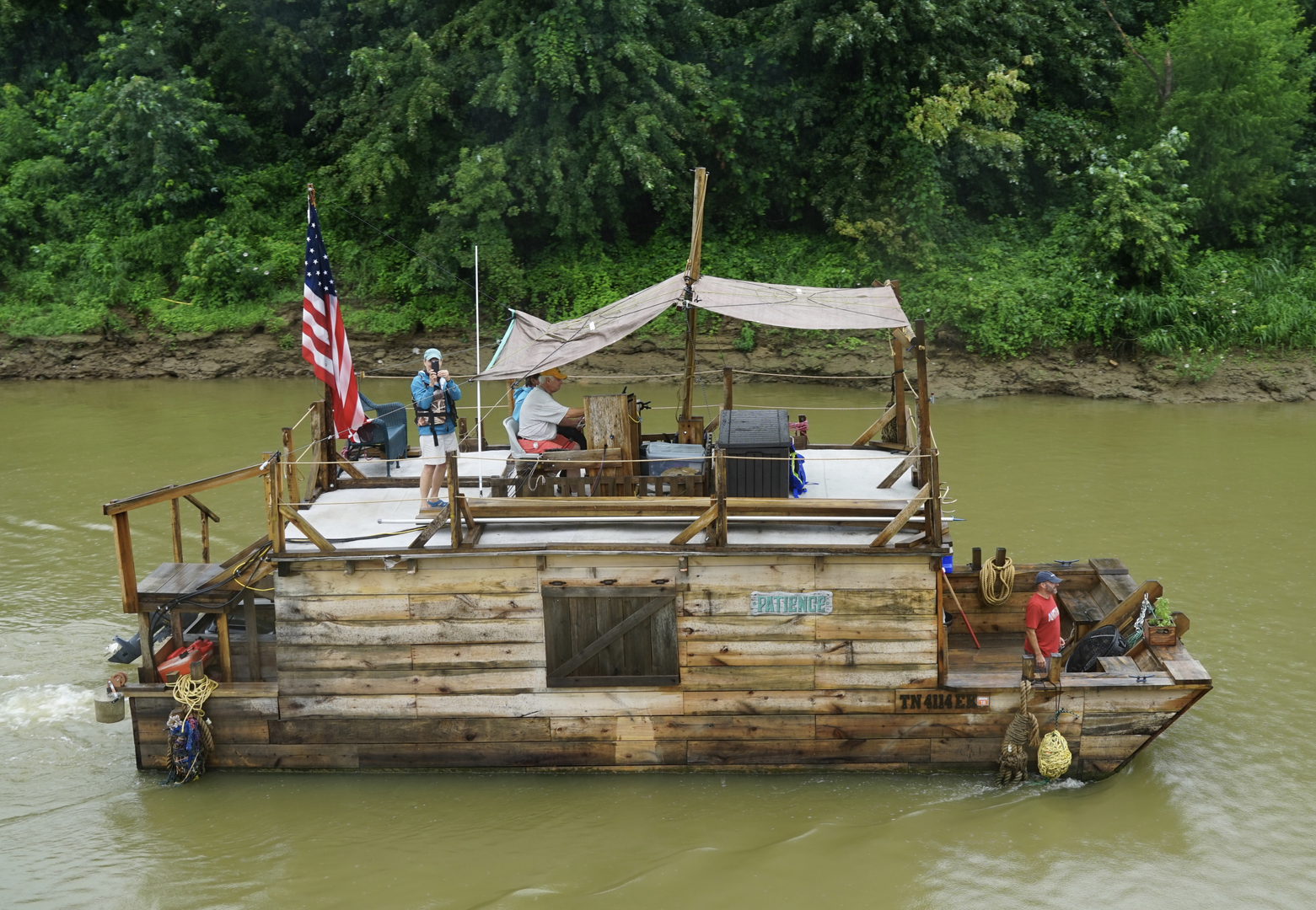
Life on the Mississippi is the tale of the trip by Buck and his misfit crew — another piece of serendipity in that the flatboat captains of the early-to-mid 1800s usually pulled together a crew from whoever was available. As the author states early in the book, “the flatboat was indeed an ideal school for acquiring a knowledge of human nature.”
Besides an enjoyable travelogue, Buck also educates the reader about past histories and present-day challenges. Often they overlap. He has a moving and thoughtful chapter on the “burden of the 19th-century, trans-Mississippi frontier. Our thriving as a people depended on our destruction of the people who were already here and were now considered in America’s way.” Later he examines the forced migration of millions of enslaved Blacks from the Mid-Atlantic states to the deep South, to help expand King Cotton’s grip on our economy and nation. Both are extremely sad chapters in the country’s past. Yet how we remember history, Buck asserts, “is as important as history itself. Authenticity matters.”
The current life and death struggle of river valleys dealing with the transition from coal to other forms of cheaper and more environmentally friendly sources of power also comes in for examination. The topography of the Ohio River valley hides much of this from the American public and many of the locals he meets blame Washington but conveniently miss the point that the coal industry brought much of this downfall upon itself. Buck is a patient educator, who recognizes the different perspectives but focuses on the facts. When viewing the vegetation taking over abandoned docks and rusting plants, he notes: “Along the landscape of the inland rivers, the persistence of man was dramatically yielding to the persistence of nature.”
Buck, a progressive “Yankee” working his way through the deep red South, identifies misinformation at every turn. He was constantly told he was going to die, usually by people who never went on the river. “Misinformation is as American as apple pie,” he notes in another of his apt metaphors for life today.
An easy-to-read companion, Buck references histories written by those who first traveled the Ohio and Mississippi rivers and their tributaries such as the Cumberland and Wabash. These accounts are written by plain folk of the early frontier, giving their voices authenticity. One of the most colorful was the traveling minister and diarist Timothy Flint, who wrote: “Almost every boat, while it lies in the harbor, has one or more fiddles scraping continually aboard, to which you often see the old boatmen dancing.”
“A violin medley that started out as a Scotch-Irish reel from Ulster might be passed on along the river to a German fiddler from Mannheim, or a Bohemian Jew, or even a wayward Brahmin from Boston.” notes Paul Schneider. The inland river country …
… had become quintessentially American — slapdash, colorful, ethnically mixed.
Cumberland Gap is a tune no doubt heard on the river. This version by Notorious Folk includes some nice dancing.
Take a pause — to use a phrase that Buck employs — to luxuriate in the stream of time.
More to come …
DJB
 MORE TO COME...
Pingback: Observations from . . . September 2023 | MORE TO COME...
Pingback: The books I read in September 2023 | MORE TO COME...
Pingback: The 2023 year-end reading list | MORE TO COME...