A trim and stark memoir, written in plain language, begins with a simple sentence. Yet in the hands the 2022 winner of the Nobel Prize for Literature, it turns into an unexpected study of life.
Five years ago, I spent an awkward night with a student who had been writing to me for a year and wanted to meet me.
I stumbled upon this intriguing work at Takoma Park’s wonderful new independent bookstore — People’s Book — on a recent visit, and I’m glad I made the discovery.

The Young Man (2022) by Annie Ernaux (translated by Alison L. Strayer) is the account of her love affair with A., a man some 30 years younger, when she was in her fifties. That first awkward dinner followed by drinks at her home turned into weekend connections and daily phone calls. For some, hers is an awkward romance, although she notes that if the roles were reversed between man and woman few would look twice. It is awkward in some respects, as he “tore her away from my generation, but I was not part of his.” Yet she saw it as a relationship of mutual gain, where she was “the one who could change his life.” She led her young admirer to see making love as something more than “a more or less slow-motion satisfaction of desire,” becoming, instead, “a sort of continuous creation.”
In more than one domain — literature, theater, bourgeois customs — I was his initiator, but the things I experienced because of him were also initiatory. My main reason for wanting our story to continue was that, in a sense, it was already over and I was a fictional character within it.
This is not a salacious memoir; rather, Ernaux uses the backdrop of this brief romance to explore themes of the movement back and forth between youth and age, of memory and time, of misogyny and class, of life’s pitfalls and pleasures.
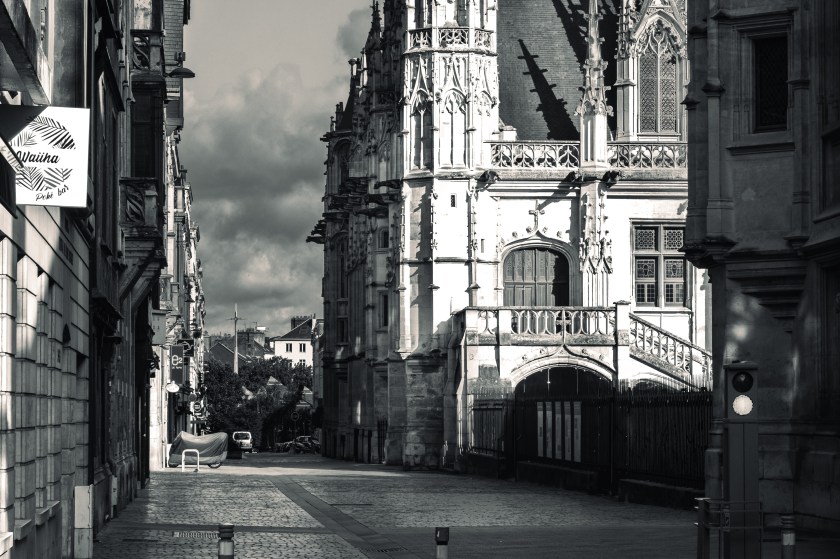
Along the way Ernaux is transported back to Rouen, the city where she lived as a young student, and to the places, now much changed, where she first experienced those heady years. It is, she suggests, as if she is living life backwards. Yet this time is different, as A. is very much a “young man of his times.” He would “say ‘stop’ or ‘that’s good’ instead of ‘thank you’ when I served him at the table . . . Work for him meant nothing more than a constraint with which he did not wish to comply, if other ways of life were possible . . . He had never voted . . . (and) believed that nothing whatsoever about society could be changed.” Thirty years earlier, she writes, “I would have turned away from him” not wanting to be confronted with the signs of her own working-class origins. Now she was the literary bourgeoisie.
Ernaux writes that during this time her memory “seemed to me infinite. There was a great sweetness to that layer of time which stood between us, it gave more intensity to the present.” She looks at this time without sentimentality and is able, through the power of her words, to “analyze all kinds of intersecting threads — aging, class, desire, regret — without a sense of shame or an impulse to sugarcoat any of the truths she uncovered during her time with A.”
The Nobel Prize description suggests how The Young Man fits into her larger body of work.
In her writing, Annie Ernaux consistently and from different angles, examines a life marked by strong disparities regarding gender, language and class. Her path to authorship was long and arduous. Among her novels are A Man’s Place, A Woman’s Story, and The Years. Ernaux’s work is uncompromising and written in plain language, scraped clean. And when she with great courage and clinical acuity reveals the agony of the experience of class, describing shame, humiliation, jealousy or inability to see who you are, she has achieved something admirable and enduring.
It is when A. begins to say that he would like to have a child with her that she realizes “that his role in my life — that of revealing where I stood in Time — had come to an end. Mine of initiatrix in his life had no doubt ended too. He left Rouen for Paris.”
It was autumn and the end of the twentieth century. Ernaux begins a new book and found “that I was happy to be entering the third millennium alone and free.”
More to come . . .
DJB
Photo of Rouen by jimmy desplanques on Unsplash
 MORE TO COME...
Pingback: Observations from . . . October 2023 | MORE TO COME...
Pingback: From the bookshelf: October 2023 | MORE TO COME...
Pingback: The 2023 year-end reading list | MORE TO COME...