
The question of authorship has been around for centuries. Who gets to tell stories, and how, is certainly a fundamental — some would say existential — issue for our time.
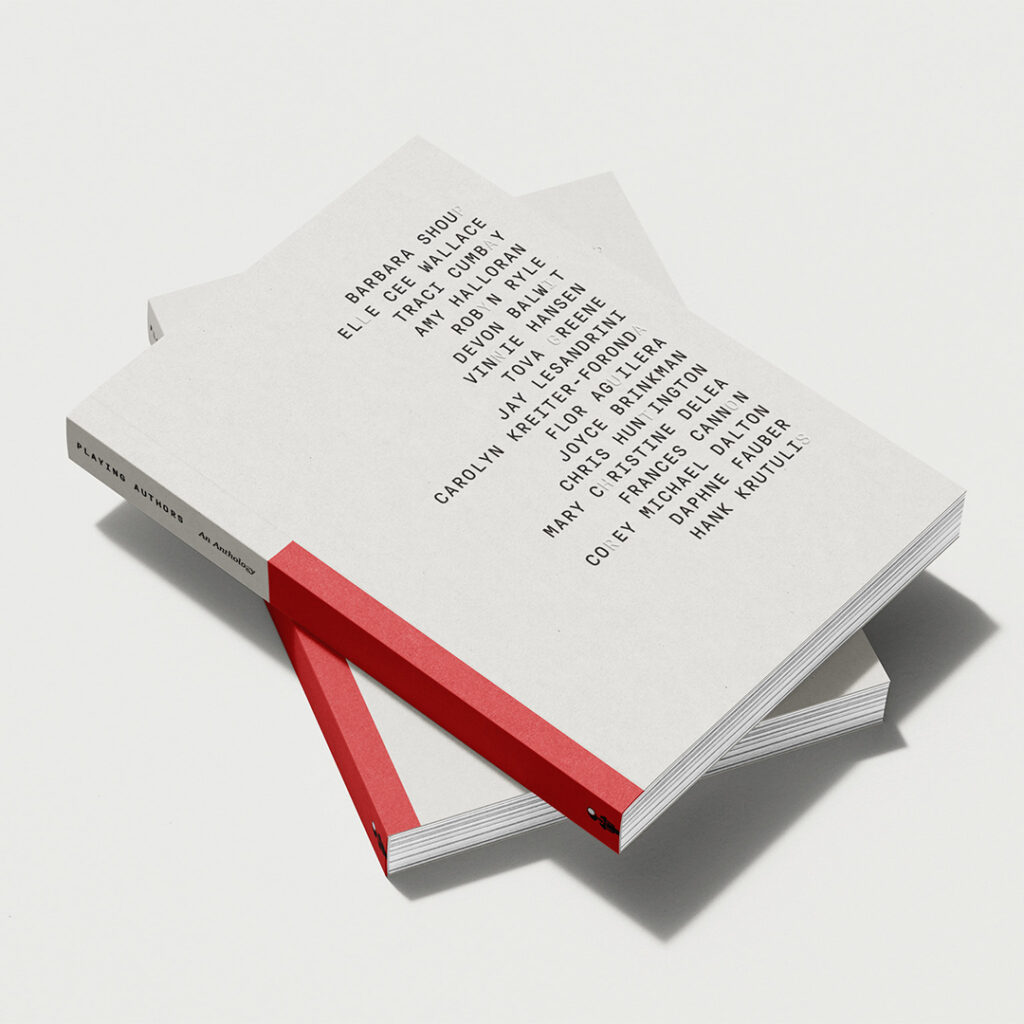
Playing Authors: An Anthology (2023) is a collection by 18 writers asked to consider this question of authorship. The creative act of writing in today’s world is at the heart of this newest release from Old Iron Press, a female-led, small independent press in Indianapolis. The description of the project as “literary mashups, personal essays, alternative history, and other disobedient forms” shows the range and imagination of this work.
The historian in me connected with Amy Halloran‘s “The Author of Nature” about the erasing of the history of Jesse Hawley’s “authorship” of the Erie Canal by powerful politicians. I also loved the odd modern fable, as told by Mary Christine Delea, of the Ford Motor Company contacting Marianne Moore, wanting her help in naming their new car. They turned down Thundercrest, among others, and instead chose Edsel. We know how well that turned out. Marianne Moore, on the other hand, got to throw out the first ball at a Yankees game. Don’t mess with the poets.
The anthology’s opening story, “Hemingway Goes on Book Tour” is sad and insightful and laugh-out-loud funny. Here’s a small slice:
“Cranky old white dude is not a brand,” the marketing director said. “You’re no Bernie Sanders, Ernest.”
The story’s author, Robyn Ryle, writes the Substack newsletter You Think Too Much and is also the author of Throw Like a Girl, Cheer Like a Boy as well as the young adult novel Fair Game. Robyn graciously agreed to chat with me about her story and the anthology.
DJB: Robyn, what inspired you to think about the great Ernest Hemingway going on a book tour?
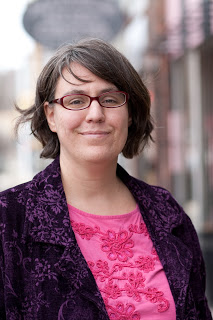
RR: I’d been thinking a lot about what it means to be an author today. It doesn’t matter if you’re traditionally published or an indie author — you’re expected to be your own marketer and publicist. I’m not very good at that public face of writing and I suspect a lot of writers feel the same way. One day I found myself wondering, rather resentfully, “Did Hemingway have to do this? Did Hemingway go on book tour?”
The answer is, not really. I think the idea of authors as promoters of their own work not coincidentally became prominent at the same time more women became authors. Promoting yourself is, after all, emotional labor. I was contemplating an essay about these dynamics when I saw the call for pieces on the playing authors theme for Old Iron Press. I decided writing a story that imagines Hemingway on book tour was more fun than writing the essay. I was right.
When the marketing director pushes Hemingway to consider his “brand,” your story ― like others in the anthology ― grapples with the challenges of the modern publishing industry. What important voices are we missing today because of the commercial focus of that industry?
It’s interesting that this was a theme that developed in the anthology. I guess it’s something that’s very much on writers’ minds today.
As to what voices we’re missing, still and always the voices of people in marginalized groups. Even with publishing’s dedication to diversity in the wake of the Black Lives Matter movement, 66-75% of the books published in 2021 were by white authors. Statistics about books by LGBTQ+ authors or authors with disabilities or working class authors are harder to come by. I’ve heard some Black, indigenous and people of color already seeing signs that even that small window in publishing is closing again now.
Also in today’s publishing world, there’s less patience with allowing authors to develop their craft over time. If your first book doesn’t sell well, you’re less likely to get the opportunity to publish a second (sort of like pitchers not being allowed to go through the lineup more than two times in today’s MLB). There are a lot of classics that we’d be missing now if the authors had been dropped by their publisher after their first novel.
It reads as if you had a great deal of fun in writing this story. Did other “famous authors on book tours” come to mind, and if so, which ones would you like to imagine in a sequel?
What a great question! I’m a little obsessed with Hemingway. For better or worse, he’s the model against which a lot of American writers measure themselves. Plus, he really did create his own larger-than-life brand.
Even as it was fun imagining Hemingway on book tour, there’s a sadness there, too. Book tours make you question your whole existence as a writer and a person. When I think of other writers on book tour, the sadness wins out over the humor. Virginia Woolf? Book tours would have been a nightmare for her. I like to think she would have stolidly refused to do any such thing. Maybe today’s authors should do the same. Jane Austen’s interesting with her wry sense of humor. I could imagine her getting into it, having a YouTube channel, a podcast, and thousands of Instagram followers.
As someone who writes regularly on Substack, in books, and for magazines, could you highlight one or two pieces in the anthology that especially spoke to you?
I love Barbara Shoup’s essay, “Author, Author,” so much. Writers’ conferences and workshops are fraught places. She perfectly captures the energy there. The desperation. A lot of people are there to GET PUBLISHED at all costs. It’s hard to be in those spaces when you’ve seen how the sausage gets made, so to speak. It’s hard not to be the oracle of doom, telling people that publishing a book doesn’t really change much about your life for most writers. People don’t really want to hear that.
I also loved Corey Michael Dalton’s story, “Cinderella,” for the sheer fun and humor.
In a recent Substack newsletter, you wrote of your need to hear more diverse voices in the books you read. What recent books by diverse authors would you recommend to our readers?
So many to choose from as there are so many in so many different genres, but I’ll focus on the books with which I’ve been finishing up my reading year. These are also books I haven’t seen on a lot of the big end-of-year lists. Temple Folk by Aaliyah Bilal is a collection of short stories about the lives of Black Muslims in the U.S. I knew a lot about the Nation of Islam during the 1960s, but not about what’s happened to that community in the intervening years. If you like mysteries, A Disappearance in Fiji, by Nilima Rao is the beginning of a new series that features a Sikh police sergeant stationed in Fiji. The series explores the British empire in early 20th century. There have been so many novels that are retellings of Greek myths, so I was happy to see Every Rising Sun, by Jamila Ahmed, a retelling of the story of Shaherazade and the One Thousand and One Nights, which centers Shaherazade’s story.
Thank you, Robyn.
Thanks so much for doing this.
More to come . . .
DJB
 MORE TO COME...
Excellent post, David. Magical, actually. Had to buy it!
Merry, merry!
So glad you enjoyed it!
Pingback: Talking with writers | MORE TO COME...
Pingback: My year in writing: 2023 – Robyn Ryle Author
Pingback: The 2023 year-end reading list | MORE TO COME...
Pingback: Observations from . . . December 2023 | MORE TO COME...
Pingback: From the bookshelf: December 2023 | MORE TO COME...
Pingback: Observations from . . . August 2025 | MORE TO COME...
Pingback: Pull up a chair and let’s talk | MORE TO COME...
Pingback: Readers choice: The best of the 2025 MTC newsletter | MORE TO COME...