
We all face profound questions of existence. The way in which we grapple with this existential inquiry has consequences, but for many and perhaps most of us those choices do not change the world. However, some individuals possessing brilliant, far-reaching intellect determine that their discoveries are so important that the impact to their fellow humans is of little consequence in the grand scheme of life. They make choices and follow explorations that literally blow up the world around them.
When they make these choices, the lines between good and evil are too often blurred so that they may pursue their singular study.
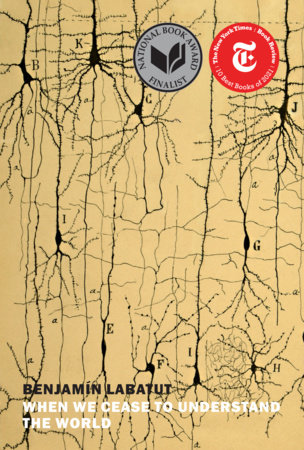
When We Cease to Understand the World (2021) by Benjamin Labatut (translated from the Spanish by Adrian Nathan West) is a troubling and haunting book “about the complicated links between scientific and mathematical discovery, madness, and destruction.” By taking the real-life discoveries of scientists and adding rich fictional detail to link their compelling stories with real-life consequences, Labatut makes the reader face uncomfortable truths. Labatut, notes one reviewer, “has written a dystopian nonfiction novel set not in the future but in the present.”
When We Cease to Understand the World is not a work to be taken lightly. The first chapter is a fast-paced trip through the discoveries that alternately saved hundreds of millions of lives and — in the hands of the war machines of the first and second world wars — killed millions of people. Most of what he writes at this point is based on historical fact. It isn’t long before we are “introduced to a blur of real-life characters,”
. . . including the drug-raddled Hermann Göring, who crushed a cyanide capsule in his mouth to avoid the hangman’s rope; the father of computing, Alan Turing, who is reputed to have killed himself by biting into an apple he had injected with the same poison; Johann Jacob Diesbach, the inventor of Prussian blue, the first modern synthetic pigment and the basis of cyanide; and the alchemist Johann Dippel, who may have been the model for Mary Shelley’s Frankenstein.
The real villain here, however, is the chemist Fritz Haber (who died in 1934), who directed the program of poison gas attacks that killed tens of thousands of soldiers in the first world war, an accomplishment that drove his disapproving wife to suicide. Haber also discovered how to harvest nitrogen and make the fertiliser that saved the hundreds of millions of people who would have died in worldwide famines at the beginning of the 20th century. All the same, in the end he was overwhelmed by guilt, “not,” Labatut writes, “for the part he had played . . . in the death of untold human beings . . . but because his method of extracting nitrogen from the air had so altered the natural equilibrium of the planet that he feared the world’s future belonged not to mankind but to plants”.
Haber, Alexander Grothendieck, Werner Heisenberg, Erwin Schrödinger and others are among the luminaries “into whose troubled lives Benjamín Labatut thrusts the reader,” showing us how they grappled with the most profound questions of existence.” Along the way their discoveries and strokes of genius begin to alienate friends and lovers as these individuals of impressive intellect descend into isolation and insanity.
Some of their discoveries reshape human life for the better; others pave the way to chaos and unimaginable suffering. The lines are never clear.
Included on Barack Obama’s Summer 2021 Reading List, this was a troubling book that I could not put down. As the work progresses into the explorations of quantum mechanics, Labatut weaves webs of association across scientists, fields of study, and decades of time. The annihilation of nuclear holocaust is always nearby. He spins more and more fiction into the lives of these individuals, having us imagine what they dreamed, considered, and did as they chased their illusive answers to questions that may not have answers.
There is another part of the book that is troubling, as a perceptive New Yorker reviewer notes.
There is liberation in the vision of fiction’s capabilities that emerges here—the sheer cunning with which Labatut embellishes and augments reality, as well as the profound pathos he finds in the stories of these men. But there is also something questionable, even nightmarish, about it. If fiction and fact are indistinguishable in any meaningful way, how are we to find language for those things we know to be true? In the era of fake news, more and more people feel entitled to “make our own reality,” as Karl Rove put it. In the current American political climate, even scientific fact—the very material with which Labatut spins his web—is subject to grossly counter-rational denial. Is it responsible for a fiction writer, or a writer of history, to pay so little attention to the line between the two?
At the end of this book, Labatut introduces us to “the night gardener” who tends his plants when they’re asleep and won’t be distressed by his interfering with them.
It is to this mysterious figure that the narrator—or Labatut, since the two seem synonymous—gives the last, alarming, word. For the gardener, sums are the root of all contemporary evil: “It was mathematics—not nuclear weapons, computers, biological warfare or our climate Armageddon—which was changing our world to the point where, in a couple of decades at most, we would simply not be able to grasp what being human really meant.”
Some things are, to my mind, mysteries that will not be discovered in this life. Scientific inquiry can help explain the “how” but not necessarily the “why” just as spiritual works and the teachings of the mystics can lead us along the path to the “why” of being human without necessarily being too terribly factual on the “how.” The ToE, or Theory of Everything that the “scientific heirs” of this generation search for may be illusive for a reason.
More to come . . .
DJB
Photo by Jeremy Thomas on Unsplash
 MORE TO COME...
Pingback: From the bookshelf: February 2024 | MORE TO COME...
Pingback: Observations from . . . March 2024 | MORE TO COME...
Pingback: The 2024 year-end reading list | MORE TO COME...