
The human costs of war are vast and incalculable. Americans as a people came to see this firsthand during the Civil War. In the insightful This Republic of Suffering, historian and former Harvard President Drew Gilpin Faust reveals the ways that death on such a massive scale, in an army made up almost entirely of volunteers, and usually occurring without relatives nearby to help with the nursing and grieving, changed not only individual lives but the life of the nation.
In her work, Faust describes “how the survivors managed on a practical level” and how a deeply religious culture of the time “struggled to reconcile the unprecedented carnage with its belief in a benevolent God.” She uses the voices of real people—soldiers and their families, statesmen, generals, preachers, poets, surgeons, nurses, northerners and southerners—to make it personal and to give the reader a vivid understanding of the Civil War’s most fundamental and widely shared reality.
Ukraine is going through a similar catastrophe today. Russia’s unprovoked attack and the unconscionable dithering by House Republicans to provide the support this democracy needs continues to result in great horror, destruction, and unnecessary death.
As in Faust’s book, the stories of those who have died, who have seen their dreams interrupted and then denied, have a power to force us to stop and think of what is at stake. I recently came face-to-face with forty of those stories, told in a most powerful way, at a place devoted to peacemaking.

The United States Institute of Peace is a national, nonpartisan, independent institute, founded by Congress in 1984. The Institute is:
. . . dedicated to the proposition that a world without violent conflict is possible, practical and essential for U.S. and global security. In conflict zones abroad, the Institute works with local partners to prevent, mitigate, and resolve violent conflict. To reduce future crises and the need for costly interventions, USIP works with governments and civil societies to build local capacities to manage conflict peacefully. The Institute pursues its mission by linking research, policy, training, analysis and direct action to support those who are working to build a more peaceful, inclusive world.

I attended the April monthly open house at USIP, where the focus was on Ukraine. Short presentations were made by Katie Ruppert, Senior Program Officer in USIP’s Europe and Russia Center; Lauren Baillie, Senior Program Officer, Atrocity Prevention; and Ambassador William B. Taylor, Vice President, Europe and Russia at USIP. However, the most moving statements were silent, coming from the displays set up around the great hall.
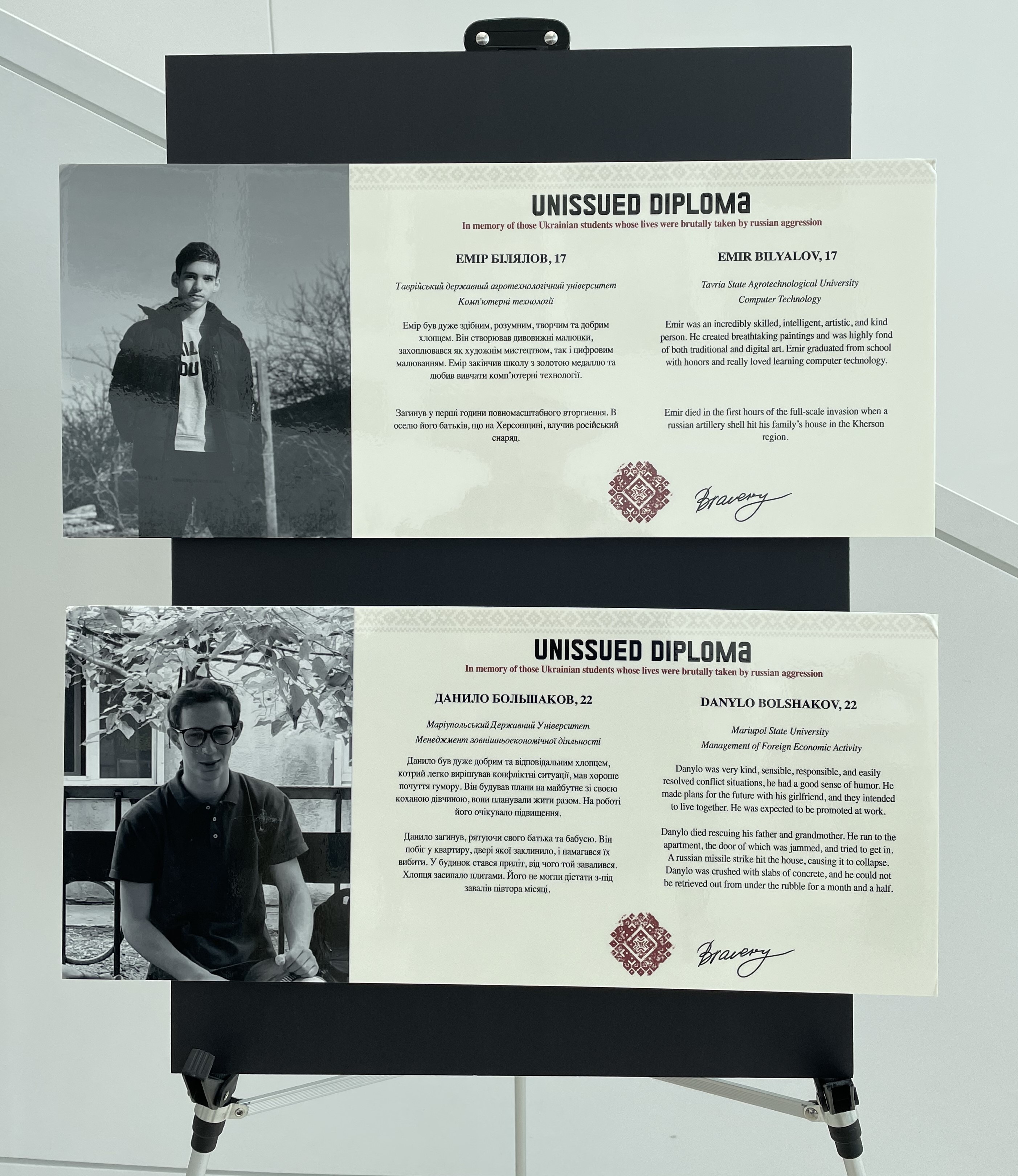
Unissued Diplomas is a powerful exhibit reminding the world about the ongoing war . . .
. . . and the price Ukrainians pay daily in their fight for freedom. Unissued Diplomas honors the memory of Ukrainian students who will never graduate because their lives were taken by the Russian invasion.

Some enlisted and died while fighting the war. Others were civilians trying to go about their daily lives. Current estimates—although difficult to verify—are that 70,000 Ukrainian soldiers have been killed in action, and perhaps as many 10,582 civilians, including 587 children, have died. The Russian—who are employing a “meat grinder” strategy to wear down the country—have suffered heavy losses as well in the process.
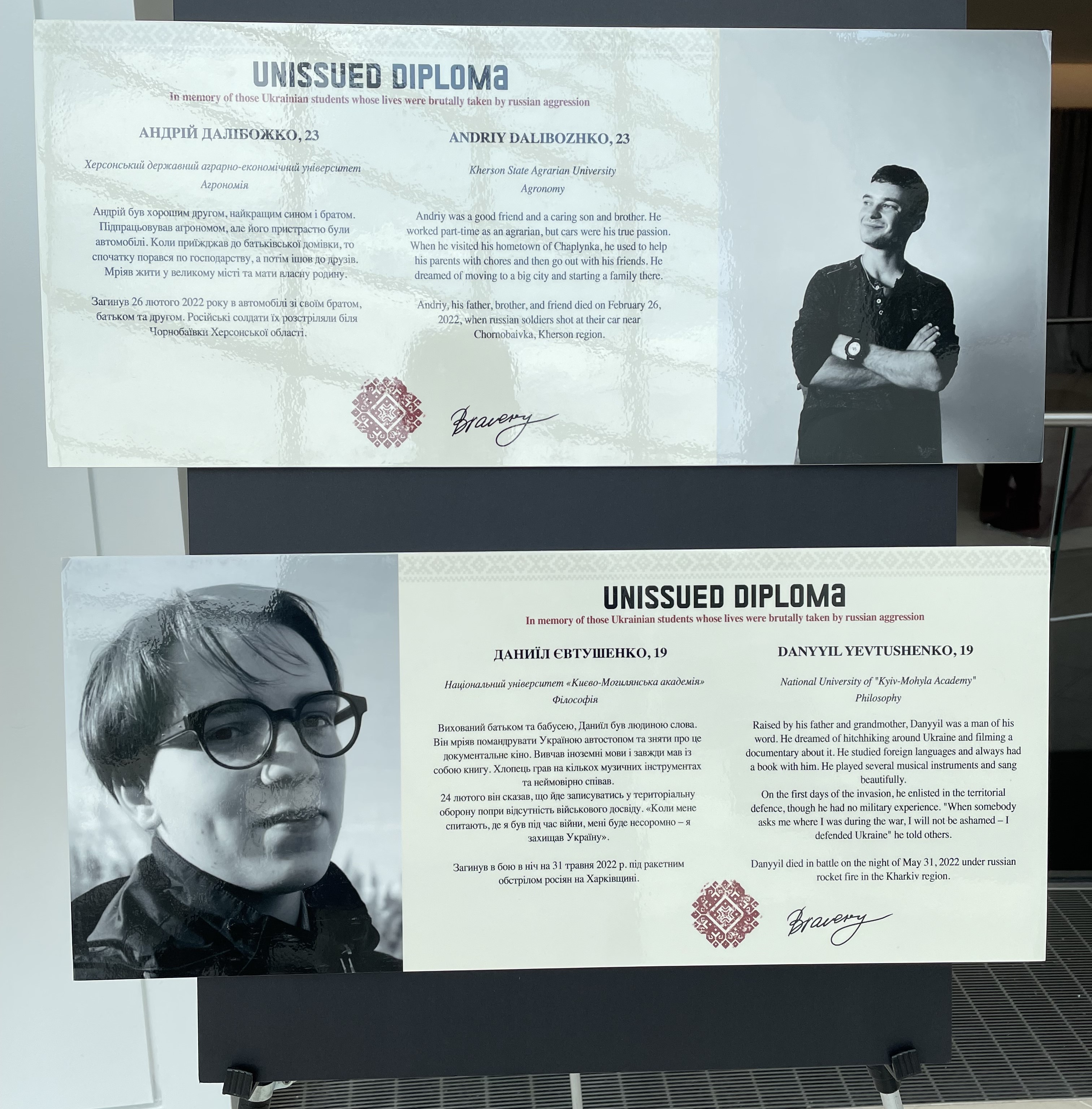
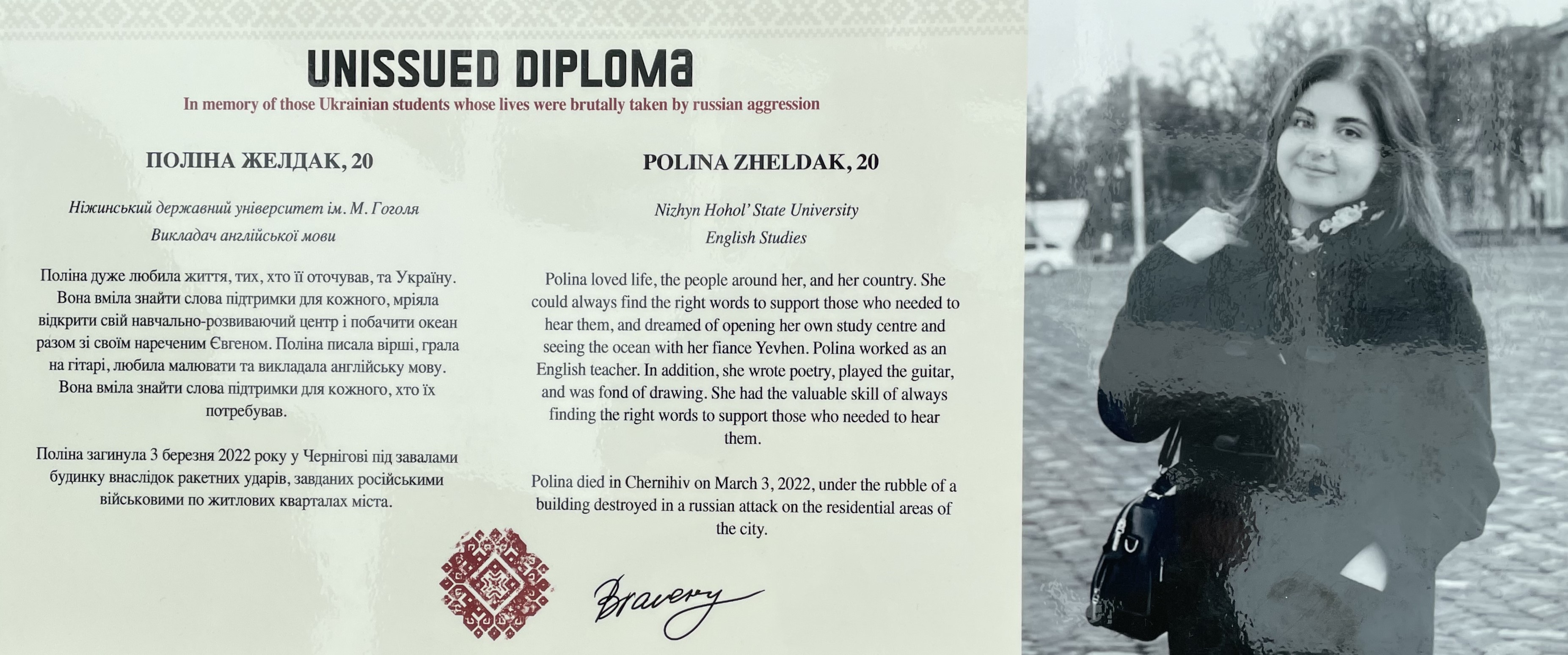
The stories we read are utterly heartbreaking, showing what we lose in war. An English teacher, lover of poetry, and guitar player who died in a Russian attack on a residential area of her city. A mother of twins with a dream of being a landscape designer, who lost not only her life but those of her children when Russia bombed her home. A boy who was unbelievably good at waltzing, later enlisted, and lost his life fighting on the front.


And then there are those like Leah Krylova, age 20, who was studying tourism at Mariupol State University. We don’t know her story because she died with her whole family when a Russian shell made a direct hit on her father’s home.

Similar stories can be found around the world in Gaza, Israel, and Palestine; in Sudan; in Bolivia; in Afghanistan; and in many other countries. Not all those affected look like us or think like us, yet we are all intimately connected by our humanity.
Originally drawn by Lorraine Schneider, this poster first appeared in 1966 in reaction to the Vietnam War. Its timeless message is as potent now as it was then.

More to come . . .
DJB
For other posts on the Ukrainian War on MORE TO COME, see:
- Google Sudentenland, 1938 (February 1, 2024)
- Protecting the pearl of the Black Sea (January 26, 2023)
- Gratitude to Ukraine (December 22, 2022)
- Observations from abroad: It’s not all about us (October 6, 2022)
- Ukraine and the myths of war (February 19, 2022)
Photographs by DJB
 MORE TO COME...
Wow, David — what a moving testimony that exhibit is. Thank you for sharing (and for reminding me of a long-forgotten graphic of another war-protest era).
Sandy
Thanks, Sandy. It definitely pulled me up short and forced me to think. Very moving. DJB
Very powerful stories David and stark reminders of the horrors of war.
Couldn’t agree more, Nick. Thanks for your comment. DJB
Pingback: Observations from . . . May 2024 | MORE TO COME...
Pingback: Illuminating the past in light of the present | MORE TO COME...