
The Edith Farnsworth House, completed in 1951 as a country retreat, is one of two mid-century rectilinear glass houses (the other being Philip Johnson’s Glass House) that changed the face of architecture around the world. The fame for Farnsworth architect Ludwig Mies van der Rohe grew in spite of the fact that for many years the house was inaccessible to all but a small group of friends of the first two owners and to an equally small and determined group of design aficionados.
That began to change when Landmarks Illinois, the Friends of the Farnsworth House, and the National Trust for Historic Preservation (NTHP) purchased the property at auction in December of 2003 and subsequently opened it to the general public the following June. An expansive new book on the occasion of the 20th anniversary of that opening helps broaden our understanding of this iconic place.
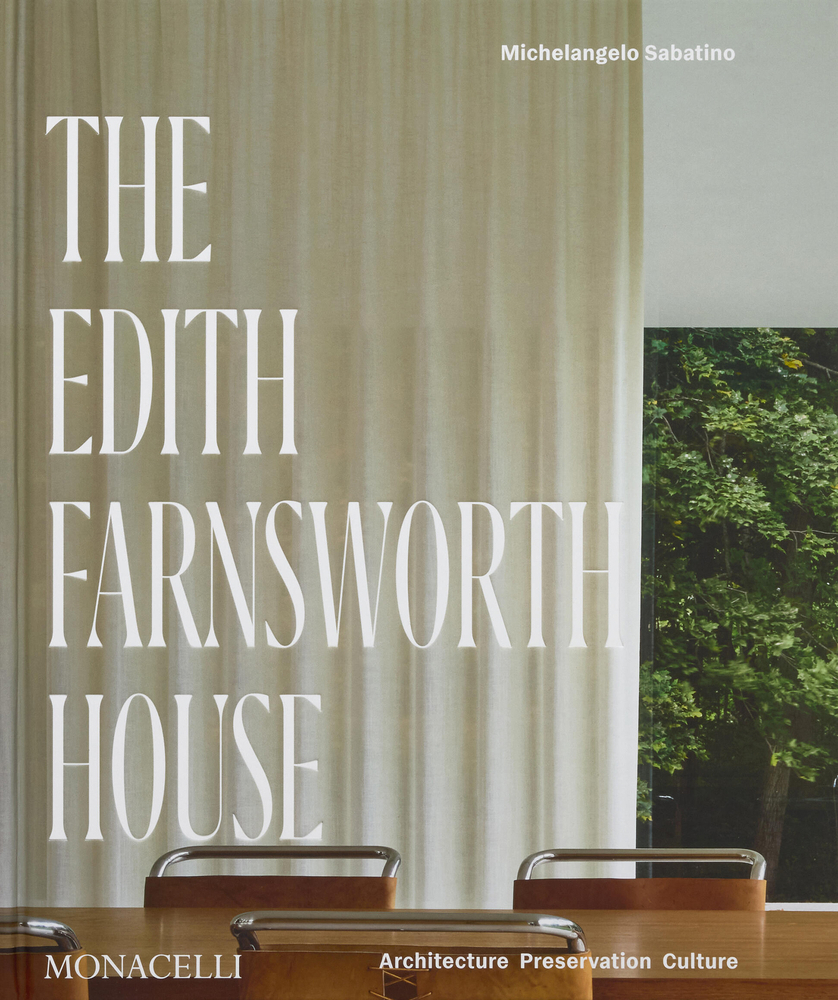
The Edith Farnsworth House: Architecture, Preservation, Culture (2024) by Michelangelo Sabatino is a richly illustrated, deeply researched, and well-crafted source of unending pleasure for the eyes, mind, and soul. Sabatino—the Director of the PhD program in architecture at the Illinois Institute of Technology—and his fellow authors Ron Henderson, Hilary Lewis, Scott Mehaffey, and Dietrich Neumann, have produced a work that broadens our perspective while helping undermine the conventional view of the house as merely a formal object sitting on its site as conceived wholly out of the mind of Mies van der Rohe.
Undermining conventional views has been an integral component of the house since Edith and Mies met at a dinner party one fateful winter evening in 1945 and the doctor asked the architect if “some young man” in his office could design “a small studio weekend house” for her newly acquired property. The effect of his reply—“I would love to build any kind of house for you”—was, in her own words, “tremendous, like a storm, a flood or other act of God.”
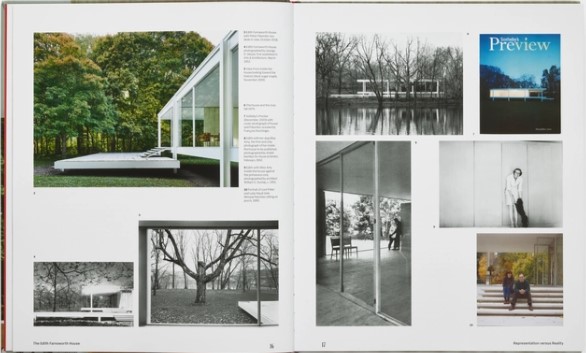
The authors intersperse insightful written essays with Sabatino’s long, carefully curated photographic interludes that take the reader from groundwork to construction to context and finally to preservation. As someone who was involved both tangentially and intimately in several aspects of the “third life” of the house from 2003 until 2019, I found this new book balanced, thoughtful, and satisfying in the depth it gives to the Edith Farnsworth House story. Other reviewers have also found this sweeping new work of great value.
The public’s understanding of preservation is often limited to the restoration process, but that doesn’t happen without financial support. Put simply, the Edith Farnsworth House would not have been saved and opened to the public without the untiring work of former Landmarks Illinois President David Bahlman, former Sara Lee Corporation CEO and renowned fundraiser and philanthropist John Bryan, and former National Trust President and CEO Richard Moe. It is a small quibble with an otherwise terrific new work, but I would have preferred to see more recognition given to their roles in pulling every string possible to raise the millions of dollars required to bring the site into the public realm. David, John, and Dick’s fundraising efforts—married with smart, strategic choices during the auction—were ultimately successful and made the preservation work of the past twenty years possible.
In the latest of my author interviews on MORE TO COME, Michelangelo graciously agreed to answer my questions about this important new book.
DJB: Beginning with Scott Mehaffey’s Foreword, the book puts Edith back into the story of the Farnsworth House. Why is that important, Michelangelo, and what have we learned from that effort?

MS: On November 17, 2021, the National Trust officially renamed “The Farnsworth House” to “The Edith Farnsworth House.”* From the early 1950s onwards, visitors and writers alike did not refer to the house and site with Edith’s first name; in so doing they failed to acknowledge Edith, the client/patron who first commissioned this pioneering modern weekend country house. At first glance the focus on Edith’s last name (Farnsworth) might not seem like an egregious omission especially considering that during those years houses typically were known with the last name of the client; recall for example Wright’s Robie House. However, even for this Prairie style masterpiece, Frederick C. Robie’s last name prevails over the wife’s last name (Lora Hieronymus). Although Edith was single and therefore the only client, not acknowledging her name or her title as medical doctor (she was one of only 3 women to graduate in 1938 from Northwestern University’s School of Medicine), led most to associate the house primarily with its renowned architect, Ludwig Mies van der Rohe. Only by expanding the focus beyond the architect to include the client/architect relationship can social and cultural history enrich architectural history.
You explore a treasure trove of photographs in the insightful introduction and through your curation of the photographic essays. Why were so many photographs taken through the years and what do they tell us about how the house has been viewed over time?
The relationship between the Edith Farnsworth House and the vast amount of photography over time that is partially shown in my book is hugely significant because the building became world famous even though it was not opened to the general public until 2004. Photography—first black and white and then color—served as a surrogate for the real-life experience especially since Edith’s country house is located approximately 60 miles away from Chicago and requires great determination (as well as time and resources) to reach, especially for out-of-town visitors.
Lord Peter Palumbo, the house’s second owner from the late 1960s until its sale in 2003, did welcome a select group of artists, architects, and cultural elite to the house. Additionally, starting in the late 1990s, he opened a visitor’s center with tours being occasionally offered to the general public. However, access under Palumbo’s ownership remained relatively limited. In addition to the general public and architectural professionals, in recent decades Mies’s architecture, including the Edith Farnsworth House, has generated considerable interest amongst artists. This interest has introduced his buildings to a group of art enthusiasts who may not have been aware or interested in architecture beforehand. Despite admiration for the house and the fact that it is open to the public most of the year, many individuals (including architectural professionals) continue to rely upon print and digital images instead of actually visiting the Edith Farnsworth House.
Unpublished memoirs, interviews, and oral histories are included in this work. What key insights do these perspectives bring to our understanding of the past, present, and future of the Edith Farnsworth House?
My new book features, for the first time ever, the complete transcription (with annotations) of the three chapters of Edith Farnsworth’s handwritten unpublished Memoirs containing her recollections of commissioning, building, and selling her famous house. Considering the strained relationship between Edith and Mies as the house was nearing completion that eventually led him to sue her (and her to countersue), granting the reader access to her side of the story is hugely significant. From the tone of her Memoirs (written during the last decade of her life after she sold her country house in Plano, left Chicago, and purchased a historic villa just outside of Florence) you understand why their relationship deteriorated over time.
Since the house witnesses three different eras (i.e. lives)—Edith/Mies era + Palumbo era + NTHP era—I believe it is important to acknowledge the history of the house through its different owners. During three decades of ownership before its sale at Sotheby’s New York, Lord Peter and Lady Hayat Palumbo cared deeply for the house; they ensured that it was given the utmost care with the expertise of Chicago-based Dirk Lohan, the only one of Mies’s grandchildren who became an architect. As the interview with Lohan attests, he was the one who informed Palumbo who was visiting Chicago at the time that the house was for sale and suggested they go see it together; this led Palumbo to immediately seize upon the opportunity of a lifetime and purchase it from Edith Farnsworth.

Chicago has had an important influence on the design of modern architecture. Where does the Edith Farnsworth House fit within that story?
My EFH book contains a chapter entitled “The Modern House in Chicago” in which the Edith Farnsworth House is situated within the broader context of modern houses in Chicago, the US, and beyond. This essay draws upon previous research published in Modern in the Middle: Chicago Houses, 1929-1975 (Monacelli, 2020), a book I co-authored with Susan Benjamin.
What is important to note is that Chicago became known as a laboratory of experimental residential architecture thanks to the contributions of two giants of “modern” architecture: Frank Lloyd Wright and Ludwig Mies van der Rohe. Even modern architects like Walter Gropius who one would associate with Mies understood Wright’s Robie House as a radical break with tradition in terms of plan and space. Although their designs were very different—one need only compare the Robie to the Farnsworth—what Wright and Mies shared in common was a deep respect for nature. This respect manifests itself in different ways. Wright tended to anchor his buildings into the site whereas Mies’s strategic use of glass and steel allowed nature to be present at all times without any “interference” from the building itself. For example, if you are inside looking outside of the Edith Farnsworth House, nature (in all of its seasonal variations) is the true protagonist, not the building itself. Here in Chicago for example, Paul Schweikher’s one-story Home and Studio in Schaumburg (1938 + additions in 1949) in Chicago common brick and unpainted old growth California redwood, owes as much to Wright’s approach to siting and materiality as it does to Miesian tectonics.
What is the importance of the landscape to the visions, realization, and restorations of the Edith Farnsworth House?
It is important to understand the role that the monumental Black Sugar Maple played in the original design of the Farnsworth House. Mies wrapped the house and its lower terrace around the tree so that it could provide shade on the South all-glass facade while anchoring the building to its site along the Fox River. Eventually the tree died and another one was replanted. It will take years before the tree will become the same monumental size as the one that inspired Edith and Mies’s design. Edith’s Memoirs recount the enthusiasm she felt for the wooded site along the Fox River that she purchased from Col. McCormick in December of 1945. Over time some photographers who have not spent enough time understanding the complex site have taken the country out of the country house by focusing excessively on the house while ignoring its relationship with its 60-acre site.
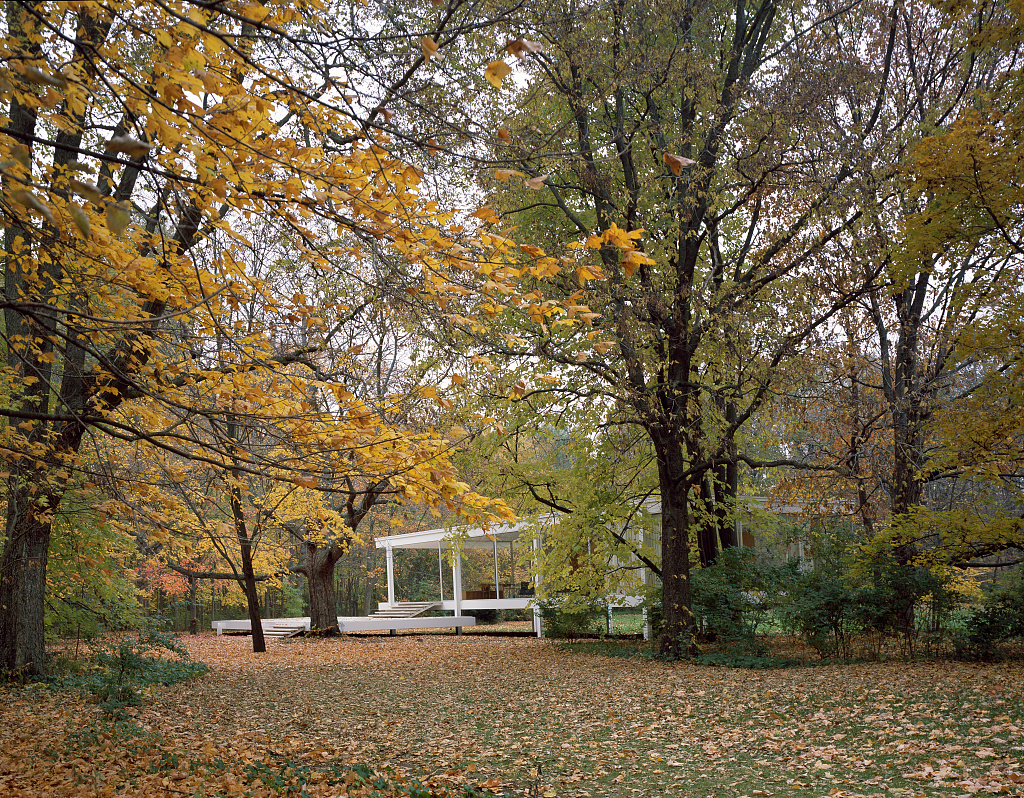
To really understand the Edith Farnsworth House one must visit and experience it during different seasons. Just as the travertine on the lower terrace was replaced along with most of the original floor-to-ceiling panes of glass, the landscape too requires constant oversight and care. Even though Mies designed the house five feet above the ground, over time, the house flooded several times. Even today, flooding remains the single most significant threat to the life of this remarkable National Trust for Historic Preservation property.
Thank you, and congratulations Michelangelo.
Thanks, David!
More to come . . .
DJB
*Fairbank Carpenter (1930-2023) son of Edith’s only sister Marion Farnsworth Carpenter, attended the renaming ceremony held at the EFH in Plano, Illinois.
Full disclosure: I was the Executive Vice President at the National Trust at the time the property was purchased and for the first 15 years of the Trust stewardship. From 2010-2019, I was also the organization’s initial Chief Preservation Officer with responsibility for the historic sites and other preservation programs. The National Trust is also the owner of Philip Johnson’s Glass House.
In addition, Dietrich Neumann, an author of one of the book’s essays, was a professor for my son Andrew who was an Urban Studies major at Brown University where Dietrich is the director.
To learn more about the site and tours, visit the Edith Farnsworth House website.
Photos—except where noted—from the Carol Highsmith Collection, Library of Congress.
 MORE TO COME...
Terrific interview, David. I enjoyed our overlap at the Trust! All best, Scott Mehaffey
Thanks so much for the note, Scott. Michelangelo did a great job in highlighting several key elements of the new book. I thought your Foreword was terrific and set just the right tone for the entire enterprise. Glad to see you thriving in this role. I also enjoyed our short overlap at the Trust. All the best, DJB
Pingback: Observations from . . . June 2024 | MORE TO COME...
Pingback: From the bookshelf: June 2024 | MORE TO COME...
Pingback: Conversations with writers: 2024 | MORE TO COME...
Pingback: The 2024 year-end reading list | MORE TO COME...
Pingback: The best of the MTC newsletter: 2024 | MORE TO COME...
Pingback: Richard Moe: A personal appreciation | MORE TO COME...
Pingback: Pull up a chair and let’s talk | MORE TO COME...