
Historical and common-sense approaches to building safe, vibrant, and delightful communities are actually prohibited in many American cities and towns. Outmoded policies—a great number of which have not been seriously reconsidered in decades—are a key barrier. For the average citizen they are invisible or impenetrable. Nevertheless, far too many of us must navigate life based on their out-of-date dictates and unspoken biases.
These policies are our communities’ zoning codes. The good news is that citizens and local leaders can reform these codes and reimagine the places where we live.
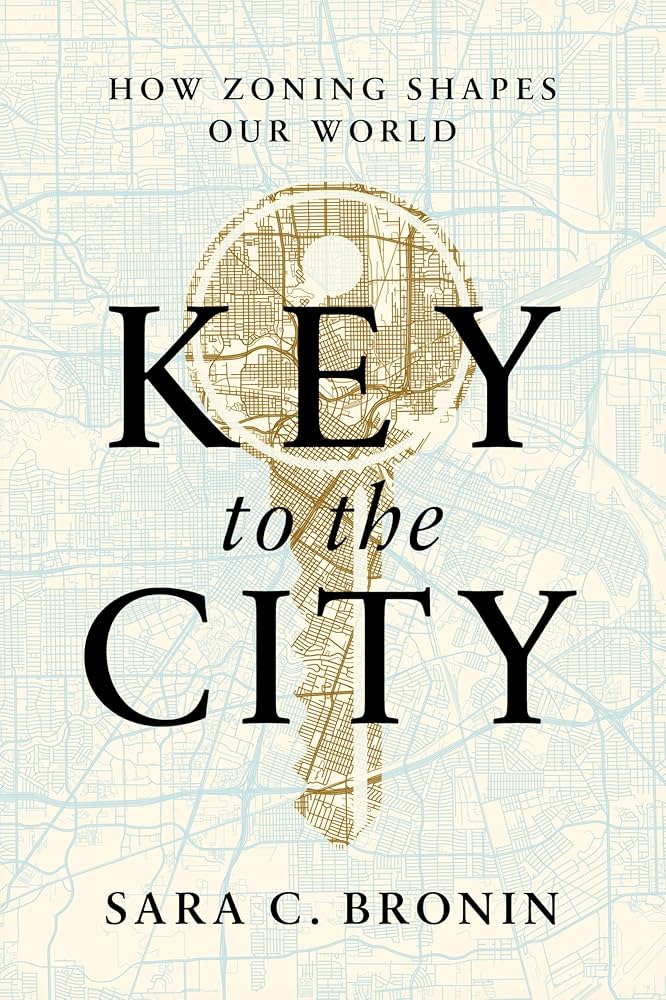
Key to the City: How Zoning Shapes Our World (2024) by Sara C. Bronin is an illuminating survey of the omnipresent tool driving the development of most American communities. An architect, attorney, policymaker, and professor who writes in an accessible and approachable style, Bronin shows the real-life consequences of codes that maintain racial segregation, build inequality, prioritize cars over people, and force us into choices that harm our health, our civic life, and the world in which we live. Changing our existing zoning policy is not easy. The new code that results from change is not a panacea. Yet in this ultimately optimistic work, Bronin makes a compelling case for what reformed and reimagined zoning codes can achieve.
With real-life examples coming from her own experience leading the overhaul of Hartford’s zoning code along with conversations with civic leaders while traveling around the country, Bronin examines how zoning can help create delightful and meaningful places that foster vibrant economies and provide households with the essentials they need to thrive.
I was delighted when Sara agreed to chat with me about her new book, which comes out today.
DJB: Sara, zoning has a long history leading to issues such as discrimination and segregation. Yet you are bullish about the use of zoning as a positive tool to address some of the most important concerns we’re facing today. What drives your optimism?

SCB: Since the dawn of civilization, humans have developed rules to organize their built environments. Zoning is just a modern incarnation of that impulse. So I guess my starting point is that some form of land use regulation is inevitable—and that zoning is what we’ve got to work with. Why not make it the best it can be?
The fundamental optimism about people’s willingness to change is why I’m a professor. And it’s why I wrote this book. I really believe if more people understand zoning, and all it can do for good, more people will be compelled to make it better.
In “Key to the City” you describe Hartford’s efforts to completely rewrite a zoning code that was originally implemented in the 1950s. Why was it important to throw out the old and write a completely new code?
Like many American cities, Hartford had inherited a zoning code that spoke to the priorities of another era. When I became chair of the city’s planning and zoning commission and really pored over the code, I was surprised at how much it seemed geared toward making the city more like the suburbs. It made downtown development very difficult—subjecting every building to an arbitrary and time-consuming “special permit” process. The result was predictable; instead of new buildings, downtown was covered in vacant parking lots. The old code zoned large parts of the city for manufacturing—perhaps in the vain hope that industry would roar back. And it prioritized the car, allowing uses like drive-throughs and gas stations along the city’s most historic avenues, while forcing property owners to build parking they didn’t need or want.
The new code changed all of that, ushering in changes that legalized dense, mixed-use, walkable neighborhoods. Over time, the zoning code should enable the city to develop the way it did for its first three hundred years—and yes, Hartford (founded in ~1635) was over three hundred years old when it first adopted zoning. More cities should interrogate their codes and fix them so cities can become cities again.
You make the case that zoning can be used to create communities that foster vibrant economies. What key lessons did you learn from studying such efforts in Chicago, Nashville, and Austin?
First and foremost, zoning has to be flexible to respond to changing conditions. One of the main reasons we’re in the mess we’re in—with so much bad zoning all across the country—is that we adopted zoning codes and then never updated them. Zoning codes aren’t sacred documents. We have to keep reviewing and revising them to be sure they’re helping us meet contemporary needs. The book highlights how codes in Chicago and Nashville have just enough flexibility to facilitate creativity and nightlife. In Austin’s case, the zoning might need to be tweaked to ensure the city’s main entertainment strip (Sixth Street) is fun for everyone… including neighbors. But in all three cities, zoning reforms have been an active conversation in recent years. And ongoing public dialogue about how zoning can and should shape the future of a place is critically important.
There are state policies which are critical in driving development decisions. Why is it important for those seeking to build more equitable communities to possess what you call a “bird’s-eye view” in dealing with our zoning codes?
Before I answer this question, I want to be sure your readers understand something important: that state legislatures are the ones with the authority to regulate land use. But, around a hundred years ago, all fifty states decided to delegate this power to local governments. In state zoning enabling acts, legislators told localities just how they could go about exercising their delegated zoning authority. In the book, I argue that local officials should harness zoning to improve street design, food security, and water management. They can do so because the powers that state legislatures give local governments to zone are pretty vast, and do, as you say, enable communities to advance a broad range of policy goals through zoning. Some local governments are taking full advantage of this—promoting urban agriculture, for example, or identifying the types of landscaping that might save on water use. Most, though, are less active. I hope more local communities start to see zoning as a tool that can advance sound transportation, food, and environmental policy.
Finally, Sara, you grew up in Houston which famously does not have a zoning code, and you make frequent references to the specific experiences of family members, including your parents, grandparents, uncle, and sister. How do these life experiences help your readers understand the personal nature of zoning on all manner of Americans, and what lessons are you working to share with your children and others of the next generation?
As a kid, of course I’d never heard of zoning—and, as far as I know, my family members didn’t think about it for a minute. But zoning affects all of us, whether we know it or not. In the book, I briefly mention my research project, the National Zoning Atlas, an online, public map that seeks to standardize information about zoning across the country. We’ve analyzed about a sixth of the country, and in Texas alone, we’ve uncovered 400 communities without zoning—over 2,200 nationally, so far. But even if you live in one of those places, the ways other communities zone have downstream effects. We’re all interconnected. And that’s why we have to collectively work to ensure that zoning, where adopted, works for all of us.
Thank you, Sara.
Thanks for including me in your newsletter.
More to come . . .
DJB
 MORE TO COME...
David- you get to interview interesting folks. This was a wonderful discussion and I look forward to reading Sara’s new book.
Thanks, Nick. I had a good time chatting with Sara, and I thought the book was top notch. Highly recommended. Glad you liked the conversation. That means a lot coming from you. Take care. DJB
Pingback: From the bookshelf: September 2024 | MORE TO COME...
Pingback: Observations from . . . October 2024 | MORE TO COME...
Pingback: Conversations with writers: 2024 | MORE TO COME...
Pingback: The 2024 year-end reading list | MORE TO COME...
Pingback: Pull up a chair and let’s talk | MORE TO COME...