
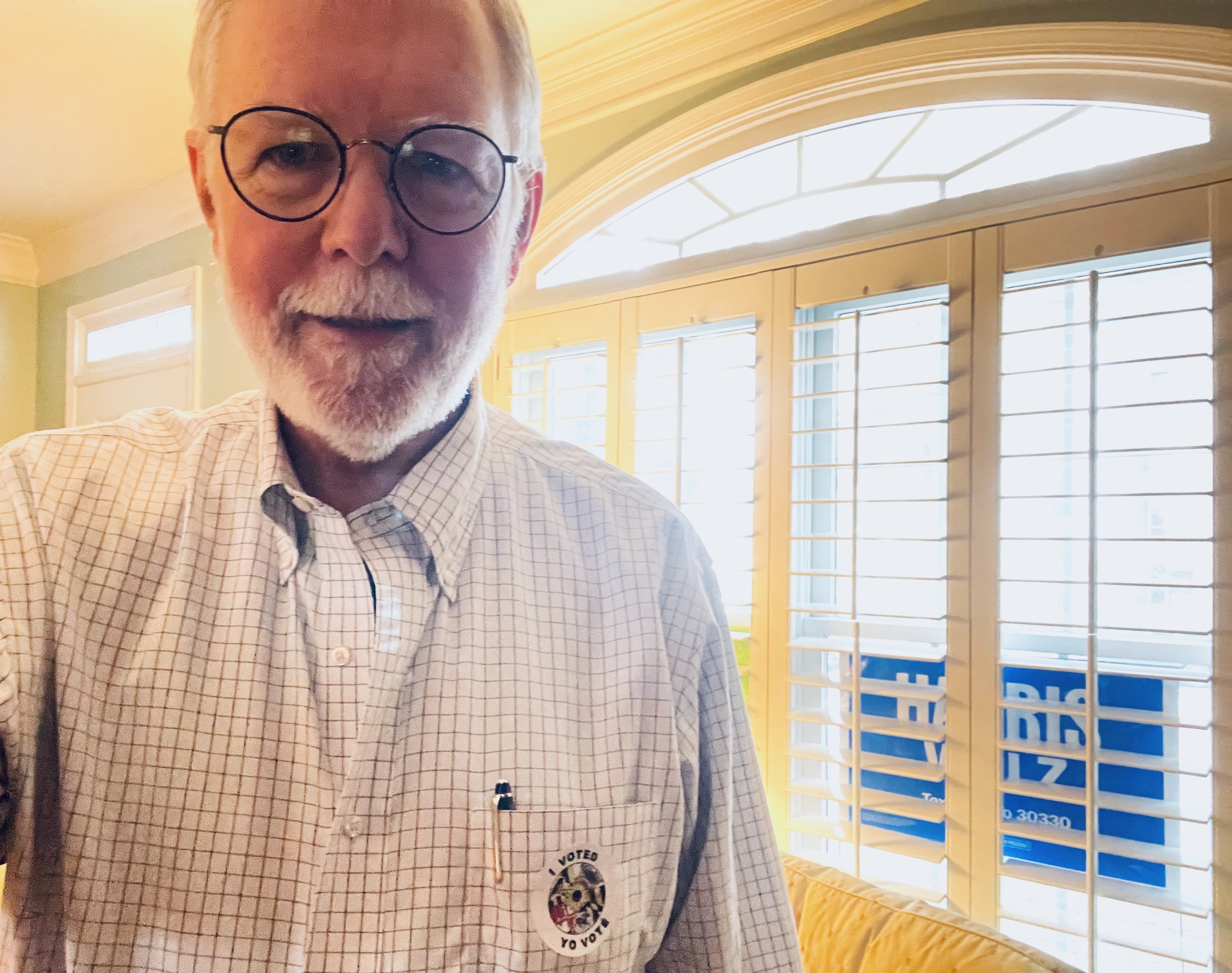
Candice and I cast our votes today, the very first day for early voting in Maryland. We walked three blocks to our local polling place. As we came in, a woman walked out wearing a stylish “I’m a Multi Issue Voter” t-shirt, with “democracy, women’s rights, climate solutions, equality” and more listed on the back. All of our county election officials were competent and courteous. There was a line, but the whole process took only 30 minutes. Our next-door neighbors arrived less than five minutes after we checked in. All in all, it was “just the democratic process at work.”
We even got to choose from among three different “I voted” sticker designs. Candice went with one that included the American and Maryland flags. I chose one with the state symbols.
My parents believed in democracy and the power of voting. Their votes occasionally offset each other (as they also believed that each individual had the right to make up their own mind), but they always voted. And I heard more than once that if you don’t vote, you don’t get to complain.
That bit of tough love came back to me when reading a post entitled “Why I Vote” by Dr. Lindsay M. Chervinsky, presidential historian and the Executive Director of the George Washington Presidential Library. Lindsay is the author of the award-winning book, The Cabinet: George Washington and the Creation of an American Institution, co-editor of Mourning the Presidents: Loss and Legacy in American Culture, and the recent Making the Presidency: John Adams and the Precedents That Forged the Republic. I am a subscriber to her informative Imperfect Union newsletter on Substack.
I want to quote from Lindsay’s October essay, as I couldn’t have said it better. She begins with Abigail Adams, who wrote her most famous letter on March 31, 1776, to her husband, John.
“In the new Code of Laws which I suppose it will be necessary for you to make I desire you would Remember the Ladies, and be more generous and favourable to them than your ancestors. Do not put such unlimited power into the hands of the Husbands. Remember all Men would be tyrants if they could.”
Chervinsky goes on to say why this last part was so critical to the future First Lady.
“She wasn’t talking about personal or emotional tyranny per se, but rather the legal system that categorized women as property to be controlled by their husbands or fathers. Few women were allowed to own property or conduct financial transactions.
These limitations drove Abigail crazy. John spent years in Philadelphia on congressional business, and then years abroad as a diplomat for the new nation. He left their estate and all financial business in Abigail’s care—and he was wise to do so. She was a savvy investor and expanded their nest egg through creative speculation and property acquisitions.”
But there were times, Chervinsky notes, that “Abigail could not make these purchases herself. Instead, she had to rely on male family members to make transactions on her behalf.”
“In other words, Abigail was arguing that if women had no role as citizens in the new nation, their rights would not be protected. Without the vote, they would be controlled by men and subject to their good will. And we know how well that often turned out.
Abigail was just one of many women who would have loved to vote. So too would generations of people of color, immigrants, servants, and more. They longed for full political participation, argued for it, fought for it, and in some cases, died for it.”
It wouldn’t be the last time that a woman wrote to a man in her family to encourage voting rights for women. In fact, it was a woman’s letter—from Febb Burn to her son Harry, a first-term legislator from East Tennessee—that pushed him to make the decisive vote that ensured the ratification of 19th Amendment, giving women the right to vote. As he noted in justifying his vote amid the outcries that followed, “I knew that a mother’s advice is always safest for a boy to follow and my mother wanted me to vote for ratification.”
Voting is so easy for people like me. But as Lindsay points out in her essay, “for some Americans, it is a much bigger lift. They have to take off work, arrange childcare, wait in line for hours, and risk intimidation.”
She ends Why I Vote—which I encourage you to read in its entirety—with this bit of sage advice.
“You are not choosing a spouse. You are not choosing a soul mate. You are choosing between two options. I agree it would be nice to have a multi-candidate system or maybe even different parties. But that’s not the world we live in. So I encourage you to go touch grass, get connected with this lived reality, and make a choice.
Voting is a civic duty. I wish election day was a national holiday, but there is little I can do about that right now. Instead, I can do my part. If you need assistance figuring out your registration or early voting, I encourage you to visit vote.org.”
Voting. Just do it.
More to come . . .
DJB
Image by Alex Shuper on Unsplash
 MORE TO COME...
Pingback: Observations from . . . October 2024 | MORE TO COME...