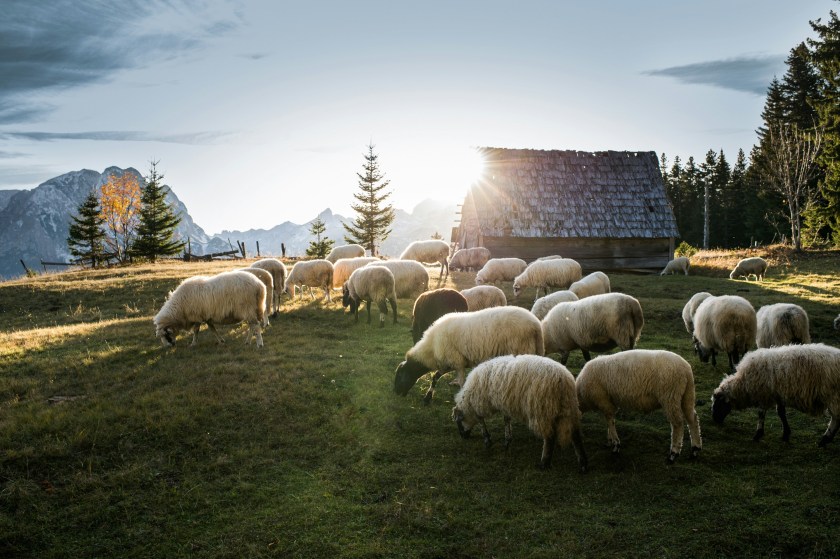
Who would have thought that the humble sheep would make for such fascinating social history? Yet beginning with “our Neolithic ancestors’ first forays into sheep-rearing nearly 10,000 years ago, these remarkable animals have fed us, clothed us, changed our diet and languages, helped us to win wars, decorated our homes, and financed the conquest of large swathes of the earth.”
When a long-time friend, colleague, and fellow National Trust Tour lecturer suggested I had to read this book, I followed her advice. When the package arrived, Candice got a puzzled look on her face and said, “who would write a book about sheep?” It turns out that the best-selling author of design and outdoor living books—including The Hedgehog Handbook, The Bee Bible, and The Little Book of Snow, who lives on a Yorkshire farm where she keeps chickens as well as, naturally, sheep—would.

Follow the Flock: How Sheep Shaped Human Civilization (2021) by Sally Coulthard tells how sheep have been central to the human story for millennia. Being an ideal animal to domesticate, sheep have been with us almost since farming began to the point that there are now around a billion on the planet. There are at least a thousand breeds and crossbreeds, yet Coulthard makes the point that these unique animals have changed us as much as we have changed them. Throughout fourteen captivating and informative chapters she weaves the rich and fascinating story of sheep into a vivid and colorful tapestry.
Coulthard begins, as one might suspect, with wool. Even with the advent of modern synthetic materials, there is no other fiber “quite as sublimely adaptable as wool.”
“It’s a chameleon; a material that can both repel moisture and absorb it, keep you toasty warm or refreshingly cool depending on the outside temperature, and be soft as silk and yet tough enough to resist searing flames. The secret of sheep’s wool rests in its hidden structure . . . wool fibres are cloaked with scales—look at a strand of wool under a microscope and the surface bears an uncanny resemblance to a gnarled tree trunk or a pine cone.”
But she moves beyond the obvious subjects of clothing and food to talk about the social history of sheep, such as the way they have changed our language. In this election season we may hear that someone is a “dyed-in-the-wool conservative” or a “wolf in sheep’s clothing.” We want to be careful not to be “fleeced” by scammers and con men. The idea that black sheep stand out from the rest of the flock, “for good or ill, probably explains the phrase ‘black sheep of the family.'” While the last one is a near universal idea that can be found in languages across the globe, it is ironic that the country with the greatest number of sheep—mainland China—doesn’t use the phrase.
Sheep have also influenced architecture in ways obvious and perhaps more obscure. Shepherds’ huts—once an uncomfortable reality for a working shepherd—have become a go-to destination for those looking for a different type of luxury break. Speaking of her native England, Coulthard observes that many farmers, middlemen, and landowners “made rich by the medieval wool trade went on to build some of the country’s finest houses, guildhalls, and public buildings.”
“And some of England’s prettiest, most chocolate-box towns and villages—places such as Hadleigh, Lavenham, Long Melford, Bury St. Edmunds and Clare in Suffolk, and Chipping Camden, Burford, Stow-on-the-Wold and Bibury in Gloucestershire—owe their embarrassment of architectural riches to the wool trade.”

In many of these same communities, those who made their money in the wool trade lavished their wealth on the local house of worship, resulting in parishes which came to be known as “wool churches.” These are some of the most celebrated examples of “medieval craftsmanship and architecture” in England. “There are literally hundreds of them. The county of Norfolk, for example, has 635 alone.”
One of the more fascinating chapters covers the history of sheep in armed conflict. Coulthard points to the animosity between the English crown and the American colonies as one example. In 1699 William III issued the Wool Act which was designed to force the colonies to only import British wool, to ban the exporting of wool out of America, and to tax any sales of wool. The colonists responded by making and wearing “homespun” which “became a mark of defiance and symbol of patriotism.” In fact, Coulthard asserts that “it was the Wool Act of 1699 that sewed the first stitches of rebellion and anger in the colonies that led, ultimately, to America’s Revolutionary War.” But by World War I, England and the US—along with Australia—were all engaged in a “Knit for Victory” campaign to help soldiers survive the cold in the trenches at the front. President Wilson allowed sheep to graze on the grass in front of the White House in a show of solidarity with the knitters, and in just a year and a half, “US citizens knitted over 24 million items of clothing for soldiers.” It had an emotional impact on soldiers as well as those on the home front making their contribution to the war effort.
Sheep and wool are so ubiquitous and beloved that Coulthard devotes a chapter to the “invention of tradition” where Irish sweaters and Scottish kilts are provided with manufactured stories that speak of home, heart, and heritage. Spinning yarns to manufacture myths— just one more example of how sheep continue, here in the 21st century, to shape human civilization.
More to come . . .
DJB
Photo from Getty Images on Unsplash
 MORE TO COME...
Pingback: From the bookshelf: October 2024 | MORE TO COME...
Pingback: Observations from . . . November 2024 | MORE TO COME...
Pingback: The 2024 year-end reading list | MORE TO COME...
Pingback: What my books reveal about me | MORE TO COME...
Pingback: What our books reveal about us | MORE TO COME...