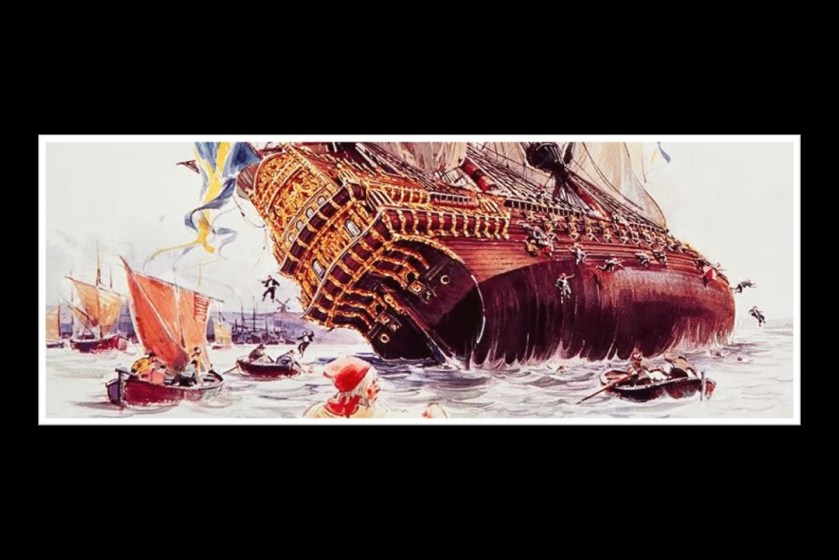
Stockholm’s most visited museum houses the Vasa—a wooden war ship which sank on her maiden voyage in 1628 and was raised in 1961. Inside the museum is the conserved and restored ship, along with incredible exhibits about the men and women of Vasa and the 1600s during the Golden Age in Sweden.
We visited in 2014 and—as I wrote at the time—this is a history museum like none other.

“History doesn’t repeat itself, but it often rhymes,” as Mark Twain is reputed (probably incorrectly) to have said. That line came to mind last week as Andrew and I were talking about the Vasa’s story, which seems to be playing out today in America.
“The loss of the magnificent Vasa after barely a kilometre’s sailing was a catastrophe on a grand scale, in full view of Stockholm’s population and foreign agents from all over northern Europe. Before his clothes were even dry, Captain Söfring Hansson was imprisoned and interrogated by the Council of State . . . On 12 August, the Council sent their first report to [King] Gustav II Adolf, who was with the army in Prussia, busy with the war against Poland-Lithuania. One can still read his fury in the reply, which insisted on an inquiry into what lay behind the catastrophe, and that the guilty should be punished.”
As described on the museum’s website, an inquest was held. But in the end, no one was officially blamed or punished, and all of those questioned were eventually promoted.
Why?
Because the main reason for the ship’s failure would have placed the blame on the king himself. King Gustav II Adolf personally approved the design, and he also had the builders load up the ship with excessive and heavy symbols of Sweden’s might and glory.
“The commission now faced an unpleasant dilemma: blame must be assigned, but without blackening the king’s name, and without removing anyone whose competence was necessary for the [ongoing] war effort. To a certain degree, the proceedings were really a piece of political theatre, to demonstrate what we would now call ‘due diligence.’ Everyone involved had had a month to get their stories straight, and Hein Jacobsson had effectively laid the blame on the perfect scapegoat. [The ship’s designer] Master Henrik could not defend himself [because he had died a year earlier] and did not need to be punished; the navy could get on with the job of managing the war.”
As the ship was being designed and built, no one dared tell the king “No.” A catastrophe followed and the country suffered greatly. Recent travels in Scandinavia and the Baltic Sea reminded me of the constant nature of conflict and the regularity of the rise and fall of empires. We think we’re exceptional here in America, but we are not. The Swedes were among those who prospered in the past—until they didn’t.
We are in a time in America when one political party is bending over backwards not to upset the attempts at disruption of the incoming president. No one wants to say “No.”
Timothy Snyder, a historian of authoritarianism, has written about Trump’s appointments and how each are part of a larger picture that he calls a decapitation strike. Presidential historian Lindsay Chervinsky has described why cabinet appointments are so important to the American way of life.
So what should we do when the past helps us see a potentially dangerous course ahead?
“We need to be clear-eyed but not deterred. Realistic but not pessimists. Most importantly, we need to be committed to fighting hard and not giving up hope. There will be dark days and times we feel like all is lost. Hopelessness is the tool of the aspiring dictator . . . We need to keep focused on hardening democracy.”
Mark Elias, Democracy Docket
When no one will push back and say “No” in today’s world, the ship of state will topple as quickly as the Vasa. And we will only have ourselves to blame.
More to come . . .
DJB
Painting of the Sinking of the Vasa credit Vasa Museum; photo of ship by DJB
 MORE TO COME...
Pingback: Observations from . . . November 2024 | MORE TO COME...
Pingback: Systemic change only occurs after acknowledging a systemic problem | MORE TO COME...
Pingback: The love of money | MORE TO COME...