
Adam Grant, the author of the book Think Again, had a recent op-ed in the New York Times entitled If You’re Sure How the Next Four Years Will Play Out, I Promise: You’re Wrong.
“Humans may be the only species that can imagine an unknown future,” Grant begins. “But that doesn’t mean we’re any good at it.”
“In a landmark study, the psychologist Philip Tetlock evaluated several decades of predictions about political and economic events. He found that “the average expert was roughly as accurate as a dart-throwing chimpanzee.” Although skilled forecasters were much better, they couldn’t see around corners. No one could foresee that a driver’s wrong turn would put Archduke Franz Ferdinand in an assassin’s path, precipitating World War I.”
And it isn’t only predictions where we fall into a confirmation bias and come up woefully short. So many of the hot takes by the media and political experts in the weeks after the election are also very much like that dart-throwing chimpanzee: all over the place.
Democrats may be determined to learn the wrong lessons (hey, we’re not part of an organized party, we’re Democrats), but it helps if we look at what actually happened here in 2024. I’ve been reading and listening to varied voices since the election and a few compelling stories come through that to me at least, are worthy of further consideration. But as Grant would caution, it is too early to reach definitive, much less correct, conclusions.
Lingering economic anxiety

We’ve been told this election was unprecedented. The reality? Not true. Due to lingering inflation and uncertainty following the pandemic, every incumbent party in every developed democracy lost elections this year—the first time that’s happened since measuring began in 1905. And the incumbent Democratic ticket in the U.S. lost by the SMALLEST margin in any of those countries.
We’ve been told that the ideological bent and policies of the Democrats are toxic and must change. Again, the facts don’t support this thesis. When you look at ballot initiatives for abortion and the fate of Democratic senate candidates in swing states, the “Democrats are toxic” message falls flat. As Paul Waldman notes, “The far more compelling explanation is simply that, just like voters in every country that had national elections this year, they essentially said ‘Ugh, inflation sucked’ and voted for the opposition party.”
The fatal error

Kamala Harris made the fatal mistake of being a woman. And of being a woman of color. Especially a smart woman of color. Someone I know well said they were “not voting for the black woman.” This individual was simply being more forthright than many who find other excuses to cover their bias. I know that some have said that this really wasn’t the case because as a woman she nonetheless made up much of the ground Biden had lost when he pulled out of the race. But as a historian and a son of the South, I am fully aware of the role that racism and sexism plays in America. As the satirist Andy Borowitz perceptively wrote, that “fatal mistake” is “no small data point in a nation that has yet to choose a female head of state—something that 88 other countries have somehow managed to do. Even macho Mexico just elected a woman, and—eek!—a Jewish one at that.”
The cruelty is the point

Let’s also be aware, as Roxane Gay stated in a New York Times op-ed entitled Enough that, “Clearly, Mr. Trump is successful because of his faults, not despite them, because we do not live in a just world.”
But to suggest we should “yield even a little to Mr. Trump’s odious politics”—compromising on issues we care about—“is shameful and cowardly. We cannot abandon the most vulnerable communities to assuage the most powerful. Even if we did, it would never be enough. The goal posts would keep moving until progressive politics became indistinguishable from conservative politics.”
Besides the world economic angst, misogyny, racism, and cruelty, there is one other key factor that I’ve been considering in recent weeks. It is summed up by the writer who said, “Trump didn’t defeat Harris in this election. He defeated reality.”
Disinformation

We’ve been told by Trump and the legacy media that this election was a landslide, resulting in a mandate. The reality? Not even close. Trump got less than 50% of the popular vote and he had the smallest margin of victory since Richard Nixon in 1968. More people voted against Trump than voted for him. Approximately 10,000 votes kept the Democrats from gaining control of the House. He’s already trying to claim this gave him a mandate, but it is simply more disinformation.
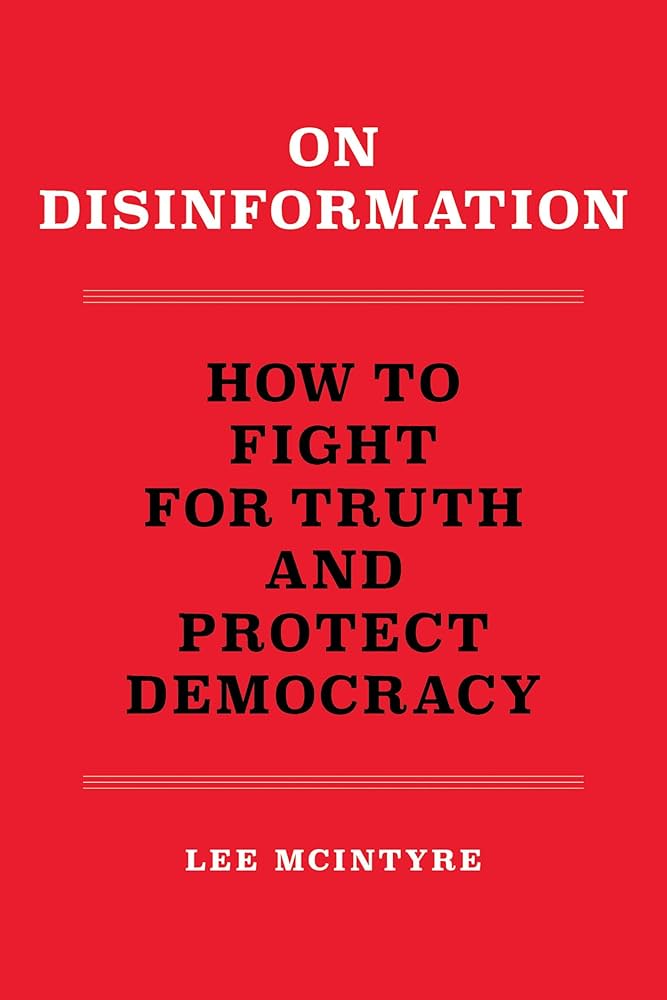
On Disinformation: How to Fight for Truth and Protect Democracy (2024) by Lee McIntyre is a powerful punch for truth packed in a pocket-sized guide. In it, he shows how the effort “to destroy facts and make America ungovernable didn’t come out of nowhere.” It is the culmination of decades of strategic denialism. Political parties learned about denialism from some of the best: the tobacco lobby which sprang into action following the first scientific report in 1953 linking smoking to lung cancer. McIntyre, who published this slim book before the election, makes the point that January 6th was “the inevitable result of seventy years of lies about tobacco, evolution, global warming, and vaccines.” These “truth killers” on the science side provided the blueprint for how to deny facts that “clashed with their financial or ideological interests.” Karl Rove, Rubert Murdoch, Mitch McConnell, Rush Limbaugh, and Donald Trump only had to take a small step to move these tactics into our political life.
McIntyre reminds us that “truth isn’t dying, it is being killed.” Disinformation is a “coordinated campaign being run by nameable individuals and organizations whose goal is to spread disinformation out to the masses—in order to foment doubt, division, and distrust—and create an army of deniers. He identifies these truth killers, provides a short history of their work, calls out the various creators and amplifiers who spread the word to the “believers” who have been taught to think that “the distinction between fact and fiction . . . true and false . . . no longer exists.” As Gay notes, many of Mr. Trump’s voters “believe the most ludicrous things . . . even though these things simply do not happen.” Unfortunately, we act as if they are “sharing the same reality as ours, as if they are making informed decisions about legitimate issues.”
Monika Bauerlein, CEO of Mother Jones takes it a step further, noting that it isn’t “just Fox News, Twitter trolls, and Facebook grifters anymore. The right has moved from creating a parallel news ecosystem to integrating itself into all the places where people scroll, click, and stream. And their power to do that is only growing as media owners make their accommodations with the incoming administration.”
McIntyre ends with a chapter on how to win the war on truth. He calls on the reality-based world to “increase the number of messengers for truth” and focus on matching the messengers to the people we are trying to reach. So what might ordinary citizens do to fight back against disinformation? McIntyre has suggestions ranging from resisting polarization to recognizing that in some sense deniers are victims to stopping the search for facile solutions. If this were easy, we would have solved it by now.
Disinformation is a choice, and it is a choice to believe anything that affirms a worldview. Yes, this is a dark moment in American history. But as George Lakoff and Gil Duran write in the FrameLab newsletter:
“[W]e must not give in—because giving in to despair is a form of obedience. Authoritarianism threatens everything we hold dear, but we still have tremendous power . . .
Remember: Persistence is the best resistance.”
I’ll end with the final verse of June Jordan’s powerful Poem for South African Women, referenced in the FrameLab newsletter, as a reminder of what’s at stake.
“And who will join this standing up
and the ones who stood without sweet company
will sing and sing
back into the mountains and
if necessary
even under the sea
we are the ones we have been waiting for
More to come . . .
DJB
NOTE: For an earlier take on the subject see the 2021 MTC post Disinformation and Democracy
Photomontage Image by Gerd Altmann from Pixabay
 MORE TO COME...
Pingback: From the bookshelf: November 2024 | MORE TO COME...
Pingback: Great necessities call out great virtues | MORE TO COME...
Pingback: The 2024 year-end reading list | MORE TO COME...
Pingback: Observations from . . . December 2024 | MORE TO COME...