
America lost one of its most lucid, thoughtful, and challenging commentators when Lewis H. Lapham passed away at age 89 in June of this year. The recent election led me to return to his tour-de-force from 2016 to try and make some sense of what just happened here in 2024.
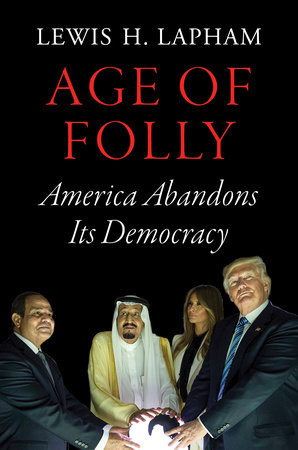
Age of Folly: America Abandons Its Democracy (2016) by Lewis H. Lapham surveys the period from 1990 to 2015 to make the strong case that America’s imperial impulses have shaken our democratic principles. The observations in the first half of the book are presented chronologically from monthly commentaries Lapham produced as the editor of Harper’s Magazine. The essays in the second half, written as backstory to various issues of Lapham’s Quarterly, seek to make the case for history as folly’s antidote. Lapham wants to teach us that “we have less reason to fear what might happen tomorrow than to beware what happened yesterday.” A nation denied knowledge of its past, he asserts, “cannot make sense of its present or imagine its future.”
Through a well-orchestrated and decades-long program of disinformation alongside the strategic disinvestment in public education as plutocrats sought to steal our public assets, America has lost knowledge of its past, fears for its future, and has a sizable minority that embraces the comfort of the authoritarian’s lie. Lapham shows how misadventures such as our invasion of Iraq during the Bush II administration led to ongoing turmoil, downgraded the country’s standing abroad, and did extensive damage to American democracy at home. He speaks to that damage in his preface, where he calls out example after example.
“. . . the bulk of the nation’s wealth amassed by 10 percent of its population, class warfare waged by the increasingly selfish and frightened rich against the increasingly debt-burdened and angry poor, the democratic electing of an American president overruled by the Supreme Court, a national security apparatus herding the American citizenry into the shelters of heavy law enforcement and harmless speech, the 2008-09 devastation of the nation’s wealth and credit, the public good systematically shuffled into the private purse, occupants of the White House pleased to hold themselves above the law, futile but unending foreign war, both houses of Congress reduced to a state of impotent paralysis, a political discourse made by a celebrity-besotted news media posing demagogues on selfie sticks.”
He continued by looking ahead to the 2016 election.
“An age of folly worthy of the name, its consequence the presence of Donald J. Trump, prosperous fool and braggart moth, on November’s presidential ballot.”
We all know how that—and the last eight years—turned out.
The book’s first essay, written in 1990, is especially prescient for its time.
“If the American system of government at present seems so patently at odds with its constitutional hopes and purposes, it is not because the practice of democracy no longer serves the interests of the presiding oligarchy (which it never did), but because the promise of democracy no longer inspires or exalts the citizenry lucky enough to have been born under its star. It isn’t so much that liberty stands at bay but, rather, that it has fallen into disuse, regarded as insufficient by both its enemies and its nominal friends. What is the use of free expression to people so frightened of the future that they prefer the comforts of the authoritative lie?”
Lapham also explores the change in our concepts of public and private and its effect on our society, noting that “the familiar story (democracy smothered by oligarchy) has often been told” but that . . .
“…it is nowhere better illustrated than by the reversal over the past half century of the meaning within the words ‘public’ and ‘private.’ In the 1950s the word ‘public’ connoted an inherent good (public health, public school, public service, public spirit); ‘private’ was a synonym for selfishness and greed (plutocrats in top hats, pigs at troughs). The connotations traded places in the 1980s. ‘Private’ now implies all things bright and beautiful (private trainer, private school, private plane), ‘public’ becomes a synonym for all things ugly and dangerous (public housing, public welfare, public toilet).”
In the final interview before his death, Lapham spoke eloquently about the desperate need for history in our country.
“Edward Gibbon had said somewhere that history is nothing more than the record of mankind’s folly, misfortune and crime. It’s the past living in the present, and the present living in the past. The voices in time are an immense resource—the founders of the American Republic were all passionate students and readers of history. History doesn’t repeat itself if you learn from it: it’s an immense storehouse of human consciousness . . .
In colleges, they teach history as if it’s gateway marble, but it’s not: it’s alive. The reason I started Lapham’s Quarterly was to teach history as alive—as the past living in the present and the present living in the past, not museum-quality marble; living, not dead. It’s the same thing that Faulkner said: the past is never dead. It’s not even past.”
Lapham then talks about our country’s history and how it has played out over the last 400 years.
“John Winthrop, the first governor of Massachusetts Bay Colony arrived in 1630 on the ship Arabella, and before the ship dropped anchor in Salem harbor the governor preached the sermon to the Puritan faithful on board the ship and told them there was no such thing as democracy; that in God’s will some will be high in dignity, some low and in submission. That was the way the world worked, and always will. The great argument that is going on and has been going on in America for four hundred years is the story of rich and poor, in one way or another.”
In the book’s final essay, Lapham looks at the writings of Thomas Paine, which speak not to the rich and privileged, but to the common man.
Lapham eloquently called us to put the wisdom of the past at the service of the present. And to recognize, as Paine so memorably wrote, that “Those who expect to reap the blessings of freedom must, like men, undergo the fatigues of supporting it.”
More to come . . .
DJB
Photo by Giorgio Trovato on Unsplash
 MORE TO COME...
Pingback: The 2024 year-end reading list | MORE TO COME...
Pingback: Observations from . . . December 2024 | MORE TO COME...
Pingback: From the bookshelf: December 2024 | MORE TO COME...
Pingback: When the narrative tries to swamp the history | MORE TO COME...