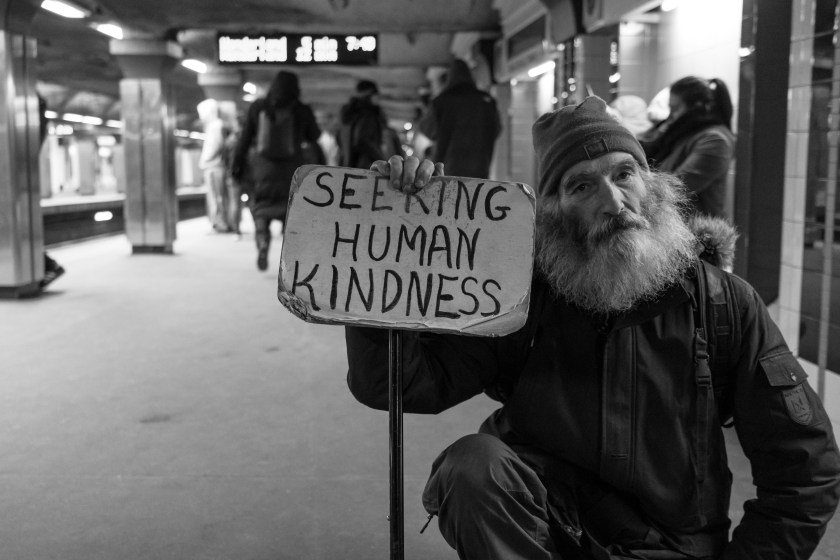
“Power at its best is love implementing the demands of justice, and justice at its best is power correcting everything that stands against love.”
The Rev. Dr. Martin Luther King, Jr.
My book group is currently reading a work by one of the twentieth century’s most influential preachers, educators, prophets, poets, and mystics. I first read what has been cited as “a timeless testimony” that demonstrates “how to thrive and flourish in a world that attempts to destroy one’s humanity from the inside out” several years ago. But our current turmoil—stirred up by those focused on hatred and division—provides an updated context. The juxtaposition of the MLK holiday and the inauguration of this new president makes it an especially auspicious moment to look back while looking forward.

Jesus and the Disinherited (1949) by Howard Thurman is the work that inspired The Rev. Dr. Martin Luther King, Jr. and countless other advocates for peace and justice. Rev. Otis Moss, III highlighted the uniqueness of Thurman’s book when he wrote, “No other publication in the twentieth century has upended antiquated theological notions, truncated political ideas, and socially constructed racial fallacies like Jesus and the Disinherited. Thurman’s work keeps showing up on the desk of anti-apartheid activists, South American human rights workers, civil rights champions, and now Black Lives Matter advocates.” Vincent Harding called the book the centerpiece of Thurman’s “lifelong attempt to bring the harrowing beauty of the African-American experience into deep engagement with what he called ‘the religion of Jesus.'”
At the beginning of this slim but deep work, Thurman notes that there is a striking similarity “between the social position of Jesus in Palestine and that of the vast majority of American Negroes” (using the term that was popular in his day), an observation that “is obvious to anyone who tarries long over the facts.” He “begins with the simple historical fact that Jesus was a Jew.” As such, Jesus was a member “of a minority group in the midst of a larger dominant and controlling group.” Thurman argues that it would be “utterly fantastic to assume that Jesus grew to manhood untouched by the surging currents of the common life that made up the climate of Palestine.” He, like almost all Jews of his day, was disinherited.
“There is one overmastering problem that the socially and politically disinherited always face: Under what terms is survival possible?”
But while he grew up in the same society, we have to recognize that he was Jesus, and the other Jews in Palestine at the time were not. Thurman stresses that Jesus, in the midst of a very difficult psychological climate for Jews, focused on “the urgency of radical change in the inner attitude of the people.”
“(Jesus) recognized fully that out of the heart are the issues of life and that no external force, however great and overwhelming, can at long last destroy a people if it does not first win that victory of the spirit against them.”
It is the “inward center” which is the critical arena. The attempt to kill the soul is everywhere. As a mentor of mine phrases it, one way evil affects us is by isolating the mind and killing the heart.
In chapters on fear, deception, hate, and love, Thurman “demonstrates how the gospel may be read as a manual of resistance for the poor and disenfranchised.” He suggests that the position of the disinherited in every age is to determine “(w)hat must be the attitude toward the rulers, the controllers of political, social, and economic life?” Jesus, Thurman notes, rejected hatred.
“It was not because he lacked the vitality or the strength. It was not because he lacked the incentive. Jesus rejected hatred because he saw that hatred meant death to the mind, death to the spirit, death to communion with his Father. He affirmed life; and hatred was the great denial.”
The hatred for “the others” has existed for centuries. Hatred often begins in situations where there is “contact without fellowship.” There are no overtures of warmth and genuineness. It is easy, Thurman asserts, “to have fellowship on your own terms.” It is unsympathetic understanding breeding ill will. Hatred becomes a source of validation for us and for our personalities.
Thurman’s words ring as clear today as they did when he wrote them almost 80 years ago.
“The basic fact is that Christianity as it was born in the mind of this Jewish teacher and thinker appears as a technique of survival for the oppressed. That it became, through the intervening years, a religion of the powerful and the dominant, used sometimes as an instrument of oppression, must not tempt us into believing that it was thus in the mind and life of Jesus.”
On January 20th, writer Carrie Newcomer notes, there will be two stories presented. This is our national holiday celebrating the birthday of Dr. Martin Luther King Jr. We “honor stories that are real and lasting, stories of hope and faithfulness, of courage and deeply ethical living.”
“I think it is important to say clearly that our celebration of Dr. Martin Luther King Jr.’s life is not a story that ended after his tragic assassination in 1968 . . . We honor the work that has come before, we take humble and grateful insight from those who have faced enormous challenges and suffering and did not quit—even in the face of grievous cost . . . [and we] decide the kind of power we choose to believe in, and the power we hope to build upon each in our own way, through our own daily actions.”
And there will be another, very different type of story presented today.
“To be sure, this is the beginning of a new and dangerous regime, but it is an old story that is essentially unoriginal and without the kind of true power Dr. King described. In the story of this new regime, there is no room for anything that is truly expansive, no room for our highest values, no room for the good we can imagine and then create, there is no room for spiritual growth, only spiritual decay.”
We each choose fear, deception, hatred . . . or love. It is the “inward center”—our soul—which is the critical arena.
More to come . . .
DJB
Photo: Matt Collamer on Unsplash
 MORE TO COME...
In our book group discussion this morning, our facilitator shared a Howard Thurman poem that seems very appropriate for the season:
The Work of Christmas, Howard Thurman, 1950
When the song of the angels is stilled,
When the star in the sky is gone,
When the kings and princes are home,
When the shepherds are back with their flock,
The work of Christmas begins:
To find the lost,
To heal the broken,
To feed the hungry,
To release the prisoner,
To rebuild the nations,
To bring peace among others,
To make music in the heart.
Pingback: Observations from . . . January 2025 | MORE TO COME...
Pingback: From the bookshelf: January 2025 | MORE TO COME...
Pingback: Reflection. Recalibration. Renewal. | MORE TO COME...