
On a recent journey through Europe I was honored to be a lecturer alongside the esteemed historian Jeremy Black, MBE, a Non-Resident Senior Fellow at the Foreign Policy Research Institute in Philadelphia and Emeritus Professor of History at Exeter University. In addition to being the author of more than 100 books on history, Jeremy is also a fan—and reviewer—of murder mysteries. After a week together on a river cruise we had both finished the mysteries we brought with us, so Jeremy proposed a swap.
Which is how I was introduced to old Edinburgh and the Raven and Fisher series.

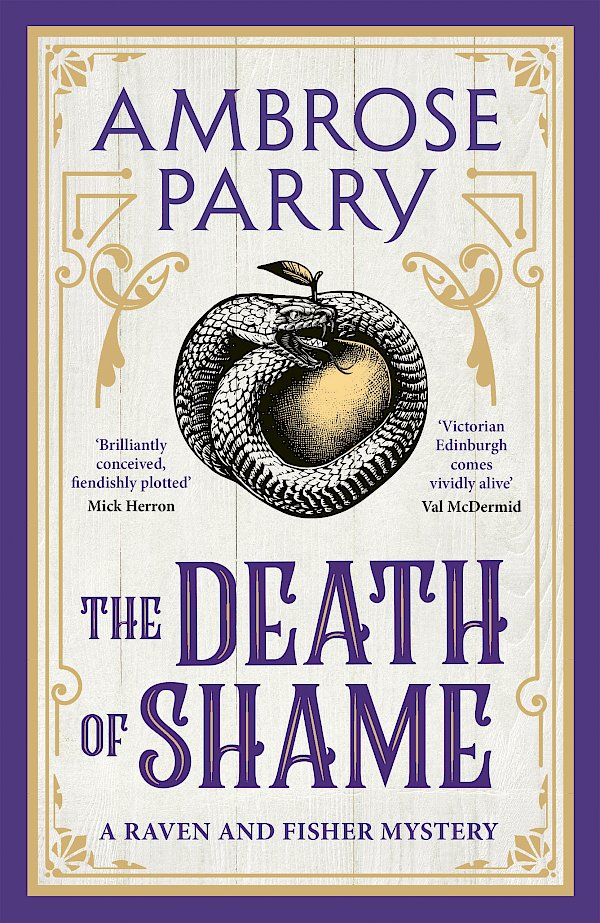
The Death of Shame (2025) by Ambrose Parry is the most recent installment of the Raven and Fisher mystery series. Set in 1854 Edinburgh, a prologue has the reader at the top of the Scott Monument, where we see one character’s dramatic response to public humiliation and shame. After some scene setting we then move into the heart of the work. In a world with strict moral codes and very restrictive societal roles for women, Sarah Fisher—a young widow left with financial resources after the death of her husband—is helping fund Dr. Will Raven’s emerging medical practice in exchange for being secretly trained as a doctor. As the story progresses, Will and Sarah are drawn into an ever more confusing and dangerous web of treachery, blackmail, secrets, and murder among the city’s more sordid residents.
The mystery begins when one of Raven’s first patients does not require medical attention. Will is summoned to the foot of the Scott Monument by Inspector McLevy to identify the body of a well-respected Edinburgh businessman whose death will cause waves. The dead man also happens to be Raven’s father-in-law. Fisher, meanwhile, is being asked to help locate a missing young lady, Annabel Banks, who came to the city at 15 years of age with a job lined up through an agency but has not been heard of in the month since she left home. Annabel, it turns out, is a niece Sarah has not seen in years. She gets no help from McLevy and the police, but Sarah is dogged in her search and finds support from Raven. Together they begin to uncover a horrific trade in young girls that Annabel may have been lured into.
If you haven’t discerned by now, the relationship between Will and Sarah is clearly important to the story. Their concern and care for each other is obvious and they should clearly be together. However, there are many reasons why this isn’t possible, not the least of which is that Will is married and has two children. That subplot is a key element of this new book, as Will balances his deep feelings for Sarah with his love for his family.
Will’s wife Eugenie has difficulty returning those feelings, however. After the grief following her father’s death and her growing distance from Will and her family following the difficult birth of a second child, Eugenie moves with her children back into her father’s home with its retinue of servants on fashionable St. Andrew’s Square.* Will remains in the smaller building in the New Town, with his office and an apartment for his growing family above. Sarah lives in the home of their former employer, the brilliant Dr. James Simpson and his family in Queen Street, working both there and with Raven.
In the midst of Raven’s concern about his wife’s increasing alienation and his work to discover the truth behind his father-in-law’s suicide, the reader sees the mutual respect and collaboration between the two lead characters. Will helps Sarah to achieve her medical aspirations and she takes on leading parts of their investigations. Both characters are well drawn, sympathetic, and willing to go to great lengths to uncover the city’s dark secrets.
Those secrets revolve around the fact that morality in Victorian Edinburgh was a weapon used to control women. A hint of being “impure” would spell ruin. The shame in the title leads to blackmail. Men are also not immune from coercion, as many so-called outstanding citizens had secrets and desires that they were desperate to keep out of the public eye.
Late in the story Sarah confronts her personal feelings on shame and virtue. In the process she finds that she can understand why a man would choose to leap from the Scott Monument. However, she also discovers “that she is not willing to be controlled by men wielding shame.”
With this revelation, Sarah uncovers the way to break the bonds held over this cast of characters by unscrupulous and vicious men and women, leading to a successful conclusion to the case. In the process, we learn more about Will, Eugenie, and Sarah. Eugenie shows a feminist side that is apparently new to the series, and her decisions at the end of the story have life-changing consequences for Raven and Fisher.
Ambrose Parry is the penname for Chris Brookmyre, an internationally bestselling and multi-award-winning author, and his wife, Dr. Marisa Haetzman, a consultant anesthetist of twenty years’ experience. The couple teamed up to write a series of historical crime thrillers, having extensively researched not only the places and social issues of the period but also the key figures and medical treatments. Many of the events in The Death of Shame are based on true historical characters and events, some first uncovered through Dr. Haetzman’s masters degree in the History of Medicine.
If you are new to the series, it is probably best to begin with the first book. However, I found that Brookmyre and Haetzman included enough backstory to bring new readers up-to-date with the lives of the main characters. And readers of historical fiction will be pleased to know that the blending of realities uncovered by the research with fictional storylines is handled with assurance and skill.
Even though I am generally not a fan of historical fiction, I found The Death of Shame a very satisfying read. I suspect that I’ll return to Victorian Edinburgh along with Dr. Will Raven and Sarah Fisher in the months ahead.
More to come . . ,
DJB
*I stayed in a boutique hotel on St. Andrew’s Square on my most recent trip to the city.

The authors even include two snippets about Lord Melville’s role in blocking the abolition of the slave trade, which I have both written and lectured about in recent years.


Photo of Edinburgh by Joshua Earle on Unsplash.
 MORE TO COME...
Pingback: Observations from . . . June 2025 | MORE TO COME...
Pingback: From the bookshelf: June 2025 | MORE TO COME...
Pingback: Librarian on the run | MORE TO COME...