Our best historians “attempt to recognize and grapple with the humanity and, thus, the fallibility of people in the past—and the present.” As one of those historian notes, “That is the stuff of history, too.”

On Juneteenth (2021) by Annette Gordon-Reed is a work of both history and memoir that explores the long road to the actual events toward emancipation on a June day in 1865 and then forward to the recognition of that date as a national holiday in the 21st century. Juneteenth remembers and celebrates June 19, 1865, in Galveston, Texas when Major General Gordon Granger announced the end of legalized slavery in the state: Emancipation Day. Gordon-Reed, best known for her deep and earth-moving scholarship on the Thomas Jefferson/Sally Hemmings relationship, looks at a more personal subject here. A native of Texas, she examines her own life and mixes it with historical events from the state, nation, and world to shape a more truthful narrative around emancipation. By taking the long view, Gordon-Reed helps the reader see, as one reviewer notes, “that historical understanding is a process, not an end point.”
The past doesn’t disappear just because it isn’t recognized. Some of us carry it forward even when governments and other groups are intent on forgetting.
“History is always being revised,” writes Gordon-Reed, “as new information comes to light and when different people see known documents and have their own responses to them, shaped by their individual experiences.” Still, she notes, humans seem to need myths and legends as well as history, in part because they are an easy way to knit groups of people into a community.
This slender volume challenges the “Alamo” and “Western” myths surrounding Texas. Gordon-Reed takes us back to the earliest presence of Black people in the state to show how we have erased history for centuries in order to control the current narrative. Our nationalist-oriented history has us seeing what was happening “almost entirely from the perspective of English-speaking (and White) people.” As noted in the book publisher’s description, her reworking of the traditional “Alamo” framework “powerfully demonstrates, among other things, that the slave- and race-based economy not only defined the fractious era of Texas independence but precipitated the Mexican-American War and, indeed, the Civil War itself.”
Juneteenth was celebrated in Texas long before it became a national holiday, and the latter initially irked Gordon-Reed. She describes how Texas is special in the minds of its natives, yes, but also in fact (if not exactly in ways that are commonly understood). The state is big geographically but it also has an outsized presence in the nation’s history.
“No other state brings together so many disparate and defining characteristics all in one—a state that shares a border with a foreign nation, a state with a long history of disputes between Europeans and an Indigenous population and between Anglo-Europeans and people of Spanish origin, a state that had existed as an independent nation, that had plantation-based slavery and legalized Jim Crow.”
Gordon-Reed writes eloquently about origin stories in this work which serves as something of a personal memoir. She remembers segregated waiting rooms and attending a “whites only” school before integration was legally mandated. She recognized that white friends treated her differently in different situations, as they struggled to maintain the racial caste system that was so important to the culture of the time. And she looks at the various American origin stories—from Plymouth to Jamestown and then into Spanish Florida and Mexico, which had slaves and battles with Indigenous peoples long before the Anglo-American versions that are such a part of our popular history. Origin stories matter to her, “even if they often have more to say about ‘our current needs and desires’ than with the facts of history.”
She ends the introduction by writing that her work on Juneteenth reveals:
“. . . that behind all the broad stereotypes about Texas is a story of Indians, settler colonists, Hispanic culture in North America, slavery, race, and immigration. It is an American story, told from this most American place.”
Annette Gordon-Reed’s On Juneteenth is a short but important work on the endlessly complicated American story, which we do well to consider on this day and every day.
More to come . . .
DJB
For previous posts on Juneteenth see:
- Acknowledging the difficulties (2023)
- Lift Every Voice and Sing (2020)
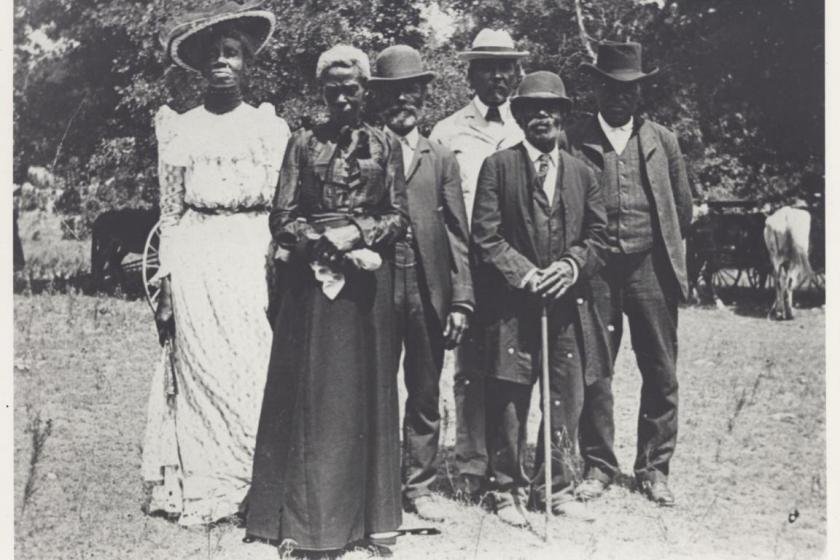
Photo: Emancipation Day celebration, June 19, 1900 held in “East Woods” on East 24th Street in Austin. Credit: Austin History Center via the National Museum of African American History.
 MORE TO COME...
Interesting, David – I’m going to put this book on my “to read” list. Years ago, I worked with a woman of Spanish descent who was originally from Texas – she was descended from Spanish conquistadors and could trace her ancestry in what is now the US back before the arrival of the English on East Coast. That was my first encounter with this strand of American history, and it sounds like Gordon-Reed’s book would help fill in that gap in my education.
Sandy, I think you would find it of interest. She writes about how our histories have been framed and erased to support larger perspectives of the dominant majority (in this case White Anglo-Saxon Americans). DJB
Pingback: Observations from . . . June 2025 | MORE TO COME...
Pingback: From the bookshelf: June 2025 | MORE TO COME...
Pingback: The year in books: 2025 | MORE TO COME...