
A few weeks ago I wrote a full review of a new book about a brainy librarian who confounds her handlers while running from a murderous ex.
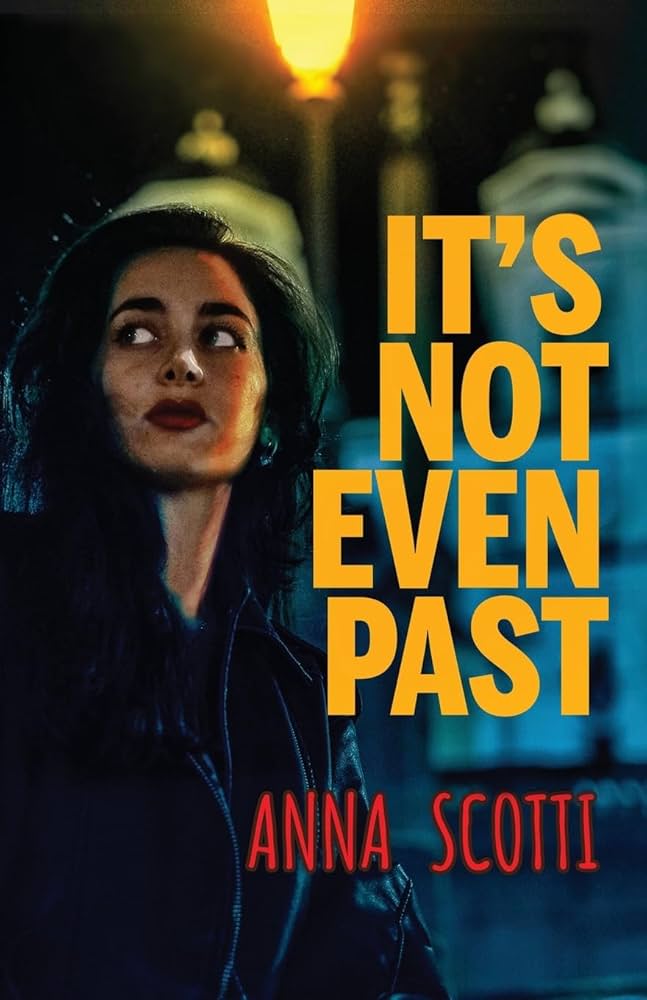
It’s Not Even Past (2025) by Anna Scotti is a brilliantly conceived set of murder mysteries involving the librarian originally known as Lori Yarborough. Lori moves through several aliases, multiple locations across the U.S., and a variety of rather menial jobs in order to stay a step ahead of her ruthless ex and his cartel henchmen. In each place our protagonist has an uncanny ability to find herself in the midst of trouble and murder; her ingenuity in solving those crimes inevitably forces her to move on, often to a new city with a new WITSEC-provided identity.
The original post generated so much positive feedback that I reached out to Anna to see if she would answer a few questions for my Author Q&A series. She did, and what follows is our delightful exchange. Enjoy!
DJB: Anna, how did you become interested in writing murder mysteries? Are there particular challenges and/or rewards in the murder mystery genre that you’ve recognized as opposed to, for instance, your writing of poetry or young adult novels?

AS: I’ve always loved reading mysteries―my mother would pass along her Agatha Christie and Elizabeth George paperbacks when she’d finished, and my dad his Dick Francis racetrack novels. My sister and I would fight over them, along with Ellery Queen and Alfred Hitchcock Mystery Magazines, which came out monthly back in the day. I even wrote a mystery―pseudonymously―when I was first getting started, but it wasn’t very good, and although it had a well-known publisher it didn’t get much attention. Around the same time I published a children’s book and a horror novel, with similar results. There was no self-publishing back then, so it was a bit of an accomplishment to publish at all. But I didn’t see how to make a living at it so I abandoned writing fiction for the longest time.
I was a journalist writing for InStyle and People, Redbook, all the big women’s magazines. I specialized in “wojep,” which is short for “woman in jeopardy” dramatic stories. The wronged wife or stalked woman would tell me her story, and I’d write it up in the first person, “as told to.” Eventually I segued into teaching school, and because I was so busy―I was a mother, too―I tinkered with poetry, thinking a shorter form might fit my schedule better. I did find my way in the poetry world, but all those wojeps lingered in my consciousness, and I still refer to them for storylines and characters. Now I work in all three forms―my young adult novel, Big and Bad, won the Paterson Prize for Books for Young People back in 2020. It got rave reviews, but pandemic books didn’t sell well, if at all.
Most of the chapters in “It’s Not Even Past” began as stand-alone short stories. At what point did you realize that you may have a book, and did that realization require you to change how you were writing your later stories?
I love this question because it reminds me to reflect on a lesson I learned the hard way! I had no thought of a series when I offered the first story, That Which We Call Patience, to Ellery Queen. But I liked the main character―a brainy, erudite, but naive librarian―so much that I wrote another story around her, then another. Ellery Queen readers are great about writing in―they will track a favorite writer down to ask questions, or more often, to lodge complaints―and whenever I published a “librarian” story in the magazine I’d hear from readers demanding the answers to questions posed or suggesting places for the character to be situated next. So I thought, this could really become something; an ongoing character who evolves and changes with each installment.
But the trouble―the lesson I mentioned earlier―was that I’d not kept notes about all the details of Cam’s personality and background. Is her tattoo on the right ankle, or the left? Or is it on her calf? Which greyhound is the male―is it Vindi, or Meme―because that’s the one that likes her? Does Cam drink coffee or is it Earl Grey Tea? Aiiii! Going back through published stories to make note of every detail that might come up in―or be contradicted by―a later story was a major task. But I learned. I have a new recurring character, Aubrey Blackwell. She’s a teacher and has appeared in a couple of anthologies, including Paranoia Blues (Down & Out Books, 2022). You had best believe I am keeping an excel spreadsheet listing every single thing readers know about Aubrey!
I love the character of Lori Yarborough/Cam Baker in part because a librarian who is in the witness protection program goes against type. But what the heck do you call her, given that her name changes every few stories?
Oh, what to call her! Another lesson learned the hard way! Writers, take heed: if you are going to create a character with changing aliases, establish his or her real name from the beginning. In Patience, the librarian was called “Audrey Smith,” and she joked that she couldn’t divulge her true name because then she’d “have to kill you.” In the next installment, What the Morning Never Suspected (EQ Sept/Oct 2020) our librarian became “Cam Baker,” but she was eventually known as “Serena Dutton,” “Sonia Sutton,” “Dana Kane,” and “Juliette Gregory.” Eventually, in the sixth EQ story (which is seventh in the collection) readers learn her real name, Lorraine Yarborough, and it’s a bit of a plot point.
But readers often read stories out of order―more than a few have discovered the “librarian on the run” by picking up a Best Mystery Stories of the Year (Mysterious Press, 2022, 2024, 2025)―then gone back to read the rest. And I didn’t want to undermine the drama of story six by referring to Lori by her real name before it was revealed. Compounding that muddle, as the series gained popularity, I got requests for interviews and was invited to speak to various organizations. Not having a name to use for my character, or having to say “the librarian we call Cam,” or “the woman on the run in WITSEC” was really awkward! It was even a problem as my publisher was coming up with book cover blurbs and summaries for potential reviewers. So lesson learned: the character can live under as many aliases as she wants, but the writer and reader need one unchanging name to call her from the beginning!
I won’t give away the ending, but do you see a future for more stories about Lori and can you hint at what that might be? Can you tell us about other projects in the works in your writing practice?
Lori had a new story in the May/June issue of Ellery Queen―it’s called Traveller from an Antique Land―and there’s another coming up later this year. I think there are a few surprises in store for “librarian” fans! As for projects in the works, we’d need a series of interviews extending into 2027 to cover it all. I’ve got my little fingers in a lot of pies! That’s not necessarily a good thing, though. I think I might be further along in my career, better known and better remunerated, if I could stick to just one genre, but I find that impossible.
Right now I’m polishing a coming-of-age novel that I’m really excited about―it’s called Real Brothers, Spit Sisters, and the Baileys Lost Their Dog. It’s about a little girl, a white girl, growing up in Washington, DC in the sixties, at the time of the Civil Rights Movement. When Ima’s older brother becomes ill, she’s sent to South Carolina―at the time, a very racially segregated state―where she is befriended by an older girl and also becomes fascinated by a Black family she sees fishing on the lake every morning. There are a lot of layers to the story. It was an exciting book to write, and I hope it’s exciting to read. Right now I’m looking for a publisher. I’ve also got a thriller I’m finishing. It takes place in the 90’s and it’s dark, but also a fun travel back in time. And I’m working on a screenplay based on the “librarian on the run,” and on another collection of stories―noir, I guess. They are stand-alone stories, not part of the series, from Ellery Queen, Black Cat Mystery Magazine, The Saturday Evening Post, and various lit mags.
For the past couple of years, I’ve had poetry on the back burner, as I worked on the novels and short fiction. And I teach creative writing classes online! But I’m getting back to poetry now. I’ve got some poems that are quite satisfactory, and I’m hoping to be able to provide publication links soon. If your readers are interested, they are most welcome to visit my website which is a good place to find links to some of my stories and poems―including audio recordings of some of the mystery stories―without a paywall.
What books/authors are you reading now that particularly inspire you?
I love and admire so many writers that it’s hard to pick even a few, but I think the writer whose work I devour most eagerly is Paulette Jiles. My God, what a talent! Each novel is based in American history, the history of the Old West, and each is a wonder, better than the one before. Enemy Women, Chenneville, News of the World … especially now, with my country in turmoil, these books are incredibly inspiring, beautifully written, and true to history. Jiles includes the stories of free Blacks, of women, of Indigenous People, of children…the reader experiences the stories from unusual viewpoints. And they’re all inspired by people who really lived. Elizabeth George’s Inspector Lynley novels are marvelous―she’s incredibly talented. What she did with the back-to-back novels, With No One as Witness and What Came Before He Shot Her provides a masterclass for mystery writers, as well as a feast for readers. I also love Emma Donoghue―she’s Canadian, I think. Sara Waters. Jonathan Franzen. And my all-time favorite book might be One Thousand White Women by Jim Fergus. You’ll cry, but you’ll also be astonished by Fergus’ trickery, and by his storytelling expertise. Oh, I had better stop. Just one more―my “comfort read” is anything by Ruth Rendell. I eat those up like candy―they are so good! I’m sure I’ve read every one of her books three or four times!
Thank you, Anna.
You’re welcome. I’ve gone on a little long, but I had so much fun with these questions.
More to come . . .
DJB
Mysterious street image from Unsplash
 MORE TO COME...
Pingback: Observations from . . . August 2025 | MORE TO COME...
Pingback: TRP August Roundup – TRP Newsletter & Blog
THANK YOU, Texas Review Press, for linking to my interview with Anna Scotti in your August roundup!
That is the wonderful thing about writing in several genres – writers, editors, and publishers support one another! Texas Review Pressfrequently mentions my mystery stories, and my poetry publisher, lightscatter press, does, too!
That’s great, Anna!
Pingback: Pull up a chair and let’s talk | MORE TO COME...
Pingback: The year in books: 2025 | MORE TO COME...
Pingback: A jewel of a novel | MORE TO COME...