
What happens to humans when they lose the capacity to see? Or to speak? How do we connect with others when we find ourselves in a place of intense loneliness and isolation?
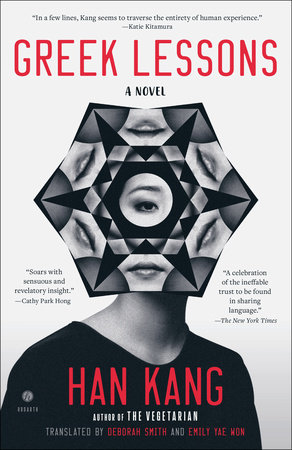
Greek Lessons: A Novel (2023) by Han Kang (translated by Deborah Smith and Emily Yae Won) is set in Seoul, South Korea, where a young woman watches her Greek language teacher at the blackboard. She tries to speak but has lost her voice. Her teacher is drawn to the silent woman, for he is also moving into isolation as day by day he is losing his sight. Two ordinary people are battling personal anguish in an extraordinary work that speaks to the importance of connection, human intimacy, and language.
As the publisher’s note reveals,
“. . . the two discover a deeper pain binds them together. For her, in the space of just a few months, she has lost both her mother and the custody battle for her nine-year-old son. For him, it’s the pain of growing up between Korea and Germany, being torn between two cultures and languages, and the fear of losing his independence.”
Han Kang, who was awarded the Nobel Prize in Literature in 2024, has written a short but powerful novel that explores the ways we reach beyond isolation through language and touch. The unnamed woman in the story pushes back on her therapist’s insistence that her loss of speech is a direct result of these other losses. That explanation “strikes her as simplistic. She experienced a prolonged inability to speak once before, in childhood, and as with a stutter, she knows the cause can’t be narrowed to any one factor or resolved with a behavioral strategy. It’s neurological. She’s lost ‘the passage that led to speech.’”
As one reviewer notes, the author . . .
“devotes the majority of the book to separate flashbacks of extreme sensory experiences that have stayed with them. Of her childhood speech block, the woman recalls how ‘words would thrust their way into her sleep like skewers, startling her awake.’ Her teacher recalls his father going blind from the same genetic disease and withdrawing from their family.”
These flashbacks can feel, in one sense, scattered and unconnected. But in the author’s skillful hands the reader moves along even as one narrator has difficulty finding a voice and the other finds it increasingly difficult to see. They both are drawn to ancient Greek as a dead language that no one speaks anymore, but that nonetheless has a complicated grammatical structure that feels safe. Almost a harbor. And that attraction helps build the attraction between our two narrators. The ending of the novel reads as poetry, as the two come together despite their isolation.
There is a sadness that pervades this story, but there is also hope. There is shared suffering that brings the man and the woman together. The Times review ends with a beautiful summary when it notes that this novel “is a celebration of the ineffable trust to be found in sharing language, whether between parent and child, teacher and student, or between words spoken aloud and those traced, painstakingly, with a finger on someone else’s waiting palm.”
Greek Lessons is, as more than one reader has noted, a love letter to human intimacy and connection.
More to come . . .
DJB
Photo of lanterns holding prayers of the faithful at Bulguksa Temple in South Korea by DJB
 MORE TO COME...
Pingback: Observations from . . . October 2025 | MORE TO COME...
Pingback: From the bookshelf: October 2025 | MORE TO COME...
Pingback: The year in books: 2025 | MORE TO COME...