
Rich Moran chats with me about his memoir of how an old house and a vineyard changed his life.
How many of us have ever had a wild dream, gulped, and took the leap of faith required to follow through? Dreams, wild and otherwise, are plentiful. Follow through—to the point where the result is a changed life—is much rarer in this world. Each of us has things we regret. Far fewer can say I didn’t want to regret a path not taken, and have built a new life complete with a compelling story to tell.
When those leaps of faith are described by a masterful storyteller who has taken his lumps, made mistakes, understands the difficulty of courageous choice, and yet succeeded at building his life’s dream, we do well to listen to that story.
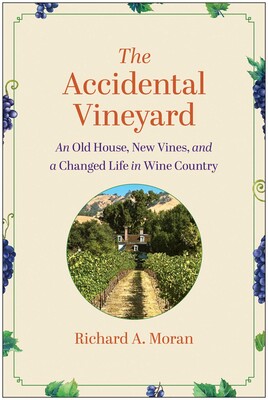
The Accidental Vineyard: An Old House, New Vines, and a Changed Life in Wine Country (2025) by Richard A. Moran is a heartfelt memoir that begins with a spontaneous drive into California wine country in an attempt to lull a fitful, crying son to sleep. On the drive Moran, his wife Carol, and their three children chance upon an old Victorian house for sale. They make the commitment to restore the house, even though it had challenges by the boatload and would disrupt Rich’s busy, corporate consulting business. Both of those facts turned out to be keys to finding the well-rounded life he didn’t know he was seeking as the journey began.
Several years into the restoration of the dilapidated Victorian, a neighbor stops by and offers to plant some vines. Before he knows it, Rich and his family are wine makers. Restoration projects and building a winery are not for the faint of heart. Moran—in simple yet compelling language—happily lets us all in on the secrets he and his family uncovered in following their dreams. This is a memoir full of heart and humor, as one reviewer phrased it, and I was delighted when Rich agreed to chat with me about the book for the newest installment of our Author Q&A series here on MORE TO COME.
DJB: Rich, you and Carol decide to take a leap of faith, change your well-ordered and successful life, and buy a house that has a “manuscript length” inspection report. What was it about this old house, in this particular small town, that caused you to “fall in love” and lead many of your friends and family members to question your sanity?

RM: David, is falling in love ever easy to explain? This old house just spoke to us. We felt like we were “adopting” it. As we looked at other houses it seemed that we would be buying someone else’s house. This one was destined to be ours. “Our” house had lots of space inside and out, it had a story to tell and we could be a part of that story, there were no neighbors nearby except for grape vines and it had, my now favorite word, “patina”. The small town of Calistoga had some of the same elements. Plus, the town was not letting money change its character.
Bats are a recurring theme, and perhaps a metaphor for other issues, during the early phases of repair and restoration. I laughed out loud at the stories of the flaming bats flying around the house and especially your recounting of the reactions of the Mexican construction crew after opening the walls on the third floor to release thousands of bats: they fell on their knees and made the sign of the cross because they felt your house was possessed by the devil. Can you describe those scenes and talk about how you dealt with dreams of a country house full of memories that are not always what you expect?
To be clear, I like bats, I just don’t appreciate them flying around in the bedroom at night. Like so many other things that seem like problems, the bats were part of the symptom, not the real problem. The problem was that the exterior of the house, including the roof, was pocked with holes into the house created by woodpeckers. The mortar in the chimney bricks had disintegrated allowing the bats to fly into and out of the chimney. To get rid of the bats, we had to fix all of the other issues first. And we couldn’t harm the bats because they are a protected species.
Like the song “the shin bone’s connected to the thigh bone” every issue led to another, usually bigger issue. We kept our sense of humor through it all. The bats are now gone and we don’t miss them. I no longer go to bed with a tennis racket by my side. What was so important in our restoration was the notion that we would take our time. We didn’t rush to do anything, including bat removal. We enjoyed the ride. But not the bats so much.

The story of how you went from just restoring an old Victorian to becoming a winemaker speaks volumes about you and Carol and your approach to life. When your “accidental vineyard” shows up, what was on your mind, and what life lessons did acquiring a vineyard in this fashion teach you?
I like wine. I like to drink wine. I like movies about wine, and there are lots of them, BUT, I never thought I would own a vineyard or make wine. When approached to enter the wine world I jumped at the chance, not knowing all that was involved. Now I do and have immense respect for those who are making great wine. There is also a romance to wine. They don’t make movies about growing soy beans. Like the house, we resolved to take our time with the vineyard. Eventually, I realized that every fall we were going to have tons of grapes, we needed a plan and taking our time was less of an option. Life lessons include: “sometimes free isn’t free” (think boats, cars). The big lesson is the beauty of nature.
What do you mean when you say that “every day takes all day” and what are the experiences and lessons you want to convey to your reader in making this point?
Whether you sat around watching TV all day or pruned 100 grape vines, each activity took all day. Why not make it a productive day? I like to think about how to spend a day and be intentional about it. Sometimes days are wasted but it still takes all day. When you go about your day, no matter what it includes, it will take your day.
Finally, Rich, restoring an old home may be great for people like you and me, but it isn’t for everyone. That certainly goes for growing grapes and making a wine that can make the wine list at the Four Seasons. But your story has a wider appeal than to preservationists and wine aficionados, and towards the end you suggest that we each ask ourselves “what am I saving this for?” Would you help us understand what you discovered during this journey, and how each of us might apply those discoveries in our lives?
When people are asked about regrets they’ve had in their lives, the answer almost always references the things they DID NOT do. I should have gone to medical school, I should have continued with the guitar, I should have married that boy/girl from college, I should have taken that big job. Of course, we all have regrets but I keep that philosophy in mind. That is, take the risk, I don’t want to regret not buying that house. I am glad we did.
Another driving force in retrospect is that I wanted to enter a world that could be shared. Golf is nice but it takes all day and Carol and the kids are left out. Same with sailing, skiing and other things. The restoration and wine making has been a family affair.
And, we are all passionate about preservation and wine. It all worked.
Thank you, Rich.
My pleasure.
More to come . . .
DJB
To see an earlier Q&A with Rich Moran, check out Banish Apathy.
Photos courtesy of Moran Manor Vineyards.
 MORE TO COME...
Pingback: Pull up a chair and let’s talk | MORE TO COME...
Pingback: Observations from . . . November 2025 | MORE TO COME...
Pingback: From the bookshelf: November 2025 | MORE TO COME...
Pingback: The year in books: 2025 | MORE TO COME...