Talking with Amy-Jill Levine about what foreshadows the familiar nativity stories of Advent.
There are times when stories become so familiar that we forget to stop and think about their roots. Their context. Their deeper meaning or perhaps their ambiguity. Maybe even their power.
A Jewish biblical scholar may seem an unlikely source for thinking about the roots, context, connections, and potency of the familiar story of the birth of Jesus. Those who may feel that way simply do not know Amy-Jill Levine.
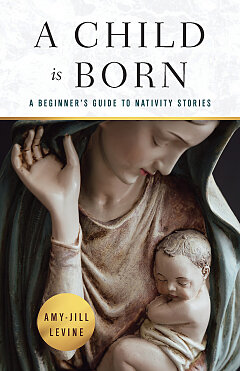
A Child is Born: A Beginner’s Guide to Nativity Stories (2025) by Amy-Jill Levine is a short but insightful book that examines the other nativity stories in the Hebrew Bible. Christians easily recall the narrative around the birth of Jesus: the annunciation of the angel to Mary; the birth of John the Baptizer to her cousin Elizabeth; Joseph and his pregnant wife’s trip to Bethlehem; the manger, shepherds, and heavenly hosts; the magi; the flight to Egypt. But how many know, much less think about, the nativity stories of Moses, Isaac and Ishmael, Samson, and Samuel. Just in time for Advent author AJ Levine has prepared a fascinating four-part study explaining the context that would have been basic knowledge for the faithful in the first century CE while showing the connections between these ancient stories and the one we now celebrate on December 25th.
AJ begins the introduction with the familiar, if not often remembered, Old Testament narrative around the birth of Moses in Egypt. She then quickly moves into the lives of Abraham, Sarah, and Hagar who are—she reminds us—not exactly role models. On the contrary, we should struggle with them. Throughout these stories she writes of displacement, of refugees and migrants, of pilgrimage, of making connections with relatives who live in different places, and of exploration. A Child is Born is a book full of insight and wisdom, and I was delighted when AJ agreed to chat with me in this newest installment of my Author Q&A series.
DJB: AJ, what can we learn by understanding the ties between nativity stories in the Old Testament and the nativity story of Jesus as told in the Gospels?

AJ: Jesus, his first followers both Jews and gentiles, the Gospel writers, and their first audiences, did not have a “New Testament.” Their Scriptures were the Scriptures of Israel; Jesus and his first followers engaged the Hebrew text; Jews in the Diaspora and their gentile neighbors had the Greek translations. These Scriptures told of despair over infertility, angelic annunciations, miraculous births, children in danger, and the responsibility, heartbreak, and joy children bring. When we hear echoes of these stories in the Gospels, the Gospel narratives become more profound; they become part of the greater symphony that the Bible offers. The Gospel narratives provide recognition and comfort in the familiar; more, they provide surprise and delight in what is new. The Gospel nativities not only anchor Jesus, Mary, and Joseph into Jewish history, but they also show the ongoing, mysterious, miraculous, joyous, and sometimes difficult relationship between God and God’s people.
Did anything surprise you as you began to delve into the similarities and differences between the story of the birth of Jesus with those of Moses, Issac and Ishmael, Samson, and Samuel?
Although I have been studying, and enjoying, these stories for decades, I find that they continually surprise me. New insights are prompted by changes in my own life, and changes in the world. Of the numerous aspects that particularly impressed me as I was writing this book, here are three.
The first is reading the texts in light of infant mortality because of war, famine, lack of medical care, displacement, etc. I am struck by the often difficult decision to conceive and raise a child. Ishmael will be expelled; Isaac has an elderly mother (which raises questions about special needs); Moses is born in the context of genocide and Samson in a time of war; Samuel is placed by his mother in an adoptive home. The infant Jesus is, according to Matthew, targeted for assassination, a refugee in Egypt, and displaced from Bethlehem in Judea to Nazareth in the Galilee.
Second, a personal note: Despite the wishes parents and caregivers have for their children, these children make up their own minds and face their own futures. There is the bittersweet sense that they are no longer our babies, the sadness that we cannot protect them from all the difficulties ahead, the joy when they find their own way, and the pain when they do not.
Third, from the academic world comes greater knowledge of Jewish stories of miraculous births and of children who have some sort of divine status, such as Melchizedek according to the non-canonical text known as 2 Enoch. Jews at the time of Jesus, like their gentile neighbors, told stories of heavenly conceptions and humans who were in fact divine (here see Philo’s Life of Moses). Hence, I am increasingly convinced that Samson’s father may have been an angel (this is the Bible; such things can happen). Here we see how the biblical stories fit into their broader cultural settings, whether of Bronze age Mesopotamia or first-century Rome.
Your description of the biblical story as one of displacement, pilgrimage, and exploration struck a chord as I read this book. Why is that such an appropriate frame in describing what we find in all of these stories, and in scripture writ large?
Thank you in particular for this question. The biblical story reflects the situations of its numerous authors and, more broadly, of the human condition. We seek a home, and when we are not home, we try to create one. We look for anchors—to our past, to our land, to our traditions; at the same time, we seek to take our own place in the world, which usually requires leaving our parents’ home and deciding for ourselves which parts of our pasts to celebrate and which to question.
I wrote myself a note at the end of your chapter on the conception and birth of Samuel that I loved the story of Hannah. Others who have read this book had similar reactions. What do you think it is in Hannah’s story that resonates with today’s readers?
The story of Hannah (1 Samuel 1:1-2:10) is the Haftarah (Hebrew “ending” or “conclusion”) reading from the Nevi’im (the Prophets) on the first day of Rosh Hashanah (the Jewish new year). It “concludes” the readings of biblical passages, which start with the Torah reading, Genesis 21:1-34, the birth of Isaac. We might think of these set readings as the Jewish version of the Lectionary.
Both studying 1 Samuel as well as hearing it, annually, in a liturgical setting, I’d thought of Hannah not only as annoying but also as morally questionable. She struck me as passive-aggressive and unwilling to share her feelings with her husband Elkanah. I pitied the (less-loved) co-wife Peninah (as I pity Jacob’s less-loved co-wife Leah). I did not like Hannah’s bargaining with G-d (“If you do this for me, then I will do that for you”) or, what seemed to me, her acting out in the shrine at Shilo. Over the years, I have developed much deeper sympathy for her: the inability to express her deepest feelings even to her husband; the effects of despair on the body; the constant reminders of her infertility; the need to do whatever it takes to achieve one’s desires…. Hannah is a fully drawn character, both flawed and admirable, fearful and courageous, puzzling and obvious.
Finally, here’s something new to think about:
The two readings on Rosh Hashanah, the new year, also fit the liturgy, which describes the holiday as Hayom harat olam, usually translated “Today is the birthday of the world.” This year, as I was sitting in the synagogue, listening to these readings, and reflecting on the stories in A Child Is Born, here’s what I thought. The Hebrew term doesn’t actually mean “birthday”; harat means “pregnant” (it is the same word used in Isaiah 7:14 to describe the “pregnant young woman” whose child will be named “Emanuel”; this is the verse Matthew cites, but from the Greek translation, to describe the virginal conception of Jesus). Olam can mean “world,” but it also means “eternity.” We might rephrase: today is the day the world is pregnant and ready to give birth—in pain and in hope, in danger and with new life. We might rephrase, “today the world is eternally pregnant”—every day is a new birth, a new start. Or, since we find the phrase harat olam in Jeremiah 20:17, which offers the horrifying image of the corpse of a pregnant woman, and so a “womb eternally pregnant,” we become so much more aware of the dangers of childbirth, and the tragedy of not bringing life to fruition.
This is a book that rightly focuses on women’s stories, but you haven’t dismissed the men. In fact, you note that in rereading the stories in Genesis, Judges, 1 Samuel, and the Gospels one can recover the stories of the fathers. Why is that important, and what do we discover in that process?
My deeper appreciation of Hannah makes me appreciate all the more her husband Elkanah, who faces his wife’s depression with generosity and love. He does what he can, even as he comes to recognize that the love of a spouse cannot compensate for her desire for and love of a child.
The fathers in these stories come with their own concerns, and their own sometimes questionable, reactions: Abraham’s (appalling) willingness to expel Ishmael and then sacrifice Isaac (Genesis 22, the story of this near-sacrifice, gets a full chapter in the next Abingdon “Beginner’s Guide,” which looks at several stories in Genesis); the near-absence of Amram, the father of Moses, but the presence of Pharaoh, a father himself, whose edict to kill Hebrew babies is rejected by two women, Shifra and Puah; Manoah, the (adoptive?) father of Samson, who is not the smartest Danite in the Ancient Near East; and finally Joseph, whose life is turned upside down by Mary’s unexpected, miraculous pregnancy.
Finally AJ, your epilogue is entitled “Continuing the Story.” What do these stories have to tell us about our lives today and how we should live in the world?
Studying the Bible is a conversation between ancient text and present reader. The Greek philosopher Heraclitus stated, correctly, that we can never step into the same river twice since both we and the river are ever-changing. The same is true with biblical conversations. The text does not stay the same, since I am always re-translating from the Hebrew and the Greek, and my translations differ over time (we see the same process, for example, in the changes from the New Revised Standard Version to the New Revised Standard Version Updated Edition). Translation is more an art than a science. My impressions also change, whether based on what I read in the news that morning or in an article in a professional journal, or a challenge I faced, or a sermon I heard, or a chat I had….
In our conversations with the Bible, our response as readers should not be, “They are people in the Bible and therefore they must be admirable and be role models.” Our response is to engage with these characters, assess their motives (the Bible rarely makes motives explicit; it tends not to offer “thought bubbles”), determine what we would do under their circumstances, and figure out what insight we might gain. If we can then extend our conversation to others, at the dinner table (I’ve found that children and especially teen-agers find these stories fascinating: unexpected pregnancies, parental doubts, marital miscommunication, children in danger—the Bible is infinitely more interesting than the latest media offering), or in a Bible study group, so much the better.
Reading the Bible presents ever-new insights and so challenges. A Child is Born concerns matters that cross the centuries: of infertility and conception; of marital miscommunication and love; of fate and free will; of obstacles both personal and political; of the desire to protect one’s child and the knowledge that we cannot always do so; of conflicts between what the parent wants and what the child wills; of how we influence children—whether our biological children, adopted children, children in our communities— and how they influence us; of past and future. The conclusions we draw will necessarily be tentative—we and the river will keep changing—but the stories remain provocative, encouraging, even inspirational.
Thank you!
Thank you for excellent questions!
More to come . . .
DJB
NOTE: For an earlier conversation with author AJ Levine, check The transformational power of stories on MORE TO COME.
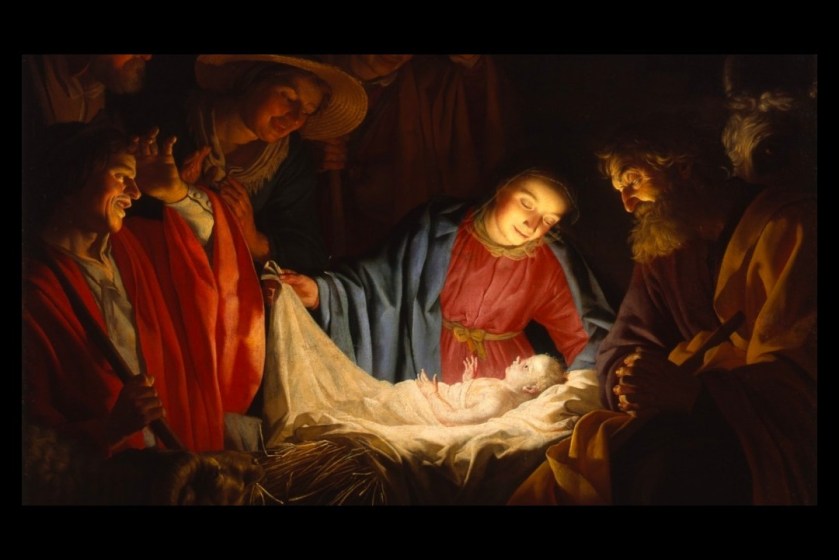
Image: Gerard van Honthorst, Adoration of the Shepherds, 1622, oil on canvas, Pomeranian State Museum.
 MORE TO COME...
Pingback: The year in books: 2025 | MORE TO COME...
Pingback: Pull up a chair and let’s talk | MORE TO COME...
Pingback: Readers choice: The best of the 2025 MTC newsletter | MORE TO COME...
Pingback: Observations from . . . December 2025 | MORE TO COME...
Pingback: From the bookshelf: December 2025 | MORE TO COME...