
A novel that speaks of dislocation, history, and the power of language.
One of the challenges of the modern age is the disenfranchisement felt by so many in the midst of great abundance and wealth. The inequalities around how money and power are distributed is certainly a part of our era. But there is an isolation resulting from the breakup of communities, the loss of language that once felt familiar, and the failure of spiritual guideposts that exacerbates our alienation. We may think our situation is unique but there is much from the past that can speak with honesty, yes, but also with hope for our present times.
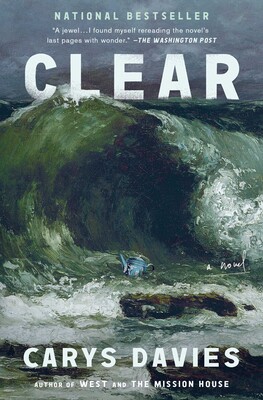
Clear (2024) by Carys Davies is a historical novel that brings a great deal of power, intelligence, and empathy into a few short pages. The story, told from three different perspectives, is set in the 19th century when two somewhat related and truly seismic events were shaking Scotland: the establishment of the Free Church of Scotland and the infamous Scottish Clearances. It is a time when around a third of the ministers in the Church of Scotland resigned because of a patronage system where landowners could nominate ministers of their choosing to congregations. That same era also saw whole communities of the rural poor driven off the land of those rich landowners in a relentless program of forced evictions, a time which gives the novel its name.
In this setting we meet John Ferguson, an impoverished Scottish Free Church minister who has accepted a job to help clear land for one of those landowners; John’s wife Mary who is apprehensive about her husband’s trip; and Ivar, the lone remaining occupant of an island north of Scotland. Shortly after his arrival on the island John falls down a cliff where he is found by Ivan, badly bruised and unconscious. A bond develops as the minister is nursed back to health by a man who has rarely interacted with another human for decades and who speaks in a local tongue that is rapidly disappearing. John works to learn Ivar’s language while Ivar begins to see himself through another’s eyes. All the while Mary’s misgivings about the trip turn to action and she sells much of what she has to book passage on a ship to find John and bring him home.
Davies tells this story in spare, beautiful prose. She says only what is necessary to bring the reader into this loving look at a vanished way of life, a magnificent but harsh landscape, and the building of human relationships against all odds. The different perspectives provided by John, Mary, and Ivar give us new and unexpected ways of looking at a story that is about finding life amidst loss.
The ending—which continues with the same sparse yet captivating style—is unexpected and will stay in the reader’s mind long after the last word is read. I found it profoundly moving, as each character makes an unexpected decision that shows how their encounters have affected them. There is a timeless quality to the ending, just as there is to the novel as a whole. The story is placed within a historical framework but there is much to consider about alienation, economic devastation, connection, empathy, and love that resonates in a contemporary context.
Davies has produced, in the end, a humane tale that is both unexpected and deeply satisfying.
More to come . . .
DJB
 MORE TO COME...
Hi David, this is Charity, sister of Sarah O’Connor. I have just read a book I think you would really enjoy – Lifelines by Julian Hoffman. Here is the Goodreads review – https://www.goodreads.com/en/book/show/220076972-lifelines – Some other reviews were too long or paywalled so this one sufficed. It takes place in northern Greece but the way he writes about his experiences and thoughts easily moves past Greece.
I really don’t know how you have time to read so many diverse books and write daily – but I love reading your musings when I can.
Thanks, Charity Moschopoulos
Thanks so much for this recommendation and kind note, Charity. We were just with Tom and Sarah for brunch on Sunday, so the Hardison family has been front of mind! “Lifelines” sounds wonderful and I’ve put it on my TBR list. Now that I’ve traveled a bit in that part of the world, I think I might understand Hoffman’s book more clearly.
I appreciate your reading and the comments. Have a great 2026.
DJB
Brilliant Reader Sara, a friend I’ve known longer than anyone who is not related to me, was the person who recommended Clear to me. She wrote the following after reading this review, and I wanted to capture it here so others can see how much she treasures this book.
“**Eloquently expressed.** This is one of the rare books that I care about keeping in my library no matter how many times I have to cull out for moving or just for extra room.”
DJB
Pingback: Observations from . . . January 2026 | MORE TO COME...
Pingback: From the bookshelf: January 2026 | MORE TO COME...