With the ending of Lent and the beginning of Eastertide I have found myself reading the works of several writers and considering their perspectives on life, death, darkness, light, resurrection, and love.
As winter turns to spring we are very much aware of both darkness and light. There are, of course, many types of darkness: the absence of light, chaos, evil, oppression, despair, perhaps even death. Mark Randall James, however, suggests that darkness “is never more than a beginning.” In the coming of spring, as in the biblical story, there is a direction, “a movement from evening to morning, darkness to light, seed to fruit, promise to fulfillment.”
To participate in a group discussion I recently reread a work on life and death, heaven and hell, light and darkness by perhaps the best-known Christian apologist of the twentieth century. It is one of a number of books by C.S. Lewis I first read forty or fifty years ago. Returning to read it now, with the perspective of time and experience, was a reminder that not every author we follow in our youth travels with us throughout life.
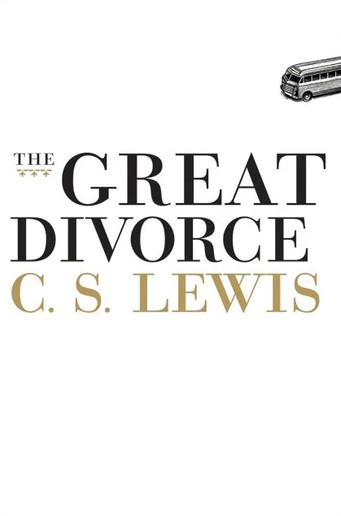
The Great Divorce (1945), by C.S. Lewis is at its base a Christian allegorical tale about a bus ride from hell to heaven. This is the book where Lewis first introduces the revolutionary idea (for some) that the gates of hell are locked from the inside. Amazingly, Lewis tells us, anyone who wants to stay in heaven can. “If we insist on keeping Hell (or even earth) we shall not see Heaven,” Lewis insists. Without getting too deep into questions of judgement, let me just say that I agree with his perspective. Returning to this work written more than 80 years ago, however, I found myself underwhelmed. The tale itself was not particularly compelling. From my perspective the book works somewhat better as a meditation upon good and evil, grace and judgment. But I should note that many online commentators have found the author’s descriptive powers and storytelling ability changed the way they think about good and evil and our ability to navigate this world.
My affinity for Lewis’s writings—with the exception of his Chronicles of Narnia fantasy novels—has lessened considerably over the decades. I have issues with some of these early works where Lewis famously gives up his atheism and writes, at least to my ear, with a certainty that is all too prevalent with recent converts.
Perhaps my lack of enthusiasm is not entirely the fault of Lewis.
Many conservative believers have laid claim to Lewis’s work and pushed them as a way of supporting their rigid theological framework. Their voices are loud and numerous, even though they gloss over significant differences between their religious worldviews with the Oxford professor. Lewis believed in biblical myth and he wrote about inspiration as opposed to inerrancy. Both beliefs, in the view of many conservatives, are wrong.
I believe in the continuation of life after death but have stopped focusing on what comes next in some great beyond. For me The Great Divorce was neither as compelling nor genuinely human as a Lewis book written in 1961 following the death of his wife, the American poet Helen Joy Davidman.
A Grief Observed is brief, poignant, and honest. Lewis works through the darkness that is the loss of love, meaning, and faith, and chronicles the efforts to regain his footing in this world. It is highly personal, so much so that author Madeleine L’Engle writes in a thoughtful foreword that Lewis’s writings on the topic helped her understand that each experience of grief is unique. Still, there is a universality to the book as well, as what Lewis describes feels so much like what so many went through in our recent pandemic period of mass death worldwide. A Grief Observed is focused on one man and woman and—at the same time—all men and women.
The earlier book is, of course, an allegory. But in A Grief Observed Lewis has no time for euphemisms and mushy thinking.
No one can say with certainty what happens after we pass (to use the old Southern phrase I like best) which is why I do not spend a great deal of time focusing on the afterlife as opposed to the one life I have to live right now. As for what comes next, L’Engle notes in her commentary on Lewis’s journal that “[t]he important thing is that we do not know. It is not in the realm of proof. It is in the realm of love.”
Other writers I follow have things to say about death, life, darkness, light, resurrection, and love . . . which seems important in challenging times. They don’t all agree, but they will make you think.
The Hope of Resurrection meditation by the Franciscan friar Richard Rohr arrived on Easter morning.
“What the resurrection reveals more than anything else is that love is stronger than death. Jesus walks the way of death with love, and what it becomes is not death but life. Surprise of surprises! It doesn’t fit any logical explanation. Yet this is the mystery: that nothing dies forever, and that all that has died will be reborn in love. ”
The Resurrection by the evangelical Frederick Buechner can be a bit “Presbyterian” for my tastes, but I do appreciate the way he points out the difference in the accounts, for instance, of the birth of Jesus and his resurrection.
“[W]e can say that the language in which the Gospels describe the Resurrection of Jesus is the language of poetry and that, as such, it is not to be taken literally but as pointing to a truth more profound than the literal. Very often, I think, this is the way that the Bible is written, and I would point to some of the stories about the birth of Jesus, for instance, as examples; but in the case of the Resurrection, this simply does not apply because there really is no story about the Resurrection in the New Testament. Except in the most fragmentary way, it is not described at all. There is no poetry about it. Instead, it is simply proclaimed as a fact.”
Easter Begins in the Dark by Episcopal priest Mark Randall James reminds us that God’s grace, since the beginning of time, has been there brooding over the darkness and the deep, preparing the way, planting seeds.
“Easter begins in the dark because it is the dawn of the new creation—and according to Genesis, creation itself begins in darkness. The light is not the first act of creation; the formless void, the chaos of the waters, also comes from God. That is why, there in the darkness, the Spirit of God was ‘hovering over the waters,’ or as some translate it, ‘brooding,’ like a mother hen (Genesis 1:2). There in the darkness of primordial chaos, God was already quietly at work, preparing to bring creation into the light.”
This excerpt is from Mark’s recent Easter Vigil sermon. I was immediately taken with his focus on the importance of darkness as he delivered it from the pulpit at St. Alban’s parish as Saturday night turned to Sunday morning. The entire piece is worth your time.
Threatened with Resurrection by the Quaker activist Parker Palmer also looks at darkness from a different perspective.
“By upending the conventional notion that death is the great threat and resurrection the great hope, Julia Esquivel opened my mind and heart to a hard truth: figurative forms of death-in-life can give us a perverse sense of comfort—while resurrection, the promise of new life, can feel threatening.”
Finally, I have returned to read some of the daily meditations of Madeleine L’Engle in her Glimpses of Grace. I am much more in tune these days with her way of looking at the world, with its different concept of time and her focus on wonder and love.
“L’Engle celebrates the Incarnation, the power of music, doubt as a doorway to truth, stargazing as a glimpse of God’s glory, stories as midwives to our wholeness, the interdependence of all living beings, and much more. Best of all, she affirms the virtues of imagination, intuition, and intelligence.”
Imagination, intuition, intelligence. All are gifts of creation to be used as we focus on the one life we have to live.
More to come . . .
DJB
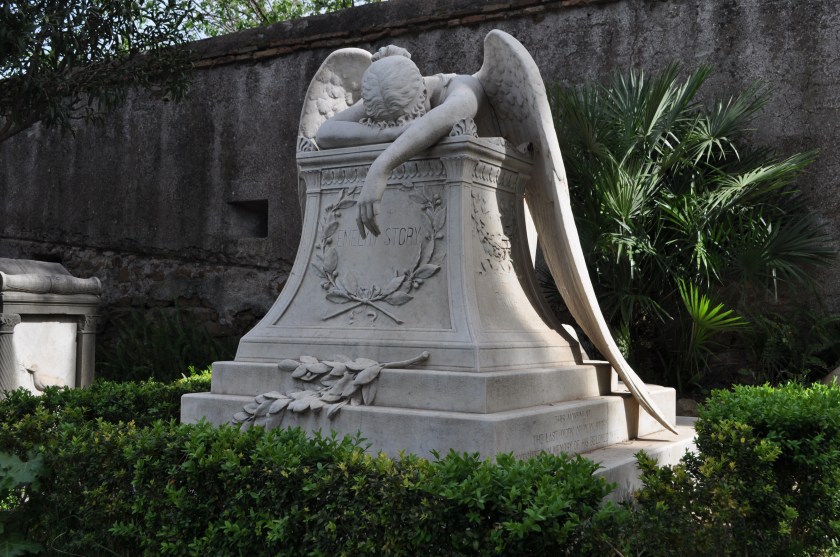
Angel of Grief by W.W. Story (photo from the Protestant Cemetery in Rome by DJB)
 MORE TO COME...