All posts filed under: Heritage Travel

Posts about travels to places around the globe that reflect our shared heritage

Oklahoma City National Memorial: The power of remembrance

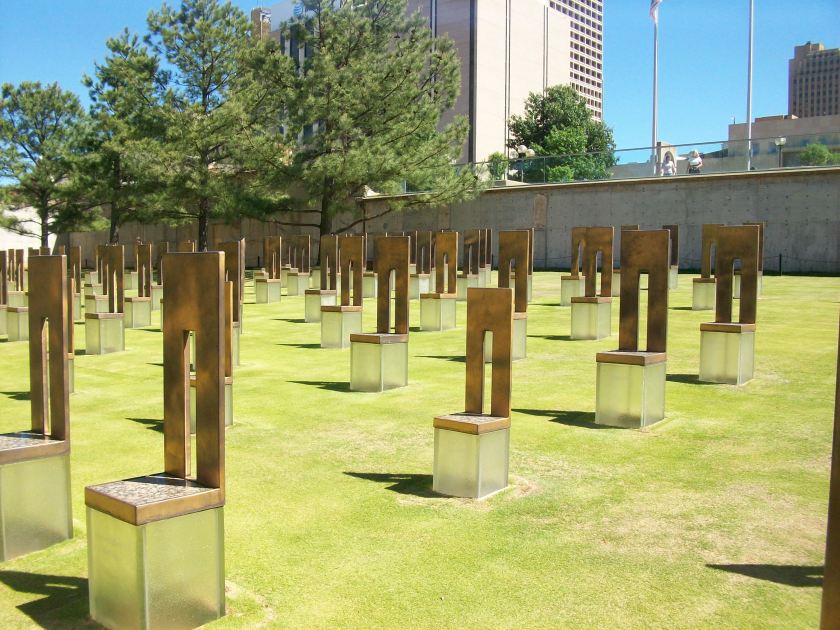
When in Oklahoma City last week, I made the time to visit the national memorial dedicated to the memory of those killed, wounded, or changed forever by the bombing of the Murrah Federal Building on April 19, 1995. It was a powerful experience that would  be moving at any time.  In these days of bombing attempts in Times Square and daily cable television rants against government, the power of remembrance seemed all the more important.  This place – forever altered in horrific ways 15 years ago by the act of an individual angry at the federal government’s actions at Waco and Ruby Ridge – is a somber counterpoint to the hysteria that counts as civic discourse in parts of America today. One enters the outdoor symbolic memorial through a gate marked 9:01 – the minute before the bombing – to represent the innocence of the city.  At the other end of a reflecting pool, the west gate is marked 9:03, after everything changed.  The best known feature of the memorial is the field of empty …

Dale Chihuly: Works in Seattle and Tacoma

Recent travels have taken me to both Seattle and Tacoma, Washington – described by writer Margery Aronson in the book Fire as “the new ‘Center of the Universe’ for the medium of glass, a shift in no small part due to (Dale) Chihuly’s decision to return to the Northwest to live, work, and continue his early commitment to education.” Glass artist Dale Chihuly has been back in his home region since 1971, making amazing sculpture, seaforms, chandeliers, towers, and more.  He’s been in my consciousness for about the past 12 years, as I’ve come across more and more of his work in my travels. So it was great to spend time recently in Chihuly’s  hometown of Tacoma and his current city of Seattle, viewing works both very public and more private. We began in Tacoma, where the 2002 Chihuly Bridge of Glass offers much for the eye.  As a welcoming gateway to downtown Tacoma, the Bridge of Glass has two rising crystal towers, a seaform ceiling that is beautiful in any light, and a Venetian …

The Intersection of Preservation and Sustainability

Portland, Oregon is a city with a well-deserved reputation for livability and sustainable development.   I visited Portland late last week and was reminded again of how much this community can teach other American cities about building an environmental consciousness and offering transportation options that decrease reliance on the automobile. In touring the city with friends and colleagues, I saw vibrant historic neighborhoods around an active downtown.  But I also learned of  preservation battles that ended with perfectly good buildings being demolished – even though preservation was the sustainable alternative.  Preservationists in Portland often feel left out of the discussions – and the decisions – on questions of livability.  It shouldn’t be that way. While in Portland, I joined two colleagues in a discussion with Mike Francis, editorial board member at The Oregonian. We talked about the intersection of preservation and sustainability, as well as preservation’s ability to prime the pump for economic development. In a piece entitled, To Be Sustainable, Use What You Have, Francis makes the case for preservation as a key to economic …

The beauty of the Dutch Antilles

Late last month I had the opportunity to visit two of the islands of the Dutch Antilles – Bonaire and Curacao – as part of a National Trust Gardens of the Caribbean tour.  (These are the B and C islands of the A-B-C Antilles.  We didn’t make it to Aruba.)  This was a new part of the world for me and it was a great experience. The scene was set with enlightening lectures prior to our arrival by long-time Trust lecturer Paddy Bowes and Williams College professor Michael Lewis, which prepared me for the very arid conditions on the islands (8 variety of cacti on Bonaire), and the Dutch city-planning and architectural influence.  You can see the latter in the photo at the top of the post of one of the most photographed streets in Willemstad. Our first stop in the Dutch Antilles was the island of Bonaire and the town of Kralendijk.  The landscape and wildlife are the stars here, with clear blue waters and pink flamingos. Our last day of the tour took …

VOA Highlights Preservation of Rosenwald Schools

Rosenwald Schools are unique in the American landscape.  Built in the early 20th century to educate African-Americans in the rural south, the 5,000+ schools quickly became  centers of community life as well as educational facilities during the difficult years of segregation. I wrote a blog post in October of 2008 after reading Mary Hoffschwelle’s insightful book on Rosenwald Schools.  Now Voice of America has featured the Rosenwald Schools story – along with information on the preservation efforts led by the National Trust for Historic Preservation with funding from the Lowe’s Charitable Foundation – in a new video on their web site.  Take a look below.  I think you’ll enjoy it. More to come… DJB

Rugby, Tennessee: Where my preservation career began

Today’s PreservationNation blog has a story and video about Historic Rugby, a 2009 National Preservation Honor Award winner of the National Trust for Historic Preservation.  The blog post brought back great memories. Rugby was established in the 1880s by the successful Victorian-era author Thomas Hughes as a Utopian community for the second sons of English gentry.  Due to the system of primogeniture, these men would inherit little or no property and had very limited career opportunities.  Hughes established this colony in the beautiful but hard-scrabble Cumberland Plateau area of Tennessee.  After some initial success, the colony fell on hard times, ultimately failed and was largely forgotten.  In the mid-1960s, residents of the area began to restore the remaining historic buildings and over the course of five decades have saved this wonderful place and turned it into a thriving community and a favorite spot for tourists. That’s the official story.  The reason it is important to me is because it is where I undertook my first hands-on preservation work, leading to a career that’s now in …

With Willie at ATT Park

Willie Mays and America’s oldest professional baseball park

Growing up, I was such a Willie Mays fan that my friends called me “Say Hey” in honor of the Say Hey Kid.  In those pre-Internet days it was tough to live in Tennessee and keep up with late-night baseball in San Francisco.  However, many was the summer morning I called the sports department of the Daily News Journal to ask for the previous evening’s scores off the wire.  This was serious business.  Many years and games later, I still believe Mays was the best, most complete ballplayer to play the game. So I was thrilled recently to see the new book Willie’s Boys:  The 1948 Birmingham Black Barons, the Last Negro League World Series, and the Making of a Baseball Legend by John Klima.  The title tells what’s in store.  This is a book about the difficult period when major league baseball was undergoing integration and Birmingham – that hotbed of both baseball and racial segregation – was at the center of the story.  In 1948, Mays was a 16-year-old rookie on the Black …

Miami Landmarks Past (and the More Recent Past)

I’m wrapping up a visit to Miami and Miami Beach for work (I know – I love my job) that ended with a spectacular tour of two landmarks of Miami’s past…and the more recent past. Recently the National Trust for Historic Preservation has listed three properties in Miami on the annual list of America’s 11 Most Endangered Historic Places.  We visited two of those sites yesterday and they gave first-hand evidence to the wide range of places that make up the American experience. First up was the 1963 Miami Marine Stadium.  Arriving by boat while listening to the architect – Cuban born Hilario Candela who at age 27 designed this aquatic marvel with its zigzag concourse floating over the stands – was an incredible experience.  It is threatened because the city sees the site as much more valuable for development, even though it doesn’t take a great deal of imagination to understand how this wonderful place could thrive again as a civic center for all South Florida.  Watch the video at the end of the …

Not So Fast, My Friend

The next time you hear someone say, “I understand preserving truly historic buildings, but I don’t think we should try and save this structure from the 1950s (or 60s, or 70s)” remind them that the Art Deco architecture of the 1920s and 30s use to be similarly dismissed. Reporting from the South Beach Art Deco Historic District in Miami Beach… More to come… DJB