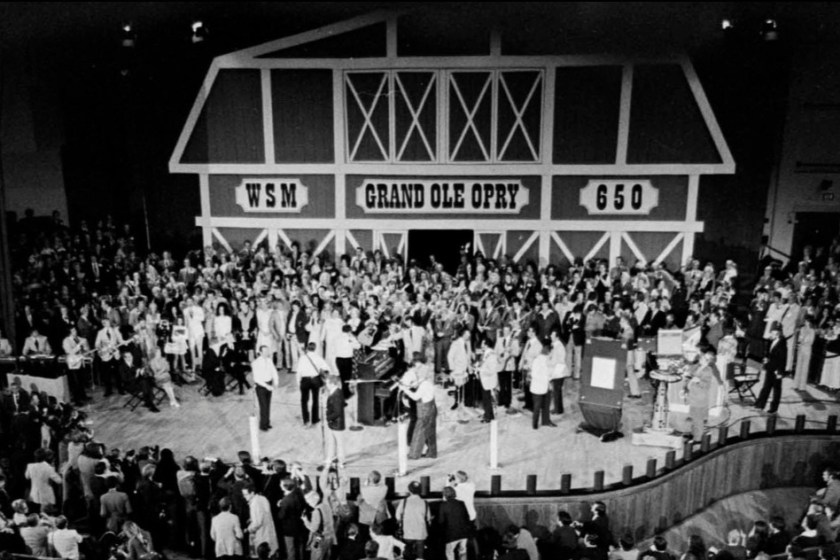
The Opry at 100
The Grand Ole Opry turns 100 years old this month.
The Grand Ole Opry turns 100 years old this month.

Sturgill Simpson is the hard-to-classify, but always intriguing singer and songwriter who sounds like Waylon Jennings or Merle Haggard (take your choice, as both were great singers); writes about topics not often heard on contemporary country radio; has outspoken progressive politics sure to rub many country music fans the wrong way; and who has a gift for surprise…as you’ll find at the end of this Saturday Soundtrack post. (Bluegrass fans who can’t wait should just jump there first!) A native of Kentucky, the son of a secretary and a Kentucky State Trooper, Simpson is the first male on his mother’s side of the family to not work in a strip mine or deep mine. Nonetheless, that blue collar, hard working sensibility comes through with every song he writes and every note he sings. He is a Navy veteran who speaks up in his songs and in interviews about the dangers of the military industrial complex. In a famous Facebook Live post outside the 2017 Country Music Association awards show, Simpson said, “Nobody needs a machine …
Even for a guy who gets to work with some amazing people and visit some of the country’s most wonderful historic places, yesterday was an extraordinary day. (And not just because I passed 10,000 visitors to More to Come…the DJB Blog – thank you readers.) Nope, the picture says it all. I was privileged to open the National Preservation Conference from the stage of the historic Ryman Auditorium. For a bluegrass loving preservationist to have a chance to speak from the place where Earl Scruggs came onstage some 60 years ago with Bill Monroe to play White House Blues and give birth to bluegrass music was an honor. To be able to tell 2,000 conference attendees why this place matters was a thrill. To be able to hear the bluegrass I’d chosen over the Ryman’s speakers for the 30 minutes before we kicked off the conference was just a rush. I knew it was going to be a great evening when the Laurie Lewis tune Who Will Watch the Home Place? – with its haunting …
Next week begins the summer Bluegrass Nights at the Ryman series at Nashville’s historic Ryman Auditorium. Known as the Mother Church of Country Music and the home of the Grand Ole Opry from 1943 through 1974, the Ryman bills this series with the line, “Experience the best in bluegrass on the very stage where bluegrass was born over 60 years ago.” That would be the evening where Earl Scruggs stepped on stage with Bill Monroe. Here’s how Richard D. Smith describes that night in Can’t You Hear Me Callin’: The Life of Bill Monroe: For Earl’s first night on the Opry, Monroe picked out a fast number that would show off the newcomer’s dazzling style – “White House Blues,” an old song recounting the 1901 William McKinley assassination. It was a perfect selection. Scruggs stepped up to the microphone with apprehension, knowing that nothing like this had been heard to date on the Opry or even over WSM radio. Use to the banjo as a country comedian’s prop, or hearing it picked or strummed in …
Today I took some time off to serve as a timer at the swim meet for Andrew’s school. I do this every now and then to make sure I connect with that part of Andrew’s life during the school year, and because every parent needs to volunteer to make these meets work. It was great fun and Andrew dropped time in all his races. I even got to time him in the 500, when he beat his personal best. What fun. But this post isn’t about swim meets and getting your pants wet (which I did . Those high school boys come in hard for the touch at the end.) Nope, this post is about why I love the Shuffle feature on the iPod. I have about 3,500 songs or so on my iPod. About 2,400 of them are in one playlist that I call “Americana.” That’s where I dump in all my albums and iTunes purchases that have anything to do with bluegrass, acoustic music, country rock, Americana, blues, you name it. I can go …
When I was a young undergraduate student at Middle Tennessee in the late 1970s, there were two English professors who influenced my life in ways that I’m still only understanding. One was Ralph Hyde, who was serving as editor of the Tennessee Folklore Society Bulletin. Ralph published the first articles of mine in a professional journal or magazine, introduced me to the rich cultural traditions of the mid-South, and gave me my first bottle of moonshine. I still think all three are significant in shaping my life (although that’s the first and only time I drank moonshine!) The other was Charles Wolfe, who taught English, succeeded Ralph as the editor of the TFS Bulletin, and – most importantly – brought scholarship and love to old time and bluegrass music. Charles was an avid collector, writer, and recorder of music from the mid-South, and I was lucky enough to be with him on occasions when he was recording or interviewing some of the area’s old-time musicians. Just the other day my father sent me a note saying that Charles – who …
 MORE TO COME...