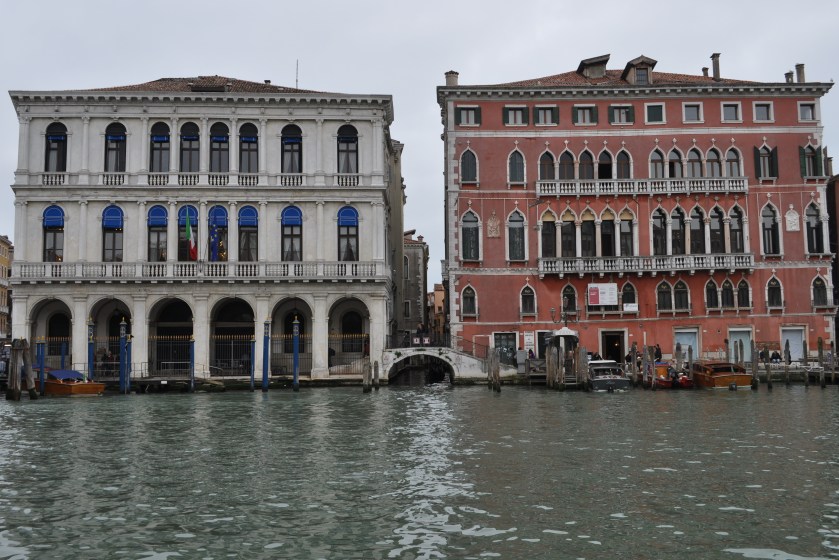
When the first sentence of a crime novel begins “The body floated face down in the murky water of the canal,” there’s a very good chance you are being transported to Venice. Long-time fans of the genre could also tell you instantly that you have picked up a book by one of the masters of the mystery novel and are about to be introduced to Commissario Guido Brunetti. Both assumptions would be correct.

Death in a Strange Country (1993) by Donna Leon is the second in what has become a 32-book series featuring the Venetian detective Guido Brunetti. In her first novel, Death at La Fenice, Leon describes Brunetti as “a surprisingly neat man, tie carefully knotted, hair shorter than was the fashion; even his ears lay close to his head, as if reluctant to call attention to themselves. His clothing marked him as Italian. The cadence of his speech announced he was Venetian. His eyes were all policeman.”
Brunetti is called down to the canal much-too-early in the morning to take over the investigation of the death of the young victim, an American serviceman who at first glance appears to have met an unfortunate end after a mugging. However, several things don’t appear right — from the angle of the knife blade that killed him to the frightened reaction of his superior officer, a young American doctor sent to identify the body, to something found in his apartment that leads Brunetti to believe that someone is working hard to make this death-from-mugging seem all-too-convenient.
In a fast-moving and briskly written story, Leon — who was born in New Jersey, lived for 30 years in Venice, and now resides in Switzerland — takes the reader into the seamier side of the beautiful city. Along the way we meet the cast of characters who make up Brunetti’s life: his vain and pompous superior, Giuseppe Patta; his fellow policeman, the detective sergeant Lorenzo Vianello; the medical examiner Ettore Rizzardi who often works out of the morgue on the city’s cemetery island; Paola Falier, Brunetti’s wife and a university lecturer in English Literature who is a delightful and loving foil for her husband; Paola’s father and Brunetti’s father-in-law, the wealthy and connected Orazio Falier; and his children Raffaele and Chiara. Leon once said that she wrote Brunetti’s character so that she would like him, and the reader quickly comes to the same conclusion.
The emotional and frightened response of the young American doctor sent to identify the victim, Captain Terry Peters, is among the first signs that Brunetti sees that something could be amiss. She is — like Sergeant Mike Foster, the victim — young, attractive, and oh-so-American. We learn later that they were also lovers, one of many secrets that Brunetti uncovers as he works his way through Venice and to the nearby American military base in Vicenza. The tale becomes darker as he uncovers evidence of U.S. military base collusion with Italian and international business interests in the disposal of toxic waste. As one gets closer to the end, we fear that Brunetti’s great detective work will come to naught when faced with the might of the military-industrial complex. However, a distraught and vengeful Sicilian mother provides some small sense of justice in this world of deceit and destruction of things beautiful and meaningful.
Leon writes about Venice with love and affection, while recognizing the city’s issues. She is less understanding with the Italian government’s corruption. And she is unsparing in her take on the U.S. military, its contractors, and Americans in general. When Brunetti first visits the base, he is fascinated to learn that it has a supermarket, bowling alley, cinema, and “even a Burger King.” His host laughs at the policeman’s surprise as he says, “It’s remarkable, isn’t it? There’s a whole little world here, one that has nothing to do with Italy. Out there lies America,” he gestures out the window. “It’s what we’re all going to become, I think.”
To Leon, and so many others, this is a sad outcome of the American century. Paola and Brunetti are discussing his visit to the base and she asks him if everyone still smiles all the time. I wonder why that is, he muses. And Paola sets him straight.
Why shouldn’t they smile, Guido? Think about it. They’re the richest people in the world. Everyone has to defer to them in politics, and they have convinced themselves, somehow, that everything they have ever done in their very brief history has been done for no purpose other than to further the general good of mankind. Why shouldn’t they smile?
Well, the 2016 election sure ended that myth.
A long-time friend gave this book to me when he heard I was becoming familiar with mystery novels. Donna Leon, he suggested, was someone I needed to know, and he was right. Death in a Strange Country was a very satisfying work, and simply whets the appetite for some more of that great Italian architecture — damp and crumbling as it is — as well as a glass of wine and a cup of espresso.
More to come…
DJB
To see reviews of the other books in my year of reading mystery novels, click here for January, February, March, April, May, and June.
The Weekly Reader links to written works I’ve enjoyed. I hope you find something that makes you laugh, think, or cry.
Photo on the Grand Canal by DJB
 MORE TO COME...
David, was a treat.. we’ve read virtually all the Brunetti series and love what you’ve observed here! Best, Alice & Chris
Dear Alice & Chris – So glad to hear from you, and to know that you are both big fans of the Brunetti series. I’m not surprised. As you can tell, I’m having a great time coming to this genre later in life. Glad to know that I captured the story well with the Leon. Take care, and hope your summer is going well. DJB
Pingback: Observations from . . . July 2023 | MORE TO COME...
Pingback: The books I read in July 2023 | MORE TO COME...
Pingback: Late to the party | MORE TO COME...
Pingback: A classic of detective fiction turns 100 | MORE TO COME...
Pingback: The girl with the troubled eyes | MORE TO COME...
Pingback: The 2023 year-end reading list | MORE TO COME...
Pingback: Just rewards | MORE TO COME...
Pingback: Truth can be elusive | MORE TO COME...
Pingback: Librarian on the run | MORE TO COME...