
We all choose our myths. Some can be illuminating and positive; others are powerfully destructive. Many have elements of both mixed-up together.
Myths help us chart our way through life and make sense of what is essentially mystery. We latch onto myths in our origin stories, in our memories of family, in our national narratives, in our deepest spiritual beliefs.
This is a story about myth that involves brown water. Perhaps over ice. Sometimes with a twist.
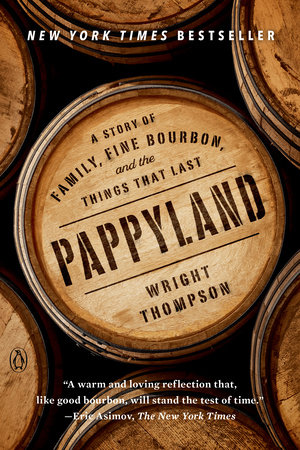
Pappyland: A Story of Family, Fine Bourbon, and the Things That Last (2020) by Wright Thompson is, on the face of it, the story of how Julian Van Winkle III saved the bourbon business his grandfather had founded on the mission statement: “We make fine bourbon — at a profit if we can, at a loss if we must, but always fine bourbon.” That grandfather was the now famous Pappy Van Winkle. In tracing the story of a grandson’s determination to resurrect his grandfather’s dream, Thompson has written a beautiful and warm reflection that goes well beyond the basic story, blending together “biography, autobiography, philosophy, Kentucky history, the story of bourbon’s origins and an insider’s look at how the Van Winkle whiskey is made and marketed.”
This bourbon-loving historian and son of the South savored every sip.
In 1935, just after the lifting of prohibition, Julian P. “Pappy” Van Winkle, Sr. used wheat instead of rye as the dominant secondary grain in his mash bill to create a bourbon named “Old Fitzgerald” at the Stitzel-Weller distillery near Louisville. By all accounts it measured up to that mission statement. Rye had come from Pennsylvania and was the “traditional” grain used alongside corn and barley in the making of bourbon. But Kentucky grew wheat, which also happens to survive extended aging better than rye. It was part of Pappy’s genius that he turned to wheat — which gave Old Fitzgerald a memorably softer and smoother taste — and made “bourbon truly of Kentucky.”
Pappy’s son, Julian, Jr., continued to operate the distillery until he was forced by stockholders to sell in 1972. Julian, Jr. resurrected the one pre-prohibition label to which the Van Winkles kept the rights, called “Old Rip Van Winkle”, and began making his own brand. When his father passed away in 1981, Julian III took over the business, determined to bring back the family bourbon and the taste he came to love as a young man.
In his do-or-die determination to save the family namesake, Julian III discovered that hundreds of barrels from the family distillery had survived their sale to a multinational conglomerate. He bought those up and began making what was soon hailed as the greatest bourbon in the world. It would also soon be the hardest to find. As those stocks dwindled, Van Winkle worked on a joint venture with Buffalo Trace distillery to create a new brand that carries the tradition of “always good bourbon” forward into the future.
Thompson — a Mississippi native and a lover of good bourbon — takes us for this ride. Along the way he talks with Julian III about craft, family, history and the myths around bourbon distilleries and brands. Many of the famous brands, writes Thompson, “like Elijah Craig and Evan Williams, were created by Jewish distillers who presumed that their customers didn’t want to open a bottle of Rosenstein Straight Bourbon Whiskey.” Bourbon is sold by today’s marketers based on nostalgia and with a longing for a time that is past. It is all BS, of course, and yet we buy it. Thompson understands the power of mythology in a day when “most distilleries are run by accountants” and when he can write, “Perhaps no word sums up the death of truth in America better than the word brand.”
A bottle of bourbon is a coded way for so many unspoken ideas to be transmitted and understood. In many ways, the most important ingredient in bourbon is added by the drinker once the bottle is purchased, which is why whiskey companies know how to tell one story and stick to it.
In the final third of the book, Thompson begins to share his own story about family. First there is the father-son relationship and how to span a generational divide. Julian, Jr. was a tank captain in WWII and was hard on his son. For the first time in print Thompson admits that his own father drank too much. Thompson and his wife have finally conceived after years of futility, and the Van Winkle family story has him thinking about the connections in life and what’s important.
He is working to sort out adulthood and calls upon an Updike quote: “Myth is both the deliverance and the curse. We tell ourselves a story to survive and then that story consumes us, destroys us. The mask eats the face.” He reads and quotes Thomas Merton, not too far from his home monastery: Abbey of Gethsemani. He thinks about being Southern and how there’s a responsibility to “shake off the comforting blanket of myth and see ourselves clearly . . . (with) our long history of trying to do the right thing while benefiting mightily from the wrong thing.”
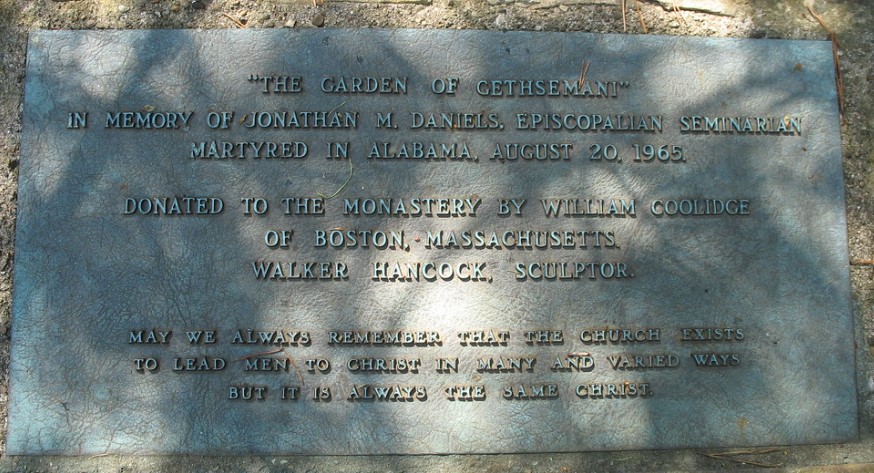
And he takes us to statues of the Garden of Gethsemani, located in a rural Kentucky field and dedicated to Jonathan Daniels, the young Episcopal priest killed during the civil rights era by a shotgun blast intended for a young African American woman, Ruby Sales. Thompson finds that the killer’s son is now a Trump supporter, making no attempt to erase the stain of sin but replacing fact with myth. The author wants his young daughter to know this story and more.
Two related themes emerge over and over again in Pappyland: the power and the fragility of memory. “Bourbon embodies both.”
Vodka is for the skinny and scotch is for the strivers and bourbon is for the homesick.
Since all truth is paradox, let’s lift a glass to myth, memory, and the unending desire to see things clearly for what they really are.
More to come …
DJB
Photo by Thomas Park on Unsplash
 MORE TO COME...
Thanks for sharing this. Getting this book for Merrick who is a bourbon aficionado 🙂
Thanks for sharing this. I think I will get this book for Merrick. He loves bourbon – I can’t stand the stuff 🙂 Sounds like an interesting read, and like the rest of the family he is a big reader (when he has time).
I saw his show at the Arena (Cambodian Rock Band). Was really fun, and any director or cast member I run into says he is the best at stage managing 🙂
Interesting that in today’s NYT Cambodia was in the paper with a new ruler.
Let’s grab coffee soon again. I need to hear about AK.
Margit
Margit Bessenyey Williams, PhD
>
Great to hear all of this, Margit. I wasn’t aware of the show, but I am now! Sounds like he’s doing great work.
Understand about the bourbon. It is an acquired taste.
Yes, let’s get together soon. We don’t have to do it just on a Sunday. I’ll email you with some options.
Take care,
DJB
Pingback: Observations from . . . August 2023 | MORE TO COME...
Pingback: The books I read in August 2023 | MORE TO COME...
Pingback: The 2023 year-end reading list | MORE TO COME...