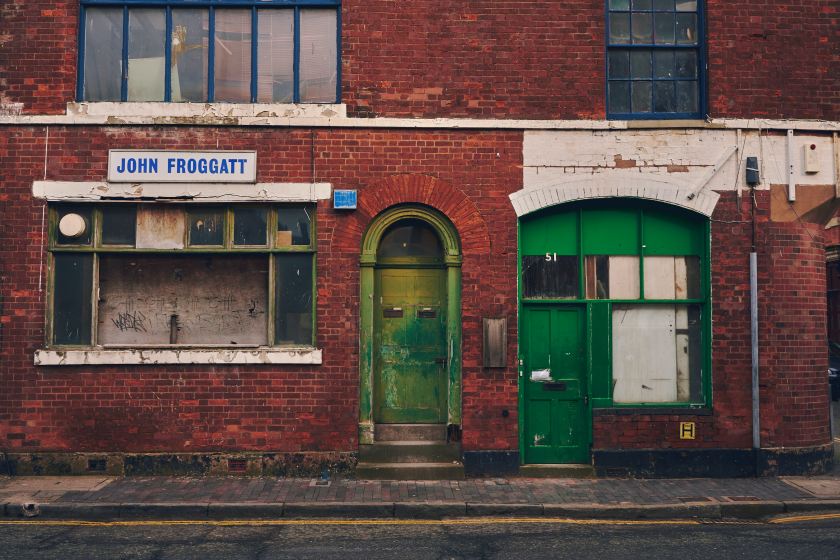
What happens . . . when we throw out thousands of years of knowledge about how cities function? When local governments become addicted to growth? When our cities obsess over out-of-towners? When we lower standards?
When that happens, we have big problems.

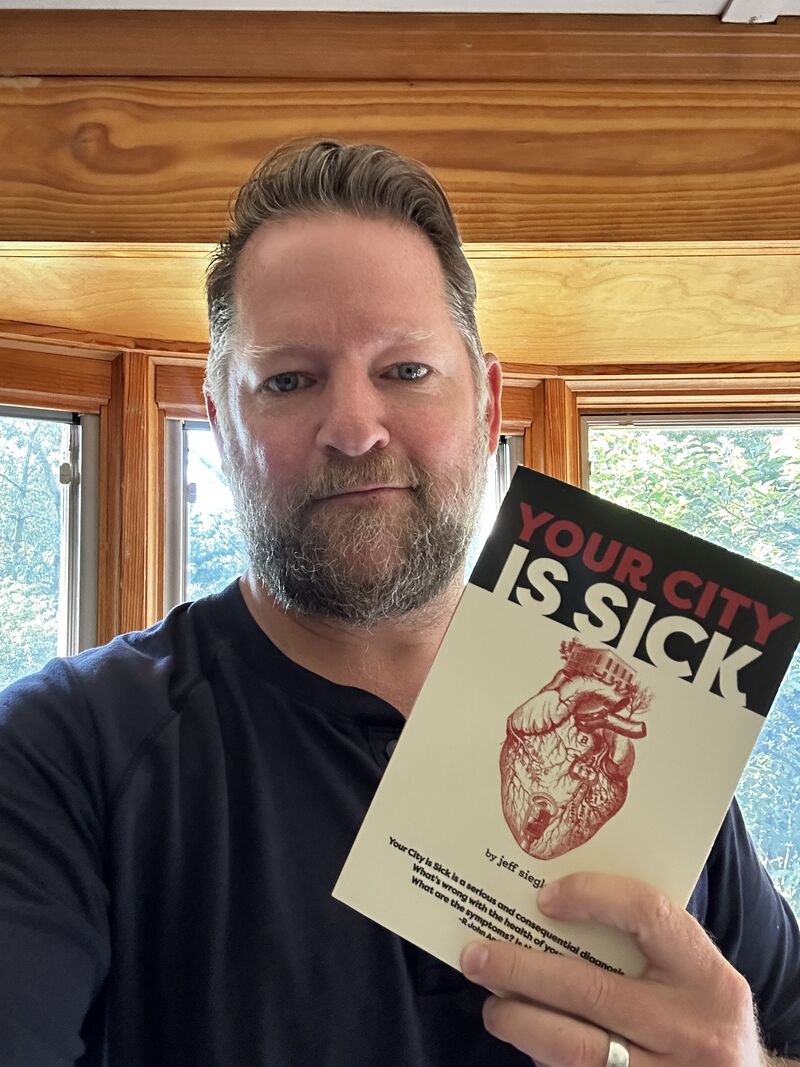
Your City is Sick (2023) by Jeff Siegler is a deep dive into how the various causes of community malaise — poor planning decisions, neglect, disregard for current residents, and more — have led to the dysfunction we see today. Cities are like people, Siegler argues, and when humans forget all we’ve learned about health care, skip the vegetables that sustain us, eat a diet of attractive desserts, and stop exercising we get sick. Cities face the same challenges.
Like a blunt yet perceptive doctor, Siegler first helps us understand the disease. Then in straightforward, no-holds-barred language he prescribes treatments to push his readers to transform their cities through relentless, incremental improvements. Jeff, a long-time friend and colleague, recently chatted with me about his hard-hitting yet essential new work.
DJB: Jeff, you write that we are all in a civic relationship, whether we know it or not. What does that mean, and why is it important for the average citizen?
JS: The civic relationship is the one we pay so little attention to, yet it is always shaping us and affecting us. Those in great cities or neighborhoods they love are well aware of this relationship. They experience the streets, businesses, and buildings making their lives better on a daily basis. They get a sense of identity and pride from the decisions their civic leaders make and how their collective community behaves. Their life is enhanced by the place they call home. I think about the fact that ancient Romans were fiercely loyal to their neighborhoods and would insist they were listed on their graves. This is the type of allegiance a community should foster! Ideally, the communities we call home should lift us up and make us feel better about ourselves, but sadly, so many people have a relationship with their city or town that, at best, doesn’t provide them with anything, at worst, actually makes their lives much harder.
You suggest that most Chambers of Commerce and Tourism Bureaus have lost their reason for existing. Why . . . and what should take their place?
I have worked with so many incredible people in the tourism and chamber industries, and I sympathize with their struggles. These organizations were created during a time when communities needed their services, but times have changed and the nature of the local economy is completely different today. These industries did not adjust and they are struggling to remain relevant. Successful organizations have to periodically look at their mission and ask themselves if they are as effective as they could be. Chambers would be better served to focus on entrepreneurship and real estate development to retain local wealth. I would love to see the same energy and attention the tourism bureau extends toward visitors being directed to residents and making sure they feel like they matter to the community.
What is civic health and how will that help heal our sick communities?
Being a member of a community used to play a much larger role in people’s lives and we are seeing how this shift from connectedness to isolation is having devastating social impacts. For 70 years we have been building human habitats that aren’t fit for humans. A sick city is going to have sick residents and our places are making people physically, socially, mentally, and fiscally unwell. A healthy city will foster dignity, pride, connectedness, joy, companionship, and physical activity just to name a few. The concept of civic health is pretty simple, cities should be designed and managed with residents’ health and well-being as the primary concern. When this occurs, communities will heal, and as communities heal, so will the people that inhabit them.
What is Silverbulletitis? How do you spot it? What measures are necessary to cure that disease?
Silverbulletitis is the ever-pervasive belief that all community ailments can be solved with one big-ticket project. You can easily spot it when you visit a community with a downtown mostly comprised of empty surface lots with a smattering of crusty mega-projects, like the parking deck, the arena, the civic center, and so on. Someone in these communities keeps buying the same old failed magic revitalization pill. Community improvement, just like self-improvement doesn’t work like that. There are no shortcuts to getting better. There are no secrets to success. The fact of the matter is, community revitalization is a long, slow process that consists of a million small improvements, and these add up over time to something amazing. We have to give up on the idea that someone from somewhere else has a solution, or that something that took 50 years to break can be repaired in one year. The cure is in empowering locals, rebuilding the same way the community was built the first time, trusting residents to rise to the occasion when given the opportunity, and understanding that a community already has every single thing it needs to be successful.
Jeff, what books on cities can you recommend for our readers?
The one that really opened my eyes was Happy City by Charles Montgomery. This book first introduced me to the idea of how the design of our infrastructure is constantly shaping our lives. I think of it this way: we intentionally design different rooms in our houses for different purposes because we understand the experience we want them to foster. A city is no different, we must be intentional in how we design the space between the homes and the buildings to foster the type of feelings and behavior we want residents to experience. Diving deeper into this concept has led me more recently to read Cognitive Architecture by Ann Sussman and Justin Hollander as well as Welcome to Your World by Sarah Williams Goldhagen. Once you realize how the design of your city is shaping your life, it becomes impossible to unsee, but it’s not a choice to take lightly.
Thank you, Jeff.
Thanks for asking me to be a part of this David.
More to come . . .
DJB
Photo from Unsplash
 MORE TO COME...
Pingback: Observations from . . . October 2023 | MORE TO COME...
Pingback: From the bookshelf: October 2023 | MORE TO COME...
Pingback: Talking with writers | MORE TO COME...
Pingback: The 2023 year-end reading list | MORE TO COME...
Pingback: Pull up a chair and let’s talk | MORE TO COME...