
Each morning I join billions of people around the world in reaching for my favorite drug. Coffee is an indispensable part of daily life. But few of us know much about its history, much less the impacts on workers and countries that are part of that past and that are still reflected in life today.
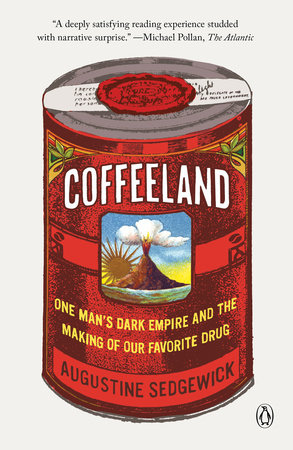
Coffeeland: One Man’s Dark Empire and the Making of Our Favorite Drug (2020) by Augustine Sedgewick is a compelling look at the volcanic highlands of El Salvador and the story of James Hill. In 1889, the 18-year-old Hill disembarked in El Salvador to sell textiles from Manchester, England. He wound up “bringing the industrial mentality of his native city to coffee cultivation in his adopted country,” in the process turning El Salvador into perhaps the most “intensive monoculture in modern history — a place of extraordinary productivity, inequality, and violence.”
Sedgewick is a Harvard-trained historian teaching at City University in New York whose research is focused on the global history of food, work, and capitalism. As Lisbeth Cohen wrote in a New York Times review, instead of taking the traditional approach of historians and looking at coffee as a commodity, Sedgewick focuses on stories to weave a vibrant fabric that displays the impact of this particular food on real people.
His approach helps the reader consider “the actual choices made by the producers and importers and advertisers who merchandised the goods, the economic and political alliances they forged in the process and the often harsh local consequences of their actions.”
It makes for a sweeping and fascinating tale.
Sedgewick begins four hundred years ago, when coffee was a mysterious Ottoman custom and “the perfect symbol of Islam.” Now, he suggests, “coffee” is perhaps the most widespread word on the planet. He traces the route through tightly controlled markets in the Middle East to a luxury drink for Europe’s privileged classes, to its position as an unrivaled work drug. San Francisco becomes a key point of entry and marketing innovation hub for coffee from Central America while “rations to soldiers during World War II and the invention of the postwar ‘coffee break’ helped feed America’s growing habit.”
Throughout the book Sedgewick returns to Hill, his children and grandchildren, and their growth into one of the “Fourteen Families” who controlled El Salvador’s export coffee industry. Over 100 years they consume land and acquire power, leading to the loss of agricultural options for the country’s working class. As they do so, they demand more political control of the military dictatorship to protect their businesses. In 1979, on the eve of full-scale revolution in El Salvador, James Hill’s grandson Jaime Hill was “kidnapped by rebels for a ransom they hoped would help finance a revolt against wealthy planters like the Hills, who had economically and politically dominated the country for decades.”
El Salvador now has a tenuous democratic government and is no longer the monolithic coffee country it was in the 20th century. Yet the story still resonates. Sedgewick’s work — a very satisfying brew — helps the reader reconsider “what it means to be connected to faraway people and places.” In doing so, “Coffeeland tells the hidden and surprising story of one of the most valuable commodities in the history of global capitalism.”
To demonstrate the pervasiveness of coffee in our culture, I typed “songs about coffee” into the search engine. Google came up with 205 million options. A couple of fun listings among the group were 21 Songs About Coffee (Caffeinated Tracks List) and — for the more punk-inclined — Coffee Songs: The Definitive All-Time Greatest Ultimate List. From those two alone I pulled up five of my favorites. Grab a cup of fair-trade Java and have a listen.
9 To 5 by Dolly Parton
We don’t really do royalty in America, or sainthood for that matter. But the closest living example in American public life today is Dolly Parton . . . it’s not a surprise that she would be responsible for crafting the Mt. Olympus of coffee as a metaphor. It appears on the global smash hit single “9 To 5”, from the soundtrack to the 1980 film of the same name, in which Parton also stars, and it begins with the untoppable couplet . . . “Tumble outta bed and I stumble to the kitchen / Pour myself a cup of ambition”
Cup of Coffee by Johnny Cash
This tune was written by Ramblin’ Jack Elliott, and he puts in an appearance here to yodel. While the lyrics are about a truck driver protesting that he doesn’t want anything stronger than coffee because he has to get back on the road, Cash sounds like he’s drunk, or perhaps smoking something. This was made during Cash’s rowdy days before he sobered up, and it shows.
One More Cup of Coffee by Bob Dylan
Bob Dylan’s One More Cup of Coffee has two former lovers saying farewell for the last time.
On its surface, it seems like a simple breakup track, but the lyrics interweave fantastical imagery of a royal father and a sister who can predict the future.
He has said that the song was inspired by his experiences of celebrations with the Roma people in France in the 1970s. Country star Emmylou Harris provided the track’s sweet backup vocals.
Black Coffee by Ella Fitzgerald
A classic blues song composed in the 1940s, Black Coffee describes a woman waiting for her lover to come back.
I walk the floor and watch the door / And in between I drink black coffee / Love’s a hand-me-down brew
Also check out Peggy Lee’s 1953 version of Black Coffee. It’s smoking!
And now for something completely different: Coffee Mug by The Descendents
Of all the songs about coffee, this 1996 track from The Descendents certainly leaves an impression — and all in less than 30 seconds. The track is a rapid-fire ode to coffee, perhaps emulating the caffeine jolt it provides.
This last one isn’t really my cup of coffee (or tea), but if I’ve missed your favorite song about coffee, please share that in the comments.
More to come . . .
DJB
Photo by Mike Kenneally on Unsplash
 MORE TO COME...
Pingback: Observations from . . . January 2024 | MORE TO COME...
Pingback: From the bookshelf: January 2024 | MORE TO COME...
Pingback: The 2024 year-end reading list | MORE TO COME...
Pingback: It’s the grounding, not the grind | MORE TO COME...