
Two days after suggesting it is time to roll up our sleeves and get to work, I’m now going to advocate for rest, reflection, and retreat. The contradiction between these two ideas is simply part of the truth of life. Work without occasionally stepping back for renewal leads to burnout and, perhaps, even an early emotional if not physical death.
These months of winter are a good time to step back. They are also a metaphor for the idea of retreat. Winter, you see, “is not the death of the life cycle, but its crucible.”
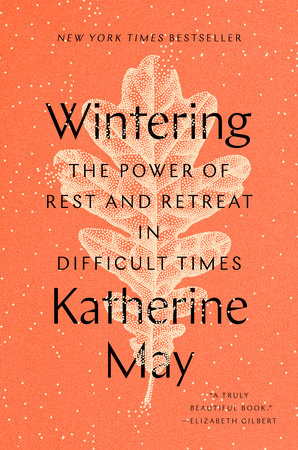
Wintering: The Power of Rest and Retreat in Difficult Times (2020) by Katherine May makes the case that the cycles of life seen in nature are the touchstones to how we should live as humans. Wintering, in this thoughtful memoir of a mindful year, is “a fallow period in life when you are cut off from the world, feeling rejected.” It’s also inevitable. Katherine May shows us how “an occasional sharp wintering” can help us heal and grow. We “must learn to invite the winter in.”
While we may never choose to winter, “we can choose how.”
May suggests that she learned about wintering early in life, as a young child with undiagnosed autism. She was “permanently out in the cold.” But it was a year in her early 40s that is the focus of this story. Her husband fell ill, her son stopped attending school, and her own medical issues led her to leave a demanding job. She was forced to winter. And as she notes, “when you start tuning into winter, you realize that we live through a thousand winters in our lives — some big, some small.”
So many of us have bought into the linear view of history and we then apply it more broadly to time and our lives. How often have you heard that young lovers are in the springtime of life and that those who are in in their 70s or 80s are living out the autumn or wintertime of their years? Yet time is not the rushed, linear path that most of us see as Americans. We think time is money, a precious and scarce commodity. For so many of us, the past is over, but the present you can seize, parcel and package and make it work for you in the immediate future. Americans talk about wasting, spending, budgeting and saving time.
But that’s not how nature works, and it isn’t how many non-Western cultures think. There people don’t attempt to control time. “Time is viewed neither as linear nor event–relationship related, but as cyclical. Each day the sun rises and sets, the seasons follow one another, the heavenly bodies revolve around us, people grow old and die, but their children reconstitute the process. Cyclical time is not a scarce commodity. There seems always to be an unlimited supply of it just around the next bend.”
When God made time, as they say in the East, she made plenty of it.
Life is full and messy. It is the fortunate ones who engage with life and grow at every stage and cycle along the way, realizing the incredible amount we learn “between our birthday and our last day” as Ursula K. Le Guin phrased it, while maintaining the seeking, trusting capacity for learning and loving that we had as a two-year-old.
When the low periods inevitably come, May suggests we stop and take time for wintering. Even if we are extraordinarily lucky in terms of health and career, we can’t avoid the winter.
Our parents would age and die; our friends would undertake minor acts of betrayal; the machinations of the world would eventually weigh against us. Somewhere along the line, we would screw up. Winter would quietly roll in.
But in wintering we learn “there is a past, a present, and a future. There is a time after the aftermath.” If we are honest with ourselves, we see that the “energies of spring arrive again and again, nurtured by the deep retreat of winter.” Life, like nature, is full of “seasons when we flourish and seasons when the leaves fall from us, revealing our bare bones. Given time, they grow again.”
It is what we do during those times when the leaves fall that helps rebuild our energies and our lives. Yes, as we age we may not have our youthful robustness, but wintering properly can help us see that we need to be “more careful with our energies and to rest a while until spring.” And I am aware that the ability to take time for rest and reflection comes from a place of privilege. But I do feel that all of us, no matter our circumstances, can find personally meaningful and important ways of wintering.
I have been moving through one of those small winters in my life, which came after a medical report prompted both a reflection and a resetting. And I’m finding that’s not only okay, but that its surprisingly freeing.
Over and over again we find that winter offers us liminal spaces to inhabit. Yet still we refuse them. The work of the cold season is to learn to welcome them.
Perhaps this time of winter in our calendars can also be a call to listen to the needs for wintering in our soul. Katherine May’s lovely book tells us that we’ll “find wisdom” in our winter. Once it’s over, it’s our responsibility to pass it on.
Each cycle is an opportunity to grow. Winter is that opportunity to reflect on what we’ve learned and apply it to our next season when the leaves reappear. It is the wise among us who acknowledge and embrace the necessity of winter.
More to come . . .
DJB
Photo by Adam Chang on Unsplash
 MORE TO COME...
Pingback: Observations from . . . January 2024 | MORE TO COME...
Pingback: From the bookshelf: January 2024 | MORE TO COME...
Pingback: What hallows a space | MORE TO COME...
Pingback: The 2024 year-end reading list | MORE TO COME...
Pingback: Rules for the road of life | MORE TO COME...
Pingback: The crucible of the life cycle | MORE TO COME...