
Jesus was pretty clear when a lawyer tried to test him.
“‘Teacher, which commandment in the law is the greatest?’ He said to him, ‘You shall love the Lord your God with all your heart, and with all your soul, and with all your mind. This is the greatest and first commandment. And a second is like it: You shall love your neighbor as yourself. On these two commandments hang all the law and the prophets.’” (Matthew 22:36-40 NRSV)
Even for those outside a faith tradition, the second part resonates strongly. However, if you were raised in the Christian church, this is a piece of scripture you hear early and often. A well-known monastic suggests there’s a reason:
“This is not merely a helpful suggestion, it is the fundamental law of human existence.”
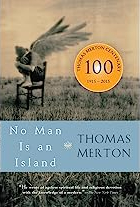
No Man is an Island (1955) by Thomas Merton reflects on the vital nature of community and the commandment to love our neighbor. In a series of sixteen essays with titles such as “Love Can Be Kept Only by Being Given Away,” “Sentences on Hope,” “Mercy,” and “The Inward Solitude,” the twentieth century American monastic and writer looks at the life of the spirit and makes the case that “by integrating us in the real order established by God,” this life puts us “in the fullest possible contact with reality—not as we imagine it, but as it really is.”
We live in an age where self is paramount. For many, self has been idolized. Merton makes the point that over-emphasizing the self conflicts with Christianity, an important reminder in an age of Christian nationalism that has elevated a narcissist as a leader.
A reworking of Merton’s earlier book Seeds of Contemplation, this collection addresses the spiritual life as a search for enduring values, fulfillment, and salvation, the latter being a complex tangle of paradoxes.
“We become ourselves by dying to ourselves. We gain only what we give up, and if we give up everything, we gain everything. We cannot find ourselves within ourselves, but only in others, yet at the same time before we can go out to others we must first find ourselves . . . The best way to love ourselves is to love others.”
I read a good bit of Merton back in my 20s and 30s, but had not taken up No Man is an Island before. This is a work selected by my Third Stage group, and I’ll admit that most of us didn’t find it the classic that is its usual descriptor. There’s much to take in, but as someone close to me once said, “I’ve often found that Merton uses a lot of words to get to the point.”
And yet, this work is full of wisdom and hope.
“Only the man who has had to face despair is really convinced that he needs mercy. Those who do not want mercy never seek it. It is better to find God on the threshold of despair than to risk our lives in a complacency that has never felt a need of forgiveness. A life that is without any problems may literally be more hopeless than one that always verges on despair.”
Merton’s main point resonates with me more every day. “Nothing at all makes sense unless we admit, with John Donne, that: ‘No man is an island, entire of itself, every map is a piece of the continent, a part of the man.'”
Love your neighbor as yourself. It’s that simple, and that complex.
More to come . . .
DJB
The Weekly Reader links to the works of other writers I’ve enjoyed.
Photo by Mario Purisic on Unsplash
 MORE TO COME...
Pingback: Observations from . . . May 2024 | MORE TO COME...
Pingback: From the bookshelf: May 2024 | MORE TO COME...
Pingback: The 2024 year-end reading list | MORE TO COME...