We can learn a great deal by listening to our children and our elders. The child in this particular case was my daughter, who had been pressing me to read a book that was unlike anything she had ever encountered, even loaning me her copy. The elders are the trees and forests that have been here long before we arrived and will survive long after humans end their time on this planet.

The Overstory: A Novel (2018) by Richard Powers is a work that—like all brilliant pieces of fiction—tells us more about reality than we often care to see. This majestic fable is actually an interlocking collection of nine human stories that, in the end, center trees as the main characters. It takes time to understand how these stories might be connected, but Powers begins to drop hints in the very first pages: we should be listening to the trees to truly understand connection. The Overstory changed the way I will see the world. One simply cannot ask more of a piece of literature.
With exceptional wordsmithing and storytelling skills, Powers lets us see that “there is a world alongside ours—vast, slow, interconnected, resourceful, magnificently inventive, and almost invisible to us. This is the story of a handful of people who learn how to see that world and who are drawn up into its unfolding catastrophe.”
To call The Overstory a work about activism and resistance doesn’t do it justice. Yes, activism and resistance against clearcutting logging practices in old growth forests is key to understanding the deeper truths Powers mines throughout this book. But as the Pulitzer Prize citation for fiction put it, this is “An ingeniously structured narrative that branches and canopies like the trees at the core of the story whose wonder and connectivity echo those of the humans living amongst them.”
Powers writes powerful prose, much of which comes from one of the book’s key characters, Dr. Patricia Westerford, a plant ecologist who was shamed out of the academy by conventional-thinking and threatened academicians only to have her work vindicated by later scientists. Early in The Overstory, her father—an agricultural extension agent in Ohio who takes his young daughter on his visits to the region’s farms—teaches her that most humans are “plant-blind.” He calls it “Adam’s curse. We only see things that look like us.”
The book Westerford eventually writes is entitled The Silent Forest, and it begins with this paragraph:
“You and the tree in your backyard come from a common ancestor. A billion and a half years ago, the two of you parted ways. But even now, after an immense journey in separate directions, that tree and you still share a quarter of your genes . . .”
Dr. Westerford “closely resembles, and is probably based upon, the scientist who first researched the way trees communicate, Dr. Suzanne Simard of the University of British Columbia.”
The fictional Dr. Westerford’s “immersion in her work is almost literal: She sees herself as part of the forest ecosystem.” And that vision leads her to observe that,
“No one sees trees. We see fruit, we see nuts, we see wood, we see shade. We see ornaments or pretty fall foliage. Obstacles blocking the road or wrecking the ski slope. Dark, threatening places that must be cleared. We see branches about to crush our roof. We see a cash crop. But trees—trees are invisible.”
The Overstory also builds upon the real-life work of Peter Wohlleben’s The Hidden Life of Trees. * “Forests are not first and foremost lumber factories and warehouses for raw material, and only secondarily complex habitats for thousands of species, which is the way modern forestry treats them,” Wohlleben writes. “Completely the opposite, in fact.” But in a fictional tale, Powers can take this understanding and expand it in ways that one dare not do in a non-fiction context.
Since this book won the Pulitzer Prize for Fiction in 2019, much has been written about it. The Earth Island Journal has an insightful review that summarizes the core plot as pivoting . . .
“. . . on five characters for whom the moniker ‘tree hugger’ would be an understatement. Their youthful endeavor to protect an old-growth forest from a clearcutting operation changes their lives irrevocably. But we also read about the quasi-spiritual journey of a reclusive coding genius, and the less-obviously relevant story of a married couple—workers in the legal profession by day, amateur actors by night—whose significance plays out (mostly symbolically) only at the end.“
Those eight all come into contact with Westerford’s book and are shaped by it. Near the end of this heart-wrenching, thrilling, poetic, and majestic work, we find that Westerford has written a sequel to her influential first book, where she reiterates the point that “This is not our world with trees in it. It’s a world of trees, where humans have just arrived.”
Powers has Westerford, now an old woman, giving a lecture at a Silicon Valley conference of scientists, futurists, engineers, artists, writers, and venture capitalists being gathered under the unlikely title of “Home Repair: Countering a Warming World.” She is unsure of the reception she will receive, but accepts the invitation so she can tell those in attendance that,
“Life has a way of talking to the future. It’s called memory. It’s called genes. To solve the future, we must save the past. My simple rule of thumb, then, is this: when you cut down a tree, what you make from it should be at least as miraculous as what you cut down.”
Trees are miraculous. Much of what we make from them comes nowhere close.
The resolution—after 500 pages—is somewhat hopeful without being unrealistically optimistic. Powers zooms out to the timeline of a tree and lets the reader consider our individual and collective next steps.
Barbara Kingsolver, writing in The New York Times Book Review, may have summarized this book most succinctly. It is, simply, “A gigantic fable of genuine truths.”
More to come . . .
DJB
*In addition to my essay on Wohlleben, also see MTC reviews of the work of Merlin Sheldrake; David George Haskell (here), (here), and (here); and Leah Rampy.
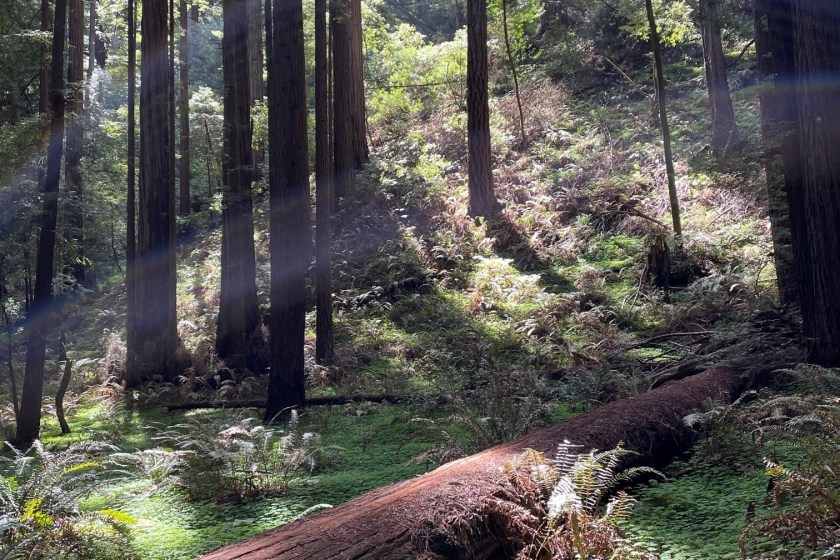
Image: Forest floor at Muir Woods National Monument by DJB
 MORE TO COME...
Pingback: Observations from . . . June 2024 | MORE TO COME...
Pingback: Memory is a poet . . . the scrapbook edition | MORE TO COME...
Pingback: From the bookshelf: June 2024 | MORE TO COME...
Pingback: The 2024 year-end reading list | MORE TO COME...