
Robert Johnson‘s early death in 1938 and limited musical output—he died at 27 and recorded only 29 songs—would seem to suggest obscurity rather than fame. Nonetheless, his enigmatic life and powerful musical voice have captivated musicians, fans, writers, and musicologists for decades, especially since the 1961 release of a compilation of his works entitled King of the Delta Blues Singers.

Among Johnson’s fans and biographers, none was more persistent, and more troubled, than Robert “Mack” McCormick.
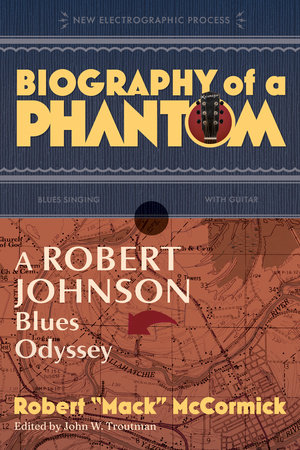
Biography of a Phantom: A Robert Johnson Blues Odyssey (2023) by Robert “Mack” McCormick (and edited by Smithsonian curator John W. Troutman) is the musicologist’s long-awaited biography of Johnson that isn’t, in fact, a biography. As Troutman details in an extensive preface and afterword, this work is essentially McCormick’s first draft, written in the early 1970s after he had finished his fieldwork. It may not be the book one expects, but it is one well worth considering.
The myth around Johnson was powerful, so much so that Eddie S. Glaude, Jr. has defined it as a blues metaphor for our nation.
“You know, Robert Johnson found his sound at the crossroad when he made a deal with the devil. It seems to me that the country is at a crossroad, whether we are going to continue to invest and double down on the ugliness of our racist commitments, or [we’ll] finally leave this behind.”
There were already myth-busting books about Johnson on the market when the Smithsonian released this “new” fifty-year-old work in 2023. Why did this particular book take so long? As Troutman explains in what one reviewer likens to advisories wrapped around a carton of cigarettes, McCormick was among the “small group of white male enthusiasts” who “assumed an extraordinarily outsized impact on national, even global conversations about Black music.” He was also a painstaking researcher who suffered from depression, became increasingly paranoid and ultimately self-destructive, and took steps—some fraudulent and perhaps criminal—to keep Johnson’s music from being released to a broader public. He continually rewrote and revised the manuscript, but it was never published before his death in 2015.
In the end, this 1973 version is no doubt the best. McCormick said he wanted to write it as a kind of thriller about his search for the truth about Johnson’s life and death. If you are looking for a definitive picture, this is not the book for you.
However, McCormick is an excellent writer who tells the story of his odyssey with a fair amount of humility and sharp attention to detail. We see him in diners as he tries to draw out stories from older Black residents of the Mississippi Delta who are naturally skeptical of a white man with a strange obsession. We travel with him along dirt backroads and into cheap motels. While racism, greed, and white supremacy are part of the larger story, McCormick truly cares for Johnson’s music and is generally aware of how his position of privilege leads to enormous amounts of caution from those he is interviewing.
He begins in tiny Friars Point, Mississippi because Johnson mentions the hamlet in Traveling Riverside Blues and McCormick’s hoping to find connections. It starts out innocently enough, when Johnson sings to his woman to “come on back to Friars Point, mama, and barrelhouse all night long.”
And while Johnson has women in Vicksburg and in Tennessee, his “Friars Point rider, now, hops all over me.” McCormick, speaking to a group of older Black men, let’s them talk as he stood to the side, “letting my thoughts pick over the crumbs they tossed out.”
“Robert Johnson was known in Friars Point. He’d had a girl here. Young, dark, small . . . That song that mentioned Friars Point had been a toast to an erotic genius he’d found here; his voice took on a keening brilliance when he sang about her: ‘She’s got a mortgage on my body now, and a lien on my soul.'”
Some of the bawdier lyrics that follow are probably the reason the song wasn’t originally released in the 1930s.
“You can squeeze my lemon ’til the juice run down my leg
(spoken) That’s what I’m talkin’ ’bout, now.”
As in most of his conversations, McCormick has difficulty finding the true Johnson story in Friars Point. However, that’s beside the point because it is in the description of the “biographer’s craft” that the work really shines. In his travels he discovers, for instance, that Johnson’s most popular song of the day is Terraplane Blues which is ostensibly about a car.
“And I feel so lonesome, you hear me when I moan
When I feel so lonesome, you hear me when I moan
Who been drivin’ my Terraplane, for you since I been gone.“
This is an odd discovery. As McCormick notes,
“‘Terraplane Blues’ has not been one of the songs that critics have praised. On the contrary, it’s often dismissed as a rather ordinary piece of double entendre, not particularly notable for either bawdiness or wit.
The assessment from the audience for whom it was intended, however, was quite different. It was, without question, Robert Johnson’s best-remembered song.”
Insightful analysis, if not exactly facts to fill in the biography.
The songs that did cement his reputation include Hell House on My Trail . . .
. . . I Believe I’ll Dust My Broom . . .
. . . and Cross Road Blues.
Elmore James brought the latter to the attention of blues fans in the 1950s. Many today know this tune from the Eric Clapton versions of the 1960s.
McCormick never truly discovers the facts around Johnson’s death in Greenwood—usually attributed to poisoning by a jealous husband—but he does in the end find a number of people in Robinsonville (where Johnson lived with his family) who knew him. Their memories are important in shaping a fuller picture.
Both Johnson’s story and McCormick’s book evoke a sadness in the reader. Johnson died before he could develop his musical voice. And McCormick was a gifted writer whose mental demons—hellhounds if you will—also stopped a full and creative career.
More to come . . .
DJB
Image: A map details the route that McCormick traveled in 1968 for his fieldwork from the Robert “Mack” McCormick Collection, NMAH
 MORE TO COME...
Pingback: Observations from . . . June 2024 | MORE TO COME...
Pingback: From the bookshelf: June 2024 | MORE TO COME...
Pingback: The 2024 year-end reading list | MORE TO COME...