
NOTE: I don’t usually double post, but I’m frontloading a couple of essays in anticipation of being away from my computer over the coming days. Read them if you wish at your leisure.
“History does not repeat, but it does instruct.” So begins a slim yet vital book that I first read in 2021 and that I returned to in July to be refreshed for the months ahead. *
I also wanted to return to this book before my travels to see the Riga Ghetto in Latvia. This city quarter, once inhabited by Russian merchants and Jews, featured small wooden houses, paved winding streets and a unique aura. It has barely changed in the last sixty years.
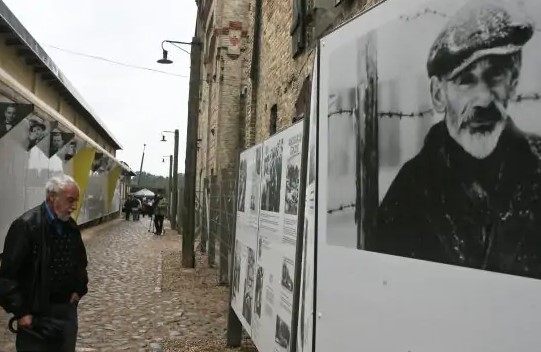
The Ghetto Museum’s exhibitions speak not only to the tragedy of Latvian Jews during World War II, but also about their lives in pre-war years, their religious traditions, their contribution to the fighting for Latvian independence, their role in education and culture.
Within several months of the Nazi occupation of the country, the Jewish population had been entirely exterminated in most Latvian towns. Between 1941 and 1945, around 70,000 Latvian Jews and around 25,000 Jews who had been deported into Latvia from various other countries across Europe were killed.
It is a chilling reminder of what can happen when authoritarianism and tyranny take hold in a country.

On Tyranny: Twenty Lessons from the Twentieth Century (2017) by Timothy Snyder, a historian of the Holocaust who teaches at Yale, is a guide to resisting authoritarianism. This small but powerful work provides present-day advice in the vein of that used by the Founding Fathers when they sought to build a governmental system of checks and balances that would be resistant to the tyranny that overcame ancient democracies.
To help instruct us in the 21st century, Snyder looks at recent history, such as that in Latvia in the 1930s and 1940s.
“Today our political order faces new threats, not unlike the totalitarianism of the twentieth century. We are no wiser than the Europeans who saw democracy yield to fascism, Nazism, or communism. Our one advantage is that we might learn from their experience.”
Snyder is no believer in American exceptionalism. Instead, he notes that while we “might be tempted to think that our democratic heritage automatically protects us from such threats . . . this would be a misguided reflex.”
After opening this 126-page book with thoughts on history and tyranny, he moves through twenty short lessons that resonate with the power that comes from long, serious study of the interwar years in Germany and the horrors that came after the rise of fascism, Nazism, and communism. Snyder’s lessons and writings are very accessible, but that doesn’t make them less compelling. His very first lesson is “Do not obey in advance,” followed by a few short pages that show how most power acquired by authoritarians is freely given by citizens of a country. In that act, they are teaching the authoritarians seeking power what they can do.
There are lessons dealing with the need to defend institutions, think for ourselves, and take responsibility for our actions in the civic sphere. As an example, Snyder writes that “you might one day be offered the opportunity to display symbols of loyalty. Make sure that such symbols include your fellow citizens rather than exclude them.” Other lessons and suggestions are focused more on the individual choices we make to stay active and alive in a civil society, such as joining and supporting causes; reading more books and spending less time on the internet; making eye contact and small talk.
Snyder’s book was published in 2017, and we know that authoritarian language and actions in the U.S. worsened over the next four years, culminating in the failed insurrection of January 6th. Lesson #6—“Be wary of paramilitaries”—discusses actions in the 20th century run-up to World War II that were repeated following the lies about a stolen election. Lesson #10—“Believe in truth”—ends with the chilling reminder that “post-truth is pre-fascism.”
Synder is especially aware of the misuse of language, and he has no problem in showing how the former president’s language only serves the leader.
Lesson #19—“Be a patriot”—begins with two pages of things that a patriot is not, each taken from recent examples. Patriotism, he notes at the end of this long list, “involves serving your own country.” Those who are nationalists are not patriots. A nationalist “encourages us to be our worst, and then tells us we are the best.”
“A patriot, by contrast, wants the nation to live up to its ideals, which means asking us to be our best selves.”
What makes Snyder’s work so important is that he shows a way forward. Each lesson is built on actionable steps we can take. And he returns to the critical need to study history in the epilogue “History and Liberty.” He notes that “the habit of dwelling on victimhood,” the province of the nationalist, “dulls the impulse of self-correction.” History, on the other hand, “gives us the company of those who have done and suffered more than we have.”
This is a work that can be read in a very short sitting. But if you are like me, many of the pages will be underlined and filled with margin notes, and its lessons will stay, hopefully, for a lifetime. For as Snyder notes at the end, “to make history, young Americans will have to know some. This is not the end, but a beginning.”
More to come . . .
DJB
*Much of what follows is from my earlier review.
Photo at the top of the post of the Jewish Ghetto Museum in Riga, Latvia.
 MORE TO COME...
Bravo. Great reminder and hope all goes well on your voyage. Look forward to hearing about it (as many details as you are willing to share!!! Prayers for safety…
So delighted Frank was able to travel! Blessings
Jane
Thank you, Jane. You are kind to remember us, and yes, I’m thrilled that Frank will be with us. Take care, and best to Bob. DJB
Pingback: Observations from . . . July 2024 | MORE TO COME...
Pingback: Observations from . . . cooler climes | MORE TO COME...
Pingback: From the bookshelf: July 2024 | MORE TO COME...
Pingback: The 2024 year-end reading list | MORE TO COME...
Pingback: A stunning work of great pain and grace | MORE TO COME...