
Today is the 50th Anniversary of the first ordination of women into the Episcopal Church, a move not without significant controversy at the time. In an act of civil disobedience, a group of eleven women and their supporters organized their ordination to become priests on July 29, 1974. The Church of the Advocate in Philadelphia welcomed them, but “the women were subsequently harassed, threatened and banned from stepping on church property.”
In May, Candice and I went to the AFI Silver Theatre to see an impressive and thoughtful feature-length documentary about this seismic event in challenging patriarchy in the church and to hear a post-screening discussion with, among others, the Rt. Rev. Mariann Budde, the Episcopal Bishop of Washington and an everyday reminder of the changes brought by the group that came to be known as the Philadelphia Eleven.
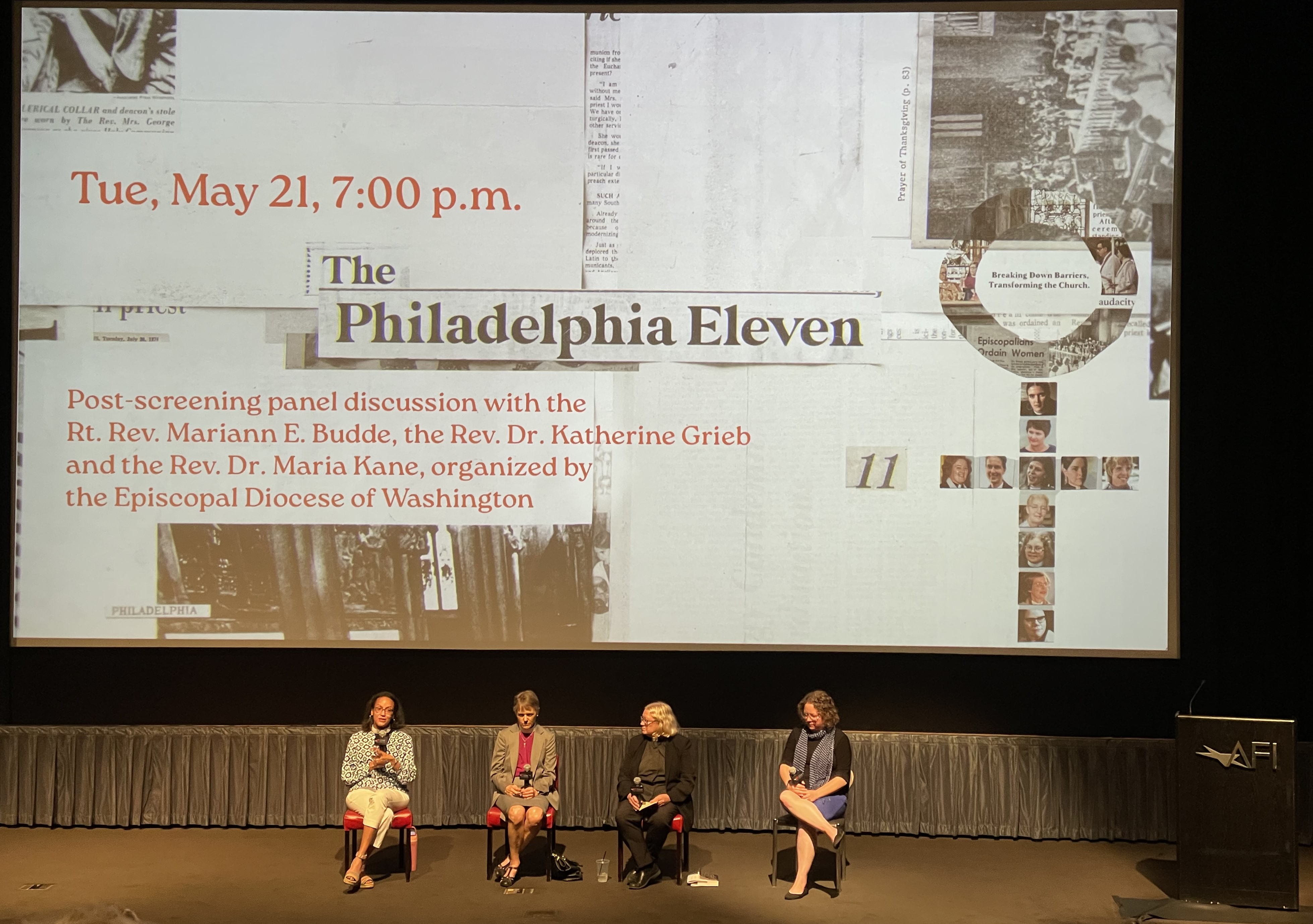
The Director’s statement about the film helps explain why it is important to tell this old story today.
“I am not Episcopalian. I was raised in a Congregational Church, and to me this story is for everyone. It is about how to break down barriers with grace and be true to oneself in the process. And it is about standing up to institutions that do not allow all people to be who they are called to be.
The story of the first Episcopal women priests has been under the radar for decades. Perhaps this is because they disregarded certain institutional edicts, or maybe because their story is inconvenient. After all, they challenged the very core of patriarchal culture. These pioneers have taught me new ways to think about whose history is recorded and remembered, and who does the work of remembering. And they provide a vision for what a just and inclusive community looks like in practice. If we are serious about loving every human being as they are, then we must find new ways forward that disrupt the hierarchies we have inherited and replace them with the same kind of radical inclusivity demonstrated by these priests.”
The official trailer of the movie provides another introduction as to the rancor these women endured in following their call to break down the superiority games of the church that focused on security, status, and control rather than God’s call toward generosity, humility, and cooperation.
It is important to recognize that the Church of the Advocate was undergoing its own transformation even before hosting this ordination service. Here’s how the Episcopal Church website describes that change.
“Although the church was designed to seat more than a thousand worshipers, the congregation began to decline in the 1950s as many of its white members left the inner city. The parish was revitalized under the leadership of Paul Matthews Washington, an African American priest who served as rector from 1962 until 1989. On July 29, 1974, the church was the site of the first ordination of eleven women deacons to the priesthood. This irregular action preceded the approval of women’s ordination by General Convention. Today the Church of the Advocate is one of the premier African American parishes in the Episcopal Church.“
I was not yet a member of the Episcopal Church when these women broke with church hierarchy, teaching, and a 2000-year history of patriarchy to remind us of the wide range of God’s love. But I remember watching the controversy at the time while I was grappling with my own doubts about my faith tradition and its complicity in playing those superiority games which, conveniently, always seem to support white males. It was another important step in my journey.
On this important anniversary, I give thanks for the courage of these eleven women and those who supported them.
More to come . . .
DJB
 MORE TO COME...
Thank you for the remembrance, David. I was still in seminary in 1974 (VTS ‘76). Looking back, my several women classmates, The Rev. Carlyle Gill among them, still faced an uncertain future. “Rigged Election”, pales when I recall terms like, “irregular / rogue” ordinations, or worse, “conscience clause”. Imagine the Constitution providing for optional acceptance of an elected president.
Thanks for your note, Randolph, and especially for the mention of Carlyle. She was the first priest to meet us as a family on our first visit to St. Alban’s parish in 1998, and her welcoming embrace is part of our story that now stretches over a quarter century at that parish. DJB
David, The Philadelphia Eleven not only faced harassment (and worse), but were unable to act as priests. Bill Wendt, then the rector of St. Stephen and the Incarnation in DC, invited one of them, Allison Cheek, to celebrate communion at a regular Sunday service. Then Bishop of Washington, William Creighton, forbade him to do so, but Wendt went ahead. Some conservative priests in the Diocese then brought charges against him, launching the first ecclesiastical trial in DC since sometime in the 1800’s. I took off from work to sit in solidarity with Wendt and the Philadelphia Eleven. The trial court ruled, 3 to 2, that Wendt had disobeyed his Bishop, but recommended only that he be given a “godly admonishment” because he had acted on his own conscience. Creighton, who basically was sympathetic to the cause of women’s ordination as I recall, was backed into a corner by the decision and had to take action, but my sense was that he was highly conflicted. Sitting in that trial is something I will never forget.
Wow, Sandy. Thanks for this remembrance. This is very moving and powerful. So glad to hear your story of solidarity with Bill Wendt and the priests. I recall mention of his work in the documentary. We’ll talk more about it when I return. Take care – DJB
Pingback: Observations from . . . July 2024 | MORE TO COME...