
The beauty of the morning light as we sailed into the harbor at Helsinki suggested a day of exploration filled with wonder, new perspectives, and joy. For a country that for the tenth year in a row took top honors as the world’s happiest, that seemed only appropriate.
We had arrived in Helsinki, Finland, for another day in our National Trust Tours visit to Scandinavia and the Baltic Sea. It was magical.


We began moving through Helsinki on bus, sampling the wide variety of architecture in this most northerly of continental European capitals. Like many of its neighbors, Helsinki featured stories of conquest, changing allegiances , and resilience throughout its history.


Amidst the blocks of office, residential, and commercial buildings, we suddenly turned the corner to glimpse the beauty that is the Helsinki Central Train Station.


More so than some of its neighbors, Helsinki has loved and preserved its historic train station, which comes with a prestigious pedigree. The tracks were built in the 1860s; the station building was designed by esteemed architect Eliel Saarinen and inaugurated in 1919.

Saarinen worked extensively in both Finland and the United States, moving to the US in 1923. Among his important American works are the buildings at the Cranbrook Educational Community—a National Historic Landmark education, research, and public museum complex in Bloomfield Hills, Michigan. He was also the father of acclaimed 20th century architect Eero Saarinen, who designed Dulles Airport and the TWA terminal at JFK airport among other important works.
The father’s railroad building in Helsinki is known for its clock tower and “The Lantern Bearers” statues. It took 15 years to build, delayed for five of those years by World War I. During World War II, the station was bombed extensively and seriously damaged, so that temporary platforms had to be used well into the 1950s.
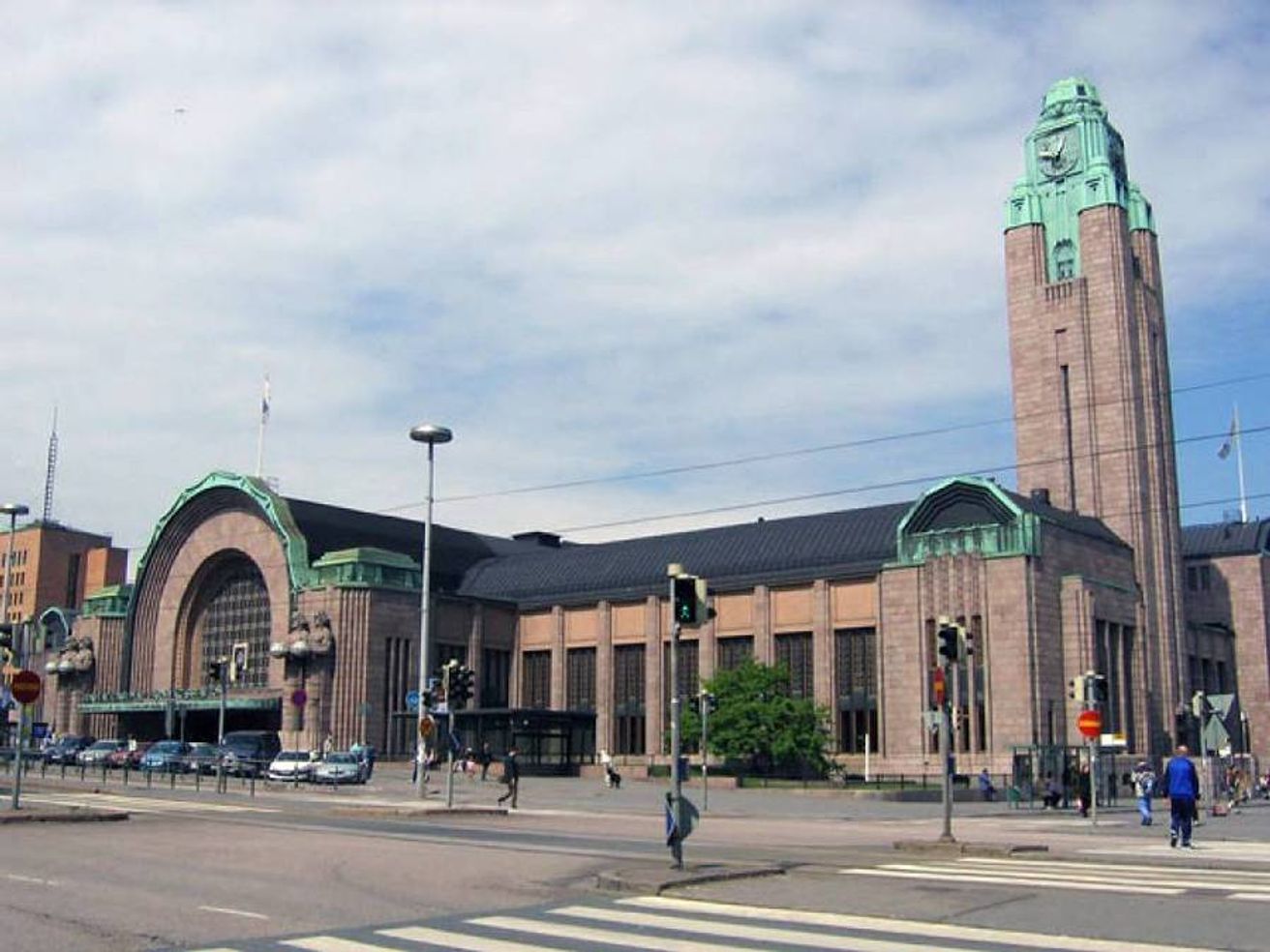
The country had deep feelings for this place that was begun under the Russian tsar and inaugurated to the strains of the patriotic song Finlandia. It has been saved and preserved through the years, although with many alterations.
In 2013, Helsinki Central was chosen as one of the world’s most beautiful railway stations and it has become the symbol of the entire railway network in Finland . . . another example of a pathway of memory, identity, and continuity connecting past, present, and future.

Places of all types are so important in how we understand our past and the connections made to life today. They key both individual and collective memories, perhaps none more so than religious sites. We may have individual memories in a house of worship related to baptisms, bar and bat mitzvahs, weddings, and funerals, but the religious sites we saw in Helsinki also sparked collective memories, both for those who live in the city and for those of us who visit.

The Helsinki Cathedral, originally built from 1830 to 1852, is the seat of the Archbishop of the Finnish Evangelical Lutheran church. It is a handsome structure situated on the city’s most prominent hill.


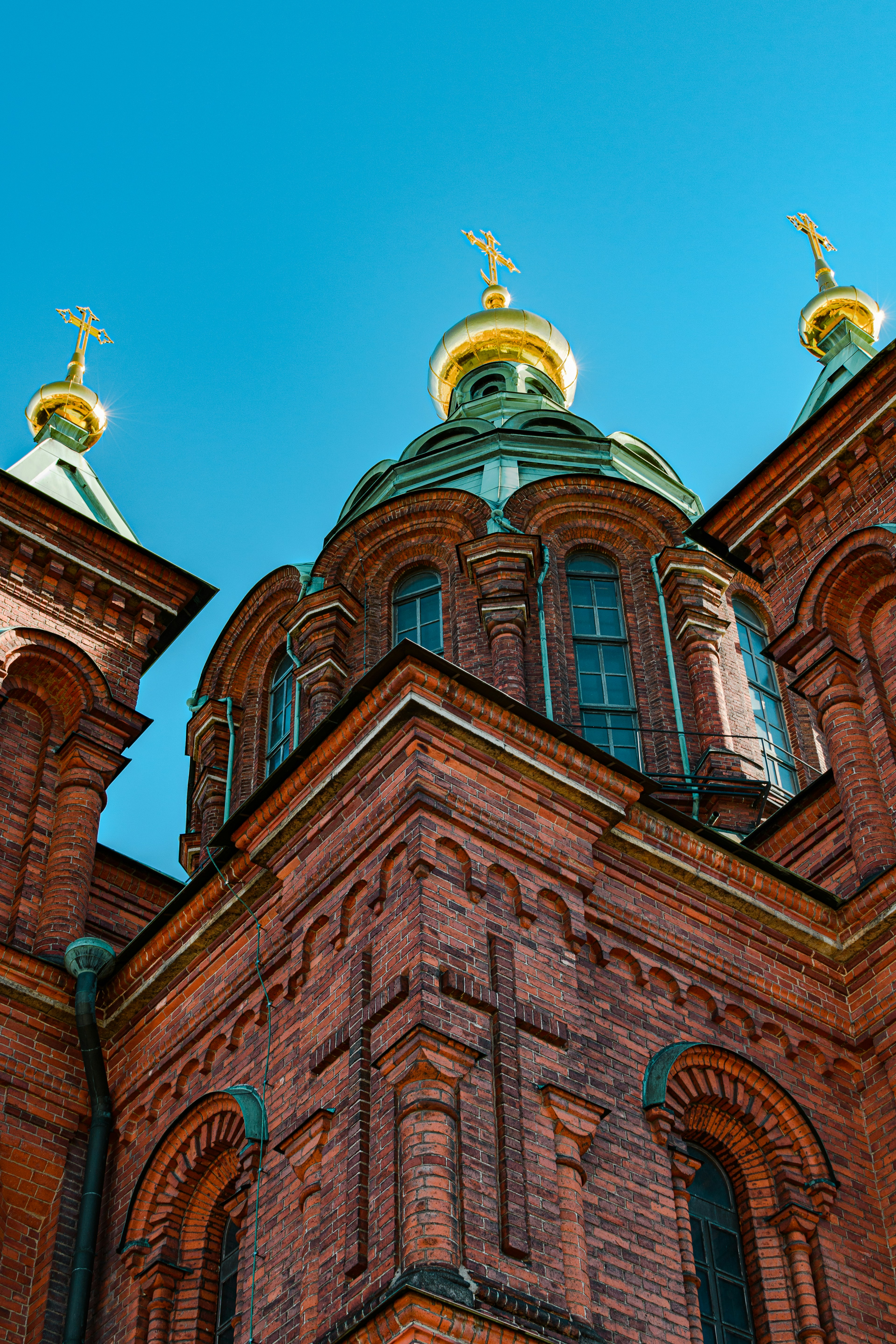
Nearby one can also find the cathedral of the Russian Orthodox Church—a vivid reminder of the role Russia has played in the life of Finland over the years.

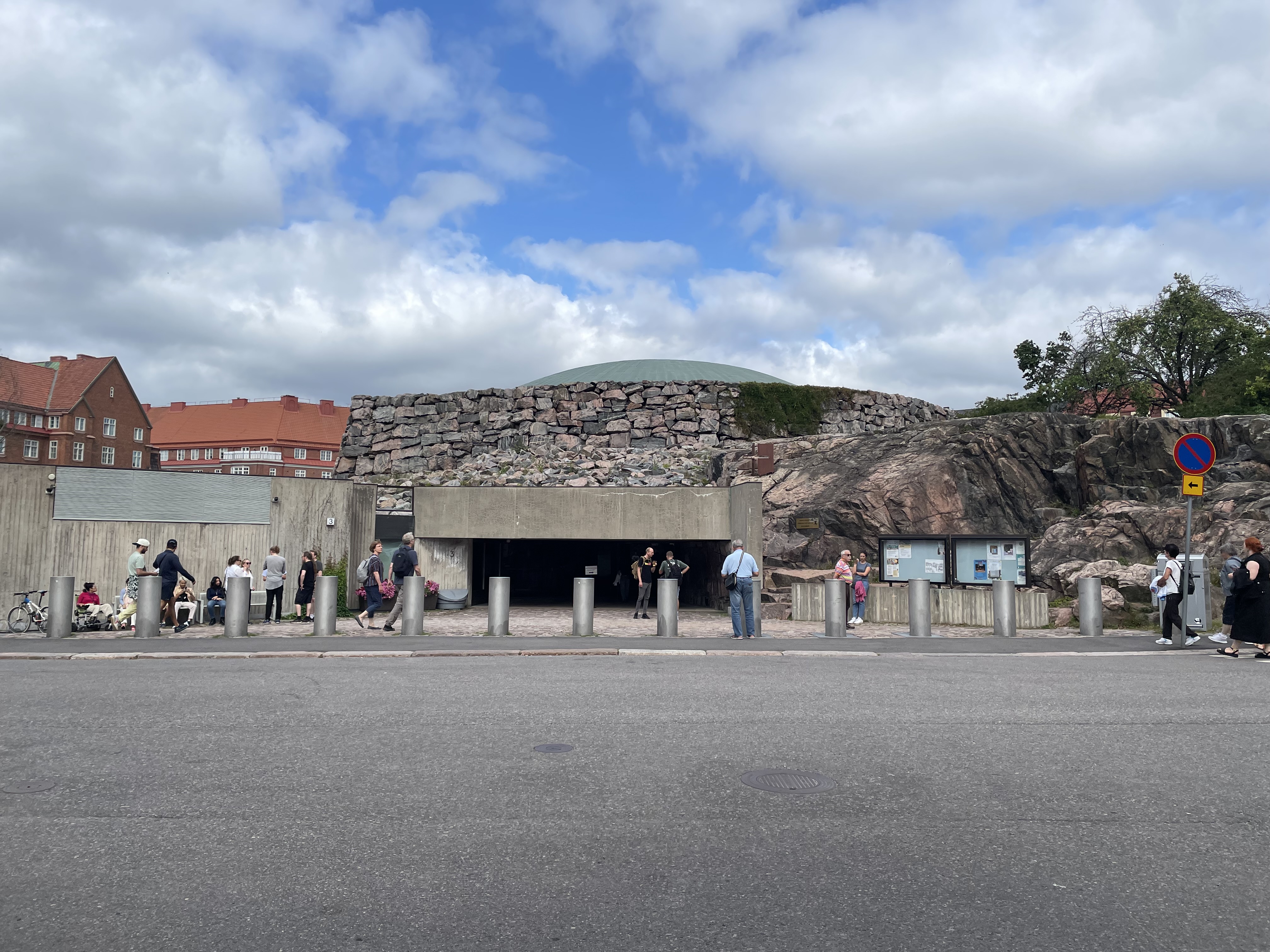
Temppeliaukio Church—also known as the “Rock Church”—is the city’s most unusual ecclesiastical design. Architects Timo and Tuomo Suomalainen designed this structure in 1961, construction finally began in February 1968, and the rock-temple was completed for consecration in September 1969.
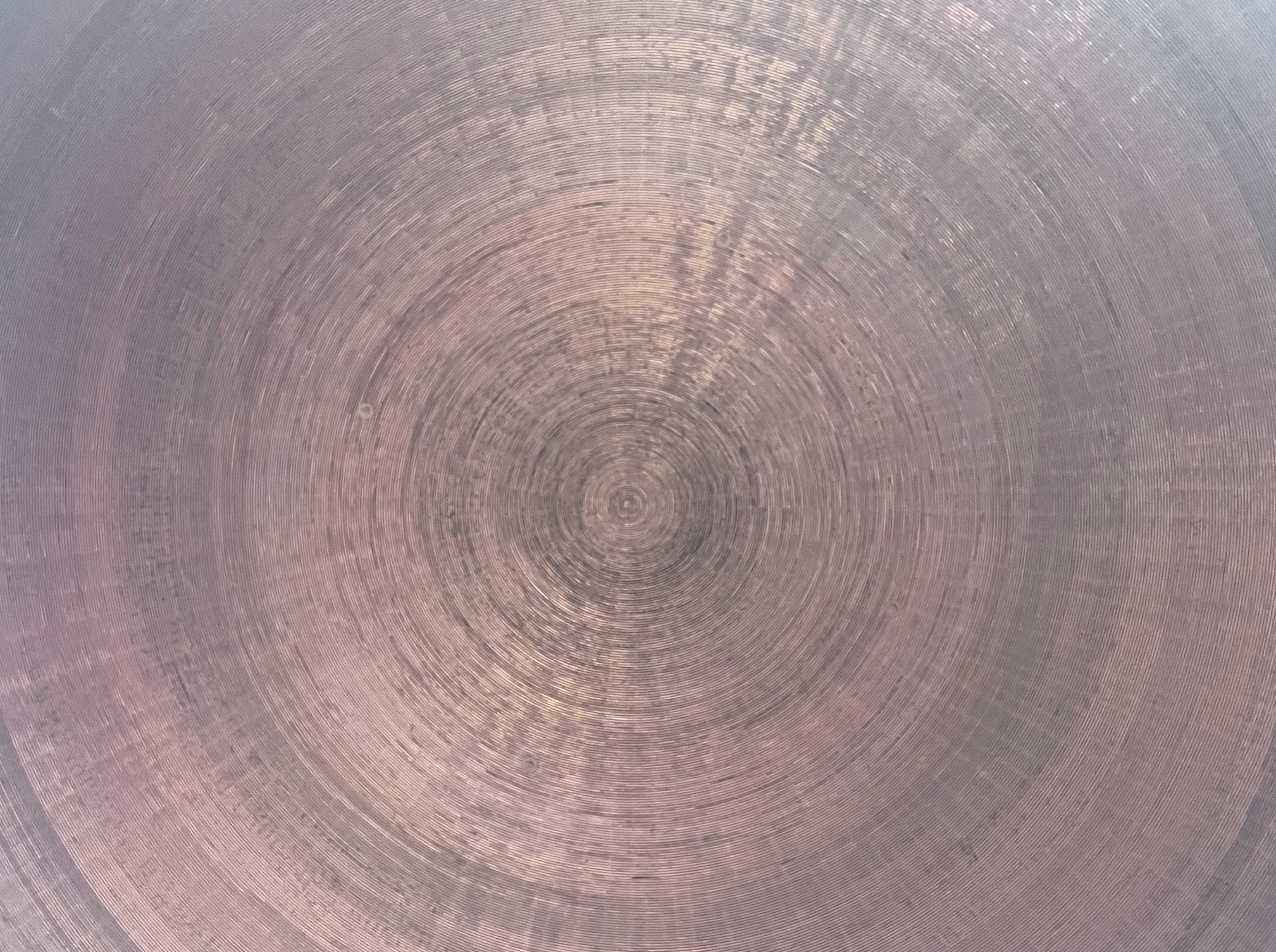
The interior was excavated and built directly out of solid rock and is bathed in natural light which enters through the skylight surrounding the center copper dome. The church is used frequently as a concert venue due to its excellent acoustics. The acoustic quality is created by the rough, virtually unworked rock surfaces. The iconic rock walls were not included in the original competition entry, even though the Suomalainen brothers had considered the idea, because they believed that it was too radical for the competition jury. But when conductor Paavo Berglund shared his knowledge of acoustics from some of the best music halls and the acoustical engineer Mauri Parjo gave requirements for the wall surfaces, the Suomalainen brothers discovered that they could fulfill all the requirements for the acoustics by leaving the rock walls exposed in the Church Hall.


I had high hopes for the Helsinki public library after having read about this amazing new gathering place in the heart of the capital city. As the son and brother of librarians, I felt special pride in seeing how a city and a country can thrive when they emphasize the many important characteristics that go into the modern library. That excitement only built as we approached the main entrance.
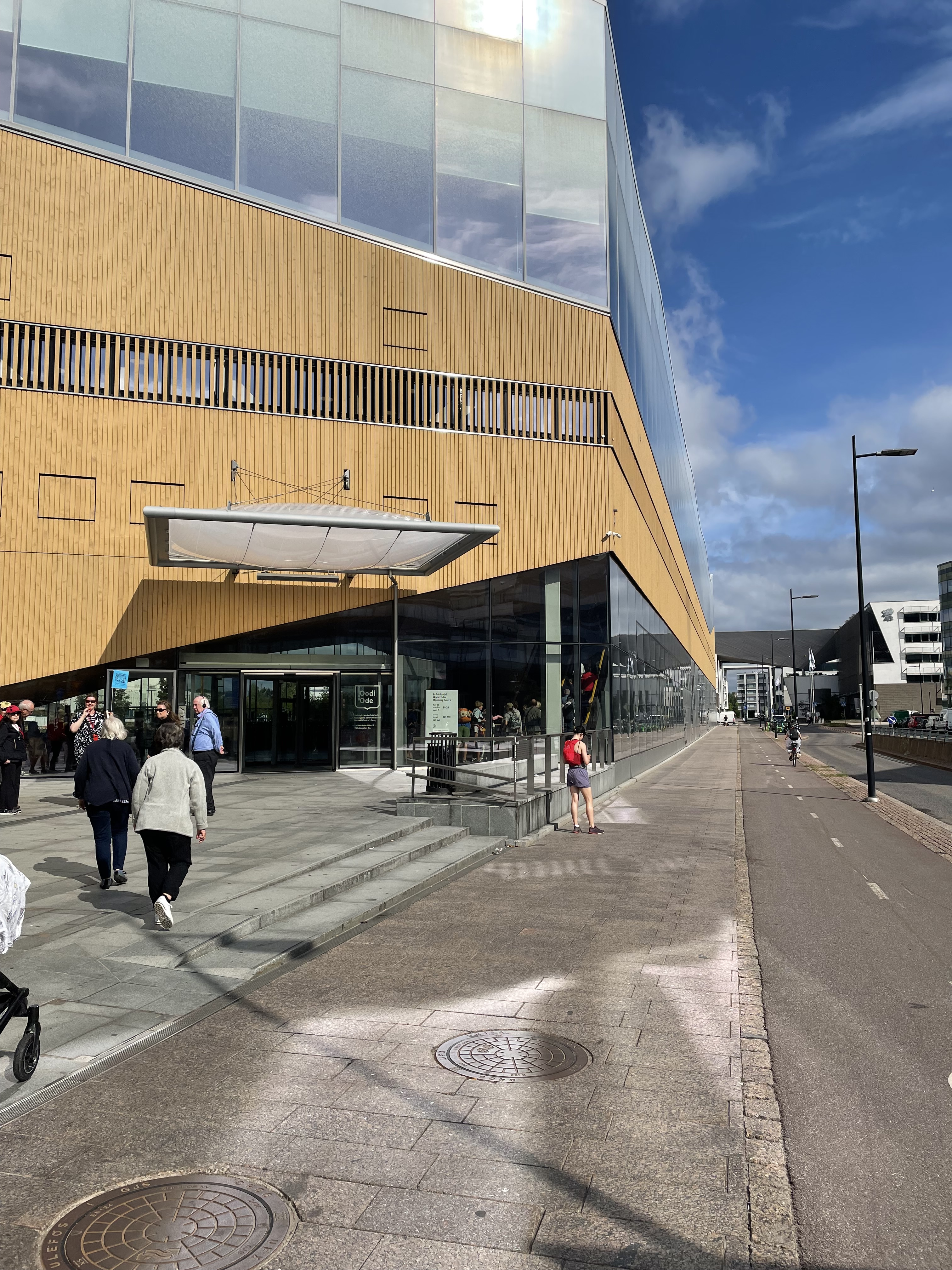
It seems oh so appropriate for the city’s “living room” to greet its clientele with tables set up for the planned or spontaneous game of chess.
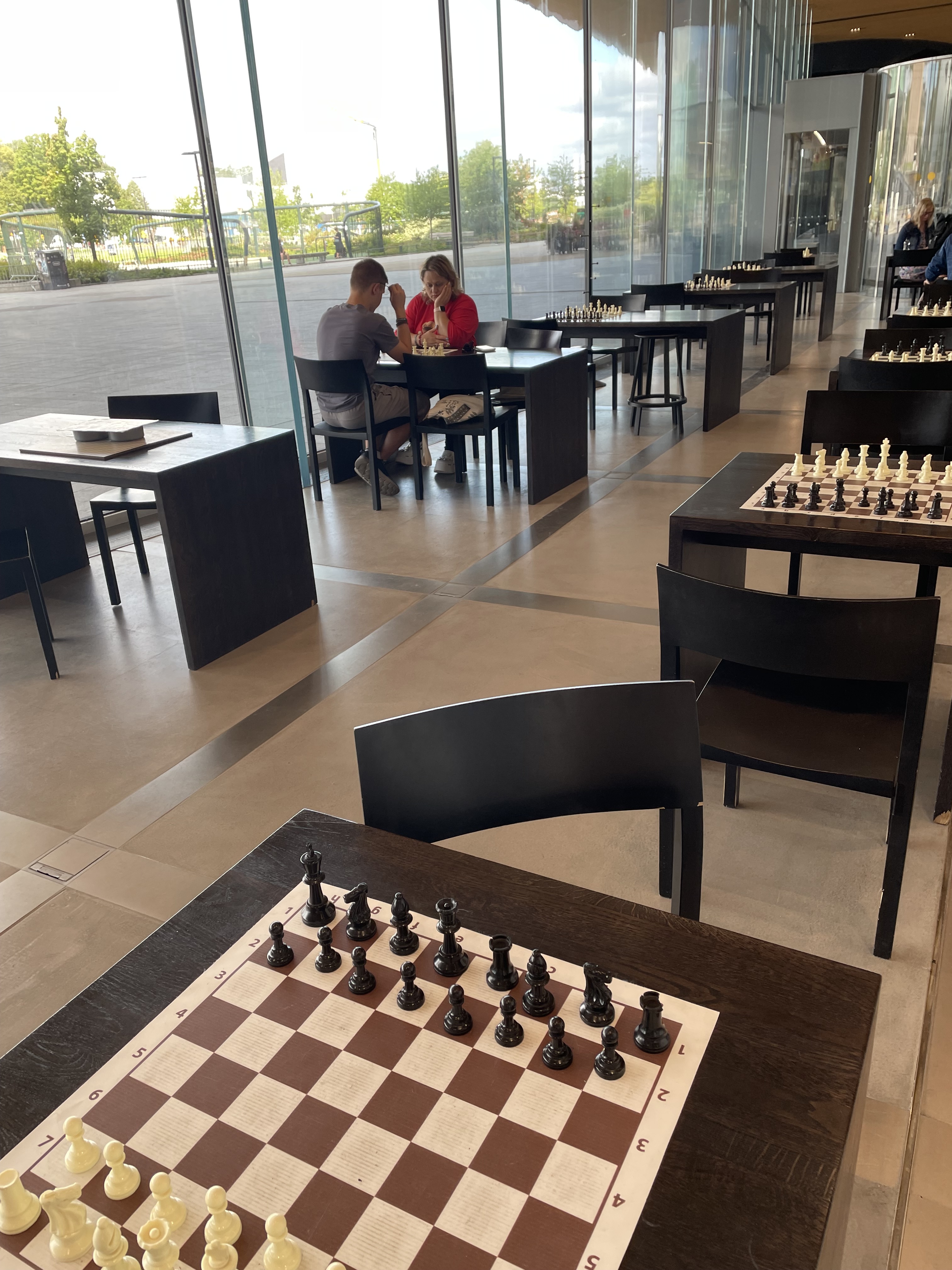

It is impossible to overstate how overtaken I was with this welcoming, wacky, warm, and wisdom-filled gem in the city.

Helsinki’s New Living Room—Oodi Library (2021) by Wif Stenger (for the Scandinavia Review) describes the work of architect Antti Nousjoki and his team of ALA architects alongside other principals including Juho Grönholm and Samuli Woolston in the context of the public enthusiasm for their new flagship library. Oodi is a “wavy, radiant structure” that opened in late 2018 as Finland celebrated its 101st Independence Day.
Creativity is at the heart of Oodi (“Ode”), a spirit that has been
taken in kind by its visitors. “The willingness of people to use and share the building in creative and respectful ways has been delightful to experience,” Nousjoki says.
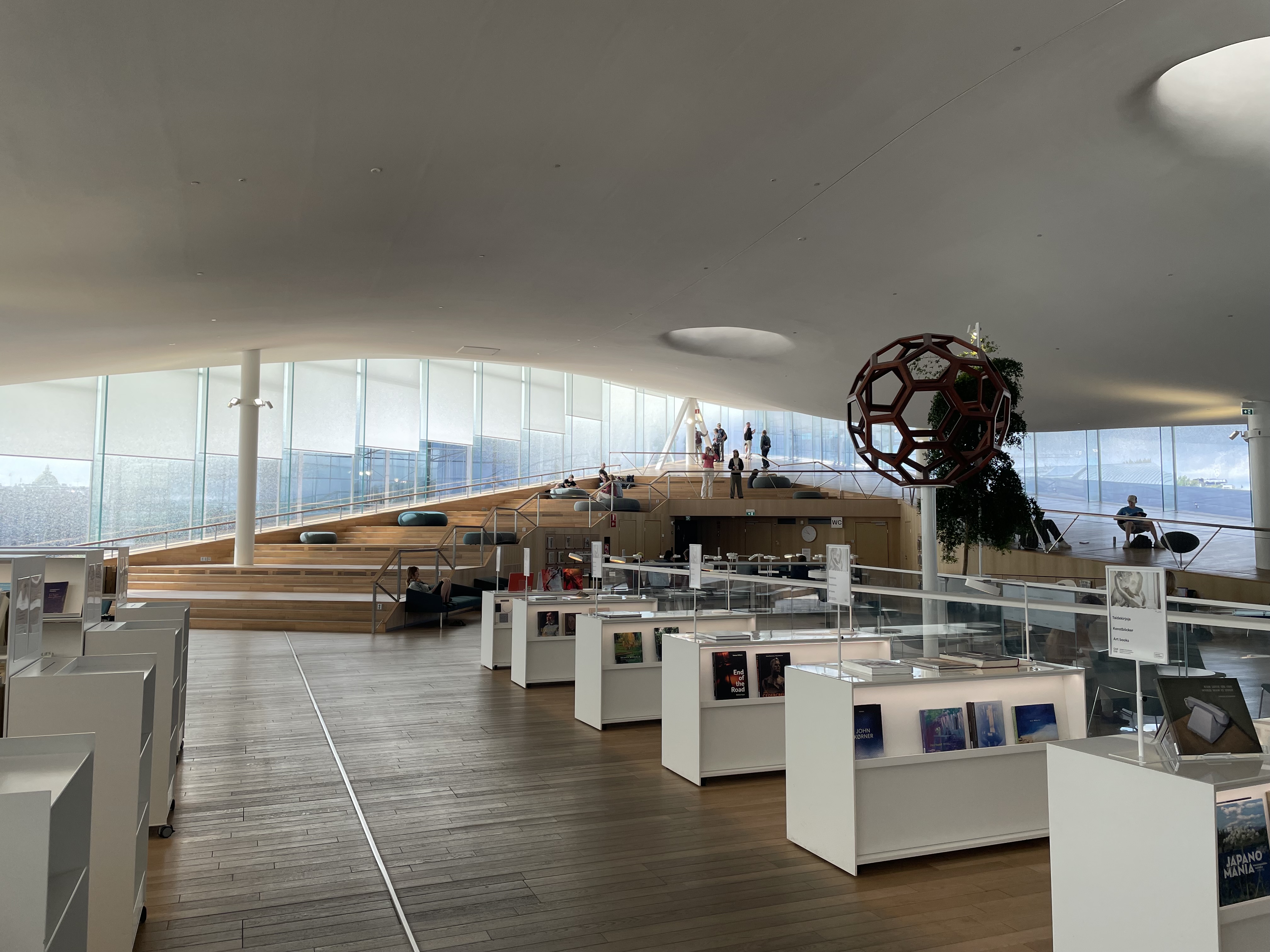
A spiral staircase decorated by artist Otto Karvonen practically calls one to follow its steps to the second floor, “devoted to creativity, with a “‘maker space’ offering a wide selection of equipment and facilities, from a recording studio complete with instruments to a kitchen, 3D printers, laser cutters and handicraft tools.”
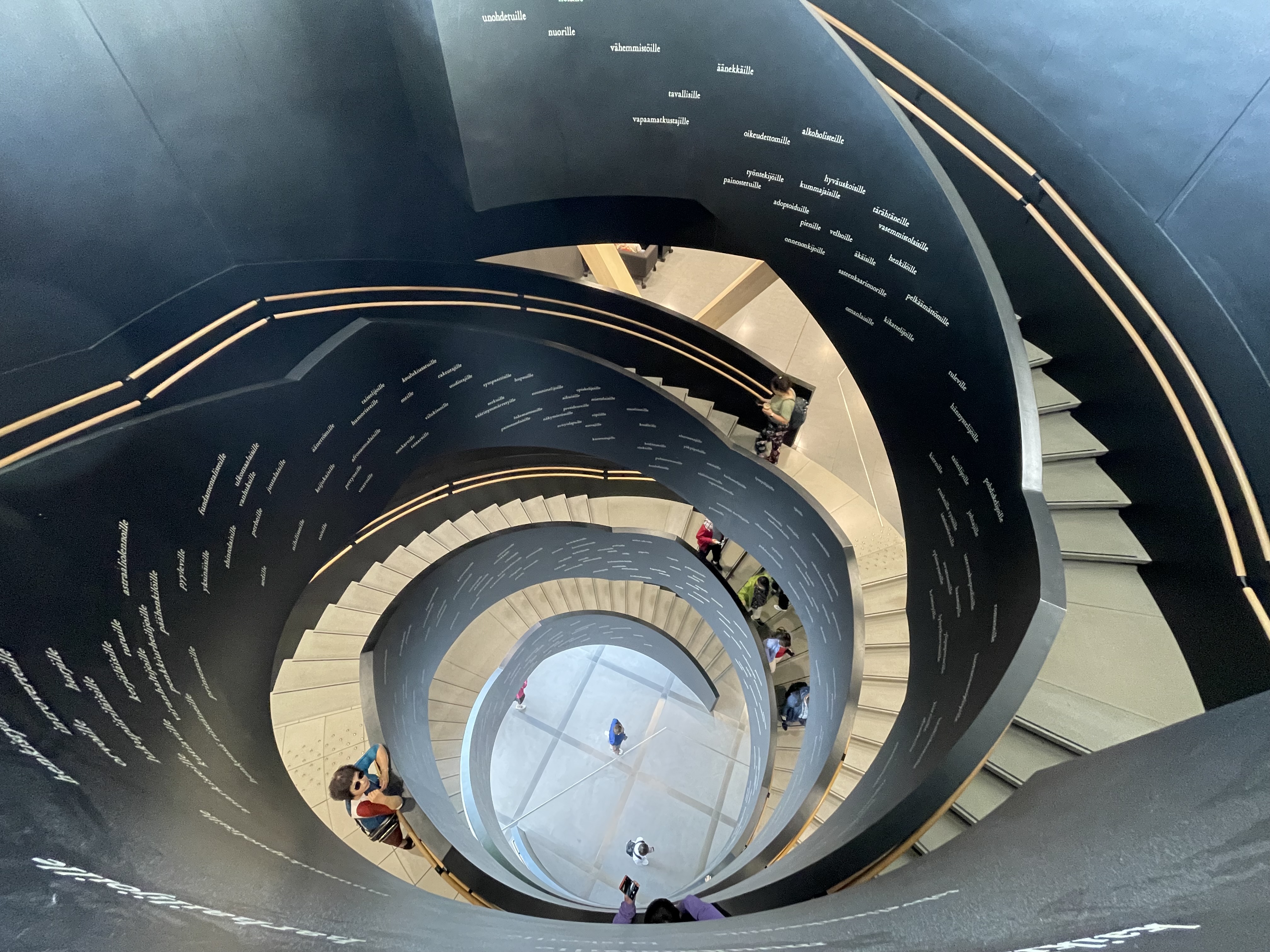
Other passageways—both inside and out—are equally inventive and alluring.
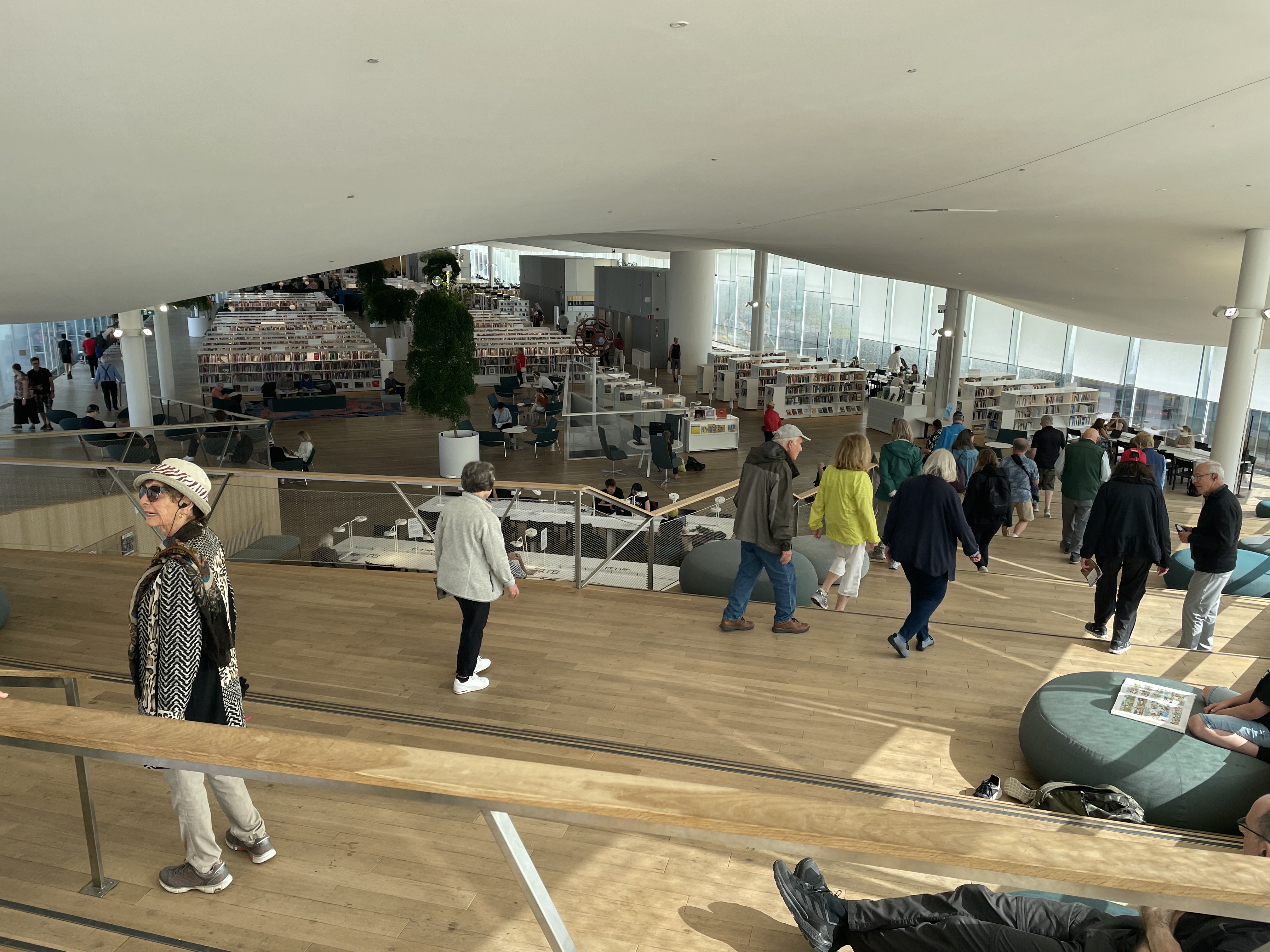
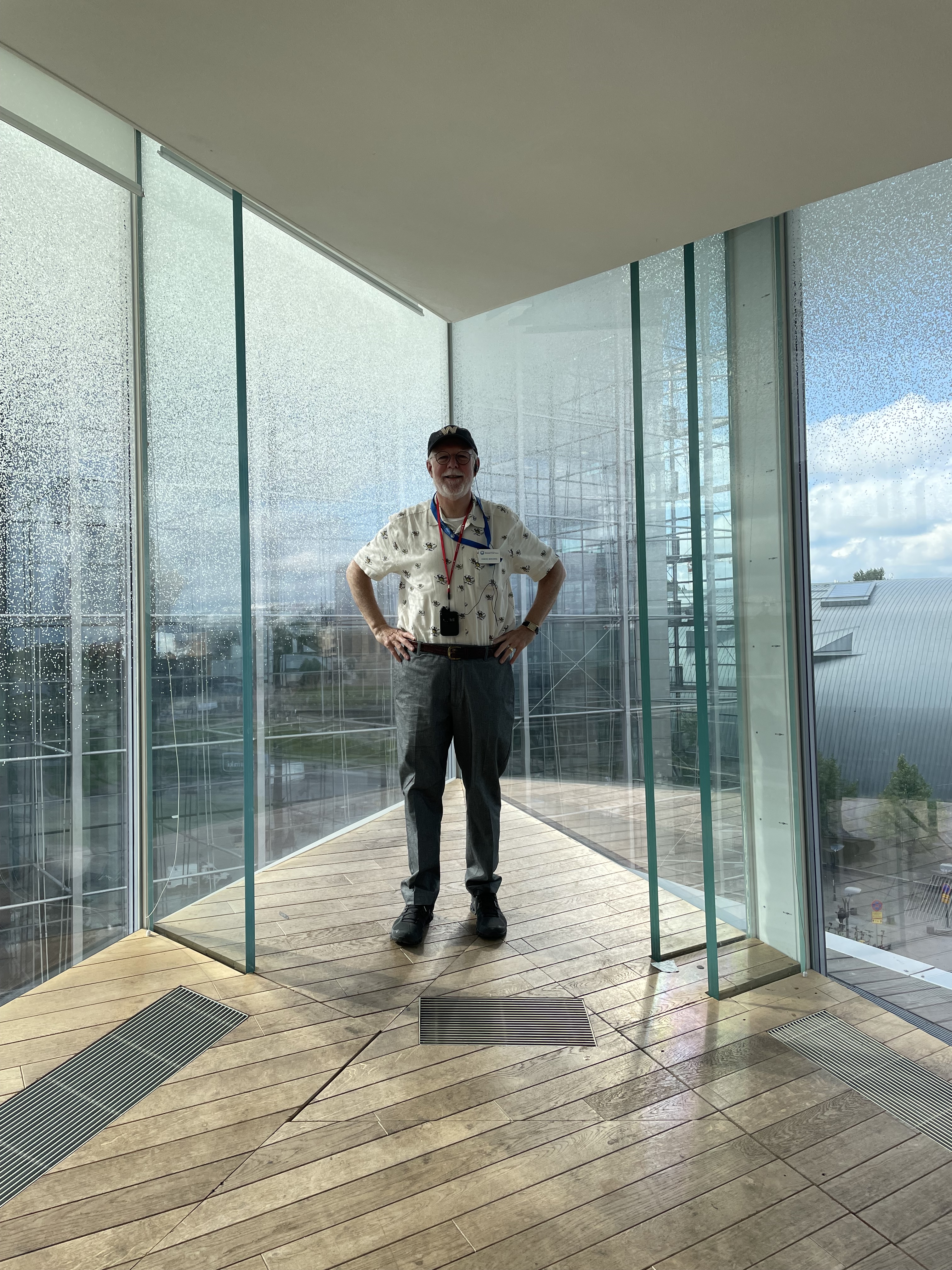

Library director Anna-Maria Soininvaara told Stenger that, “From the beginning, Oodi has been a place where people can work or study alone or together, a place where there’s always something interesting going on, from lectures and study circles to knitting clubs,” she adds. “It’s also become a general meeting place—people just say ‘see you at Oodi.'”
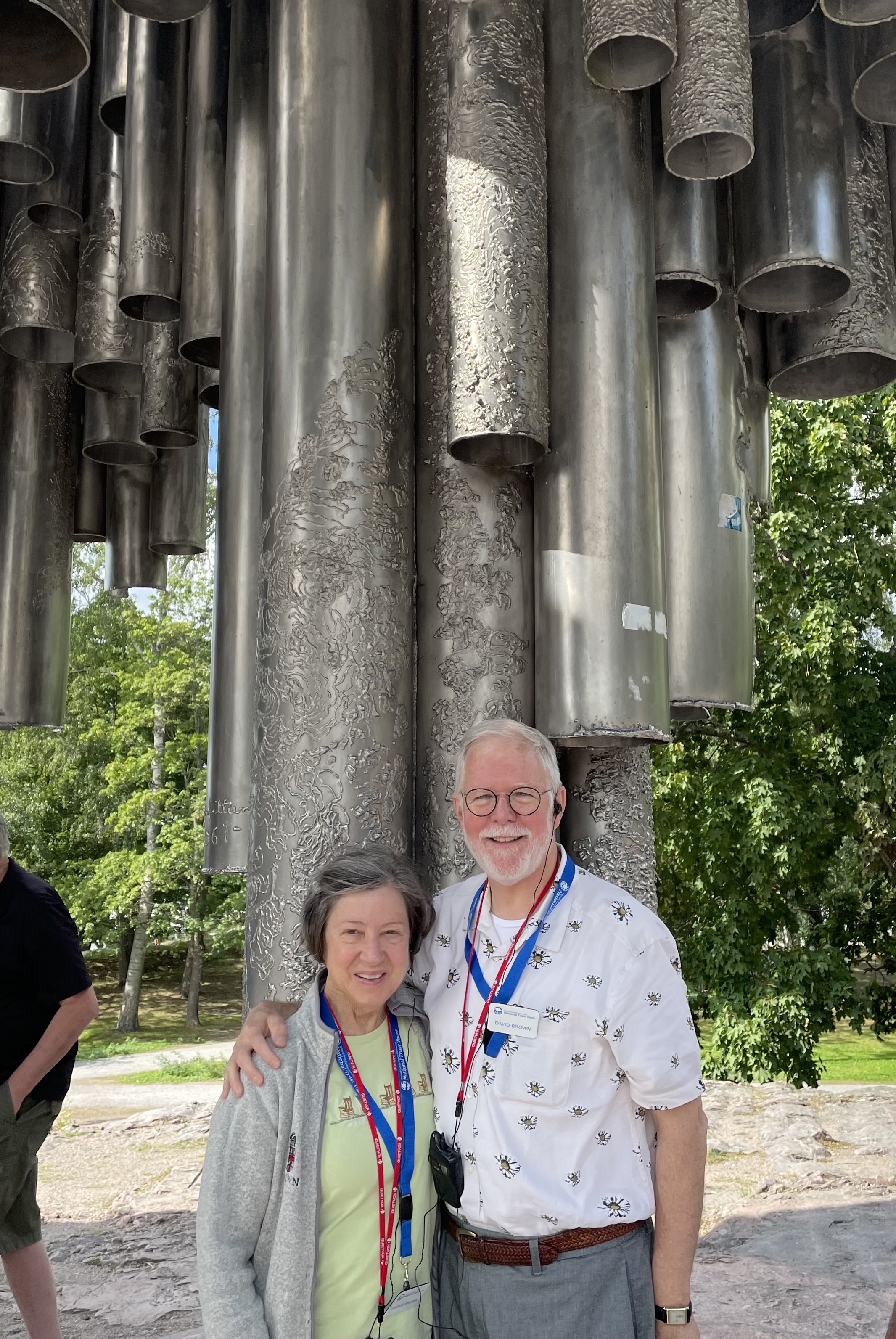
Our final stop of the morning was at the beguiling monument to Finland’s most celebrated composer, Jean Sibelius. Erected in 1967 by Finnish sculptor Eila Hiltunen, the abstract monument resembles a sound wave made from clusters of organ pipes. It consists of over 600 steel pipes unevenly grouped together at various heights, with the highest pipe reaching over 27 feet in the air.

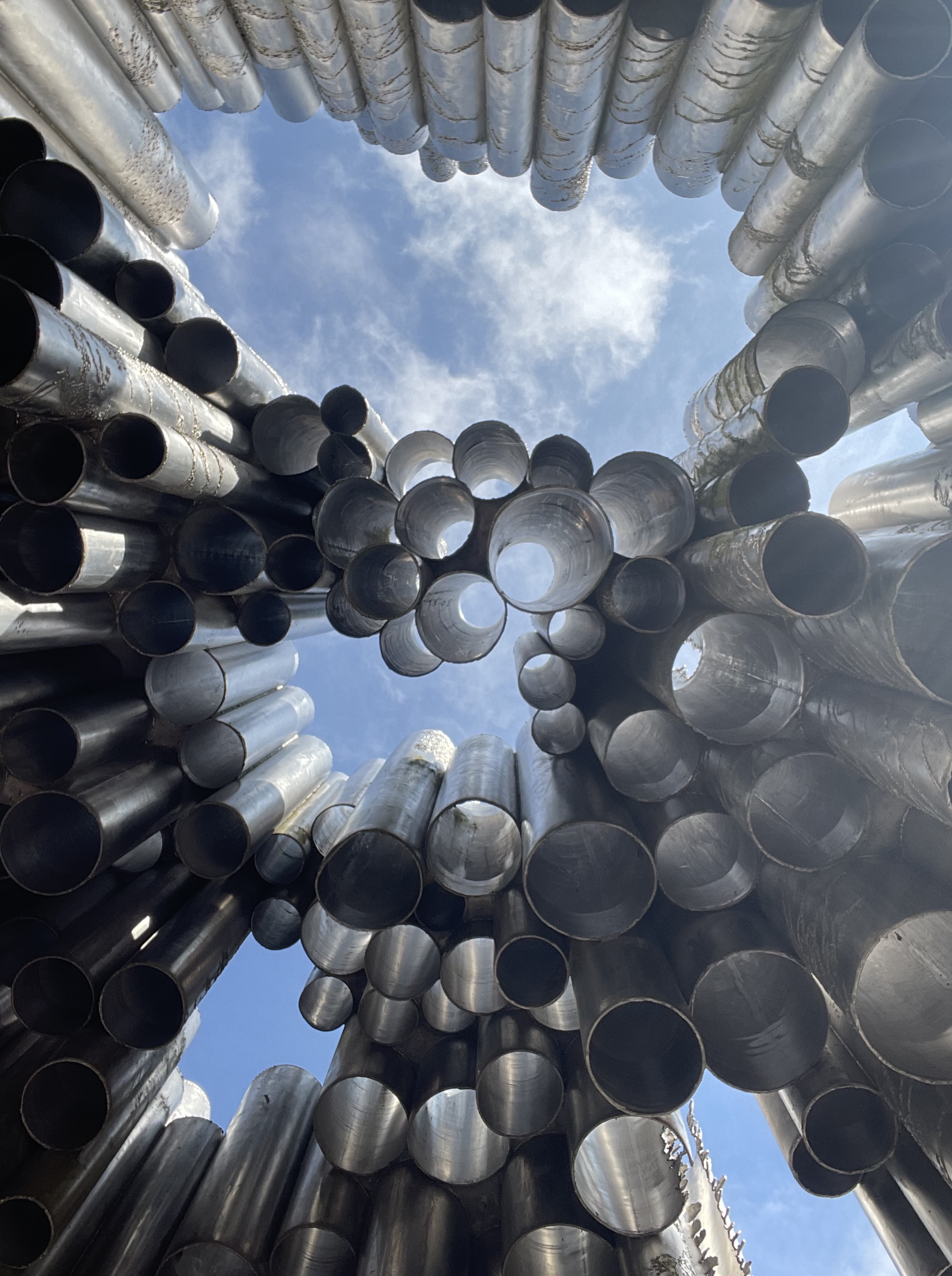
We experienced the sculpture when the park was filled with visitors, and then, for a few magical moments, after the crowds dispersed for lunch.
Sibelius is best known for the symphonic piece Finlandia, Op. 26. A tone poem . . .
The piece was composed for the Press Celebrations of 1899, a covert protest against increasing censorship from the Russian Empire, and was the last of seven pieces performed as an accompaniment to a tableau depicting episodes from Finnish history. The premiere was on 2 July 1900 in Helsinki with the Helsinki Philharmonic Society conducted by Robert Kajanus.
We’ll end with this version of Finlandia performed for the 2011 opening of the new Helsinki Music Hall. As one online commentator wrote, “you know it’s a good piece [of music] when it makes you feel patriotic for a country that’s not your own!”
Hail, Helsinki! Hail, Finlandia!
More to come . . .
DJB
Photo of Oodi Library by Hayffield L on Unsplash
 MORE TO COME...
This is a fabulous blog. . love the photos and narrative. look forward to more details in person. please note new email rehobothjane.518@gmail.com Jane
Many thanks, Jane. So glad this resonated with you! Looking forward to catching up in person. DJB
What a stunning event and well described. Lets hope the Russians will leave the city and country well alone. Thanks for the beautiful set of photos Geoff
Thanks, Geoff. This means a lot coming from you. You probably have experienced this, but I was taken about how much these Baltic countries have survived as one big power after another seized control through the years. In every one of them, there is always much made about their independence date. Take care. DJB
Pingback: Observations from . . . cooler climes | MORE TO COME...
Pingback: From the bookshelf: July 2024 | MORE TO COME...
Pingback: Observations from . . . August 2024 | MORE TO COME...
Pingback: The 2024 year-end reading list | MORE TO COME...