I was a rising sixth grader when our family moved to Murfreesboro. Like many a new student dropped into an existing and well-functioning school community, I struggled with certain subjects and relationships. My classmates had all trained under the “new math” of the 1960s, which had yet to make its way to Capshaw Elementary, my former school in Cookeville. To quote the famous idiom we use when something is incomprehensible, “it was all Greek to me.”
Ironically, my sixth grade teacher, Mrs. Adkerson, helped save me from a life of academic failure with something that turned that idiom on its head. Mrs. Adkerson, you see, had a love of Greek mythology. As she enthusiastically taught both real and mythical tales from ancient Greece, I learned that the past could come alive in the hands of a skilled storyteller. As she admonished us not to snicker when we saw naked statues of young Greek men and women, she opened up possibilities for new ways to see and appreciate beauty, art, and the wider world. As she spoke about the cities and towns of ancient Greece, I came to learn the importance of place.
I suspect—even without proof—that a young Martha Adkerson had come under the influence of Edith Hamilton. She would not be alone among Americans of the mid-twentieth century.

The Greek Way (originally published 1930, reprinted in 2017) by Edith Hamilton is a well-known survey of Greek literature and art that is definitely a product of its time. “Probably no other single person has had such an impact in shaping the perceptions of classical literature and mythology in the United States for almost a century” writes Emily Wilson in The Nation. Hamilton was a powerhouse of her age, with influences that still exist. There is much to admire in this slim work, but also much is required to place this book and Hamilton’s worldview into its proper context.
In her preface, Hamilton lets the reader know where she stands on the crucial role of ancient Greece in the world today. Writing between the two World Wars, Hamilton rightly sees a world that is “storm driven.” In such situations, she suggests, “we need to know all the strong fortresses of the spirit which men have built through the ages.”
No place was a stronger fortress in Hamilton’s mind than ancient Greece.
Her first chapter is a comparison of East and West, and she describes the Greeks as “the first Westerners.” Although ancient, they belong in the modern world. “That which distinguishes the modern world from the ancient, and that which divides the West from the East, is the supremacy of mind in the affairs of man.”
Hamilton insisted on the superiority of the (Western, implicitly white) Greeks over the “ignorant,” “subjugated,” and “wretched” peoples of “the East.”
“Later, without any particular knowledge of ancient Egyptian or Asian civilizations . . . Hamilton blithely dismissed them as containing ‘human beings…who are only partially developed,’ lacking the complete unity of ‘mind and spirit’ that was present only in ancient Greece until its reappearance, at last, in America.”
Emily Wilson
Hamilton argues that the Greeks were the first people in the world to play, and they did so on a great scale. “To rejoice in life, to find the world beautiful and delightful to live in, was a mark of the Greek spirit.” It is, Hamilton argues, different than everything that had come before. It is a blending of mind and spirit, body and soul, and it sets out the path for the Western civilization that was to follow. In chapters on poets, artists, and historians, Hamilton tells a tale where even a novice like me can see the flaws. “Reviewers at the time of her first book’s publication (such as Percy Hutchison in The New York Times) observed that Hamilton’s stark distinction between ‘East’ and ‘West’ was, historically, complete nonsense.”
Yet Hamilton wrote with a style and spirit that captured the imagination. I suspect that’s what brought Martha Adkerson into the fold, and it still has adherents today.
But context matters.
Wilson, who has recently translated both The Iliad and The Odyssey to great acclaim, is Department Chair and Professor of Classical Studies at the University of Pennsylvania. She has been named a Fellow of the American Academy in Rome in Renaissance & Early Modern scholarship, a MacArthur Fellow, and a Guggenheim Fellow. Her essay on Hamilton helps explain how this retired Latin schoolteacher with “limited formal education and almost no scholarly credentials,” come to be “one of the most influential ‘classicists’ of the 20th century.” First of all, Wilson asserts, Hamilton “maintains a constant aura of authority on the page,” especially as she includes little snippets of ancient texts into her summaries and discussions. This is clear to anyone today reading The Greek Way. Hamilton is a good writer, so her loose, evocative translations provided without sources, encourages the reader “to take them as a matter of faith, not research.”
The second great reason for Hamilton’s grip on the American reading public is that she remakes ancient Greece in the image of an idealized United States—a world of glorious individualism and democratic freedom for all (or, if not exactly all, at least for everyone who matters). She relies heavily on vague, more or less unprovable grand claims about ‘spirit’: ‘To rejoice in life, to find the world beautiful and delightful to live in,’ she writes in one of many such passages, ‘was a mark of the Greek spirit which distinguished it from all that had gone before.’ Hamilton created an image of ancient Greece that was alien enough to sound romantic, but also familiar to a readership of white Americans eager to imagine themselves as the proud inhabitants of a land of freedom and superiority.”
Hamilton’s work came at an inauspicious time, as the world around Western civilization appeared to be crumbling. After World War I, Wilson notes, colleges and universities began to offer classes on ancient texts studied in translation. These studies were considered prerequisites for understanding “contemporary issues in Europe and the United States—regions that were now often lumped together under the term ‘the West.'” Classes were devised to showcase the “‘unique features of the western world,’ a world that apparently had begun in ancient Greece and that had now reached its apex in the American present.”
The goal of connecting US citizens to a long, largely fabricated notion of ‘Western civilization’ seemed increasingly urgent in the aftermath of a war that had torn the nations of Europe apart. The fantasy of a common ‘Western’ heritage shared by white Europeans and North Americans appeared as a prophylactic against future wars, at least between those who could qualify as ‘Westerners.’ But it also did something else. By excluding the numerous surviving ancient texts and cultural artifacts from the rest of the world, these new courses on ‘Western civilization’ suggested that premodern ‘civilization’ was the exclusive property of the ‘West’—enabling a kind of mythical/historical justification for continued domination of those peoples deemed to have come from outside this exclusive group, whether it was Black and Asian Americans in the United States or the millions still living under imperial and colonial rule in Asia and Africa.”
Wilson writes, and I strongly agree, that “we could do worse than take some lessons from Hamilton,” despite her many flaws. She engaged the reading public “not by actual knowledge or credentials, but by the unfeigned enthusiasm and devotion with which she told and retold the story of her love for her own imagined, idealized version of antiquity.” Storytelling, just like context, is so very important. Storytelling first captured me as an impressionable sixth grader. Context has helped me think about what’s important as I leave to visit the islands of ancient Greece.
I’m grateful for both.
More to come . . .
DJB
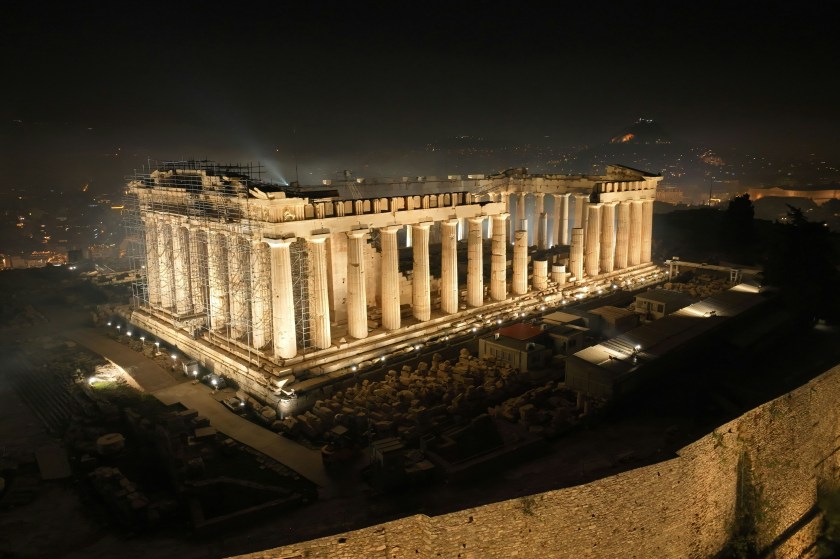
Photo of the Parthenon by Getty Images from Unsplash
 MORE TO COME...
Thank you, David. Coincidentally, a recent re-reading of George Eliot’s, “MIDDLEMARCH”, lead me to an essay about a phenomenon based on one of the novel’s more interesting flawed characters, The Rev. Mr. Casaubon. The ‘Casubon delusion’ , that is, a quest for The Theory of Everything, leads many astray. Bertrand Russell’s caveat regarding, getting after what can’t be got, is probably good advice. Safe Travels! Bob Stephenson
Thanks, Bob. Yes that caveat is good advice!
Pingback: Observations from . . . October 2024 | MORE TO COME...
Pingback: From the bookshelf: October 2024 | MORE TO COME...