
The postwar era of the mid-twentieth century—the atomic age and its corollary the Cold War—was a time of great change and widespread anxiety not unlike our current period of global unrest. In one small town along the Wabash River, a group of architects and artists—whose supporters included a philanthropist with family ties to an earlier utopian period in this place—produced site-specific contemporary works that not only went against the grain of generic modernist architecture but more importantly explored the realm of the spiritual against the political backdrop of the time.
If one understands history to be alive, with the past living in the present and the present living in the past, then this story of using history as a touchstone for community and spiritual transformation speaks in profound ways to our present moment.

Avant-Garde in the Cornfields: Architecture, Landscape, and Preservation in New Harmony (2019) edited by Ben Nicholson and Michelangelo Sabatino is an in-depth, scholarly exploration of an iconic small town in Indiana that provides insights and new perspective into architecture, landscape, preservation, spirituality, and philanthropy. The winner of the Allen G. Noble Book Award from the International Society for Landscape, Place, and Material Culture, Avant-Garde in the Cornfields traces how nineteenth century utopian aspirations based on the renewal of society through faith and later science became the touchstone for a transformation through preservation and reinvention of New Harmony’s traditions. During the Cold War years of the twentieth century, New Harmony became a spiritual “living community” and attracted a wide variety of creative artists and architects who left behind landmarks that are now world famous.
Written from the perspective of a rural town that has never numbered more than 1,000 residents, Avant-Garde in the Cornfields considers how history is interpreted through design and historic preservation. Founded in 1814 as one of three Harmonists communities led by Georg (George) Rapp, a German Pietist prophet who had broken with the Evangelical state church of Württemberg, New Harmony was shaped from the beginning “by an intermingling of faith- and science-based worldviews.” In the 1820s, the Harmonists were replaced by another group of idealistic settlers led by Robert Owen and William Maclure, and the town’s overarching idea shifted from religion to science. Michelangelo Sabatino’s accessible and thoughtful introduction provides the backdrop for this story, continuing through the inevitable decline of these utopian schemes to the town’s sleepy existence as a small Midwestern farm center and the initial efforts at historic preservation supported by private individuals and the State of Indiana.
In 1941, Jane Blaffer Owen—newly married to Kenneth Dale Owen, the great-great-grandson of Robert Owen—visited New Harmony on the way home to Houston from her honeymoon. Blaffer Owen was the well-educated and well-traveled daughter of a Texas oil tycoon and his art-collecting, philanthropic wife. Something about the buildings, landscape, and especially the story and “historical depth” of New Harmony captured her imagination.
Jane and Kenneth Owen began their support of New Harmony as traditional preservationists, focusing on restoration of buildings related to the Owen period of history. A lifelong Episcopalian who read widely and was greatly influenced by the writings and teachings of theologian Paul Tillich, Jane Blaffer Owen soon broadened the scope of her interest and philanthropy to “bring the religious devotion of the Harmonist era into dialogue with the scientific and pedagogical legacy of the Owen/Maclure era” in a way that would reinvigorate New Harmony’s built and natural environments, creating a new living tradition of faith and science.
Seven chapters from contributing authors provide—in detail that exceeds fifty pages in three instances—a comprehensive examination of a unique place where utopian ideals of the 19th century mix with mid-20th century values and design. Following a roughly chronological order, the chapters consider:
- the Blaffer and Owen family histories;
- the role of patronage in support of modernist architecture (with illuminating context around the work of J. Irwin Miller of nearby Columbus, Indiana);
- the commitment by Blaffer Owen and others to living memorials amidst the historic townscape;
- the challenging commission by Blaffer Owen that resulted in Philip Johnson’s iconic Roofless Church;
- the troubled history and ultimately unrealized project of Frederick Kiesler’s Cave of the New Being / Grotto for Meditation;
- the landscape of New Harmony which includes a memorial garden for Paul Tillich; and
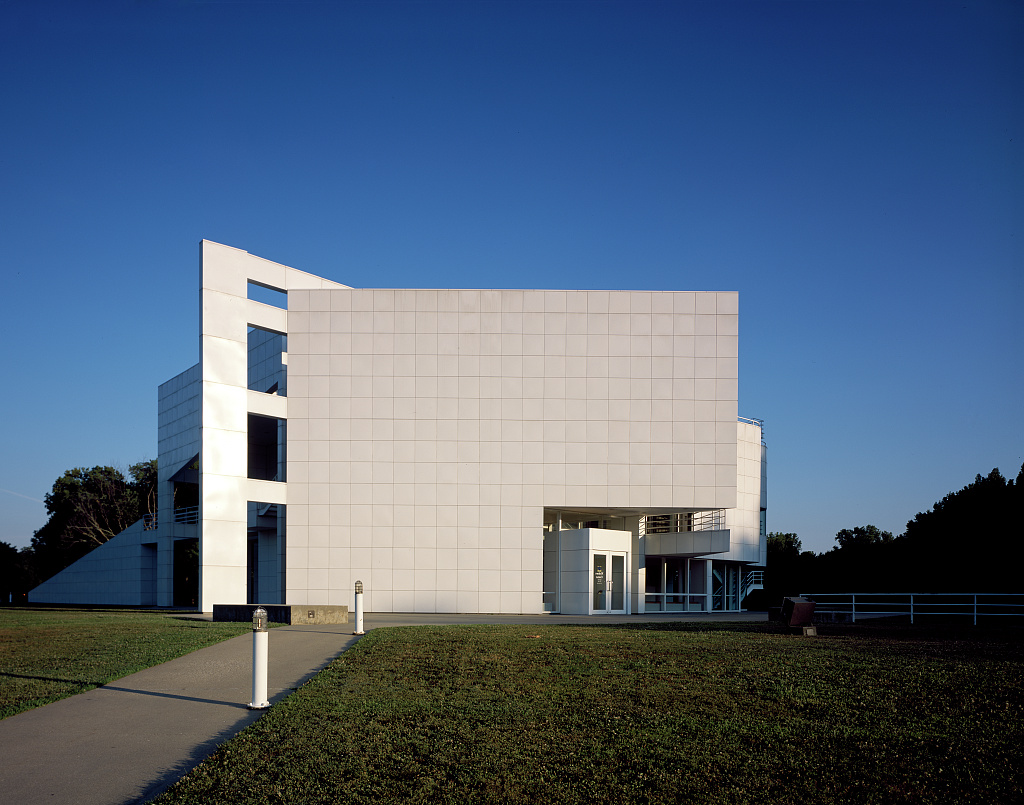
- the design, construction, and history of Richard Meier’s famous New Harmony Atheneum, including preservation and reuse issues around a modernist icon that no longer serves its original purpose.

Nancy Mangum McCaslin’s chapter on the family portrait of Jane Blaffer and Kenneth Owen opens the work and provides important context for Blaffer Owen’s unique role as philanthropist and visionary. She was drawn to the spiritual and intellectual chapters in the community’s history, believing “that both attributes were compatible rather than mutually exclusive.” Understanding this component of Jane Blaffer Owen’s worldview is a key to unlocking the development of the new path for preservation that she led at New Harmony.
Another chapter that captured my attention, in spite of its length, is Cammie McAtee’s examination of “The Rib Cage of the Human Heart: Philip Johnson’s Roofless Church.” McAtee notes that Blaffer Owen came to understand “that New Harmony’s strength lay in its potential to become a laboratory for ideas. She did not want it to be frozen in time, irrelevant to and disengaged from the present.” This revelation led her to work closely over a number of years with Johnson on a space that would serve as a spiritual focal point for the community and ultimately became her “dream of the perfect church for all sorts and for all faiths: a cathedral of earth and sky.” Johnson’s signature dome, which protects Jacques Lipchitz’s sculpture Descent of the Holy Spirit, began with an angularity of design. But Blaffer Owen’s rejection of that concept displays her vision for New Harmony, as she admonished the architect by saying: “You do not worship God with your elbows, you worship Him with your rounded arms.” By encouraging Johnson to relate the dome’s shape to the “gentle contours of the Indiana landscape,” she helped lead him to the final result, which she called “the rib cage of the human heart.”
Avant-Garde in the Cornfields is an expansive vision of this third “utopian” chapter in New Harmony’s history which the editors have brought together in one eclectic, in-depth, and ultimately satisfying volume. The story of how the extraordinary past and present of New Harmony continue to thrive today is worthy of consideration in our own troubled times.
More to come . . .
DJB
All photos of New Harmony by Carol M. Highsmith from the Highsmith Collection in the Library of Congress.
 MORE TO COME...
Sounds so interesting! I haven’t been to New Harmony, even though it’s just down the road. Always on the to-do list, which maybe will get done on sabbatical this time around. Thanks for the book rec!
Robyn
Thanks for the note, Robyn. I found the book fascinating, if a bit “scholarly” at times. The story is just fascinating. I had the pleasure of meeting Jane Blaffer Owen once or twice when I worked for the National Trust. What she did at New Harmony was so incredible, and very much down a different path than that taken by traditional preservationists. If you go, please give me a report. All the best, DJB
Pingback: The 2024 year-end reading list | MORE TO COME...
Pingback: Observations from . . . December 2024 | MORE TO COME...
Pingback: From the bookshelf: December 2024 | MORE TO COME...