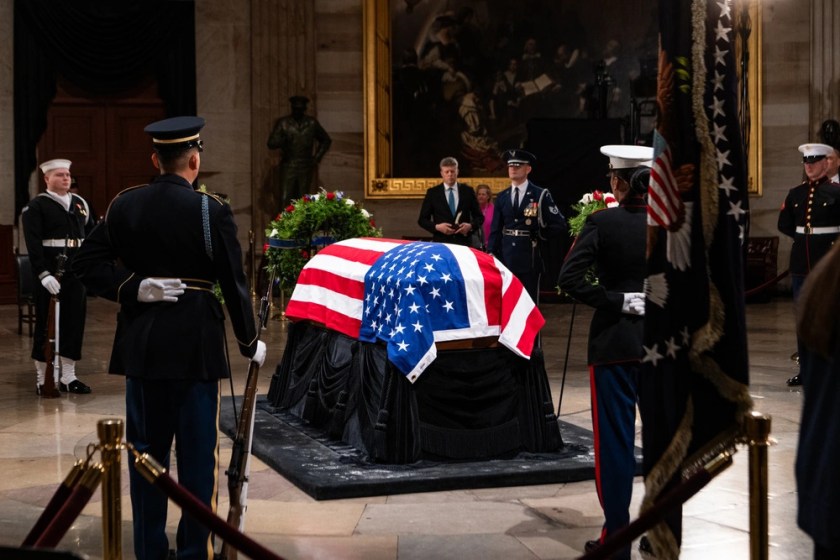
UPDATED on January 8, 2025: As Washington honors former president Jimmy Carter today as he lies in state at the U.S. Capitol and tomorrow with a state funeral at the Washington National Cathedral, I wanted to share a copy of the program from the funeral which Andrew will sing as a member of the Cathedral Choir.

My friend Carol Highsmith, who has photographed America for decades and has shared those images with the American public through her Carol Highsmith Collection at the Library of Congress, shared a photograph today of the Carters taken at the Maranatha Baptist Church in 2017.

Finally, one of the best remembrances of Carter comes from Jim Barger Jr. in the piece “Unwavering” on the Bitter Southerner website. Posted on October 1st in honor of the former president’s 100th birthday, it has the following as its summation:
“You can argue over whether Jimmy Carter was America’s greatest president, but he was undoubtedly one of the greatest Americans to ever become president. He and Rosalynn eliminated fatal diseases, championed human rights, and literally negotiated world peace. He still believes in us.”
UPDATED on December 30th: New links and remembrances.

With today’s passing of former president Jimmy Carter, we will all discover stories throughout the media—some written several years ago on special occasions such as his 100th birthday—that exemplify the type of man he was.
Such as the time Jimmy Carter risked his life to help save Ottawa by lowering himself into a melting nuclear reactor. In 1952 as a young Naval officer, Carter was in the early stages of his life and career. He had recently been sent to work under Captain Hyman Rickover at the Naval Reactors Branch of the Atomic Energy Commission in Washington, D.C. Carter, who worked closely on the nuclear propulsion system for the Sea Wolf submarine, was one of the few people in the world who had clearance to go into a nuclear power plant.
On December 12, 1952, a 28-year-old Carter was called into action after an accident occurred on a new experimental nuclear reactor at Chalk River, Canada. “Carter and his team were a part of the group of people who needed to clean and fully shut down the reactor. The short amount of time Carter and his team could spend at any stretch meant they needed to be precise.”
The fact that the capital of Canada was not decimated in a nuclear accident attests to their success. Carter exposed himself in 89 seconds “to the same amount of radiation that the general population absorbs in one year. He later said his urine continued to test positive for radioactivity for six months.”
While all the major news outlets have posted obituaries, which detail Carter’s political career, his exemplary post-presidency, his humanitarian and peace-building successes, and more, historian Heather Cox Richardson has an especially wide-ranging and thoughtful assessment of President Carter’s life and legacy. It is worth your time.
Brian Klaas also has an insightful piece on his Substack newsletter today where he writes that “post-presidency legacies are so fascinating, because they reveal true character that is dissociated from the vicious political battles in Washington and the flukes of history.”
“We have lost Jimmy Carter, but Carter’s presence will be felt around the world for decades to come. Now that he has died, consider his hidden legacies—because he has literally saved millions upon millions of people from excruciating pain, debilitating disease, and blindness. That, surely, is a legacy we can all agree is worth celebrating.”
My memories of Jimmy Carter began while I was in college but have lasted a lifetime.
The 1976 campaign, when former Georgia Governor Jimmy Carter took on the incumbent Gerald Ford, was the first time I was eligible to vote for president. A few weeks before Election Day, I was in Philadelphia as a young college student studying history and historic preservation, attending the National Trust Annual Preservation Conference—the first of 41 I attended over my career.
Philadelphia in 1976 moved me. I loved exploring a real city, a gritty city at the time, with my friends and classmates. It was so different than Murfreesboro or Nashville. We ate food that had never before passed my Southern lips and heard strange accents that sounded foreign to my ears. I was able to see and touch Independence Hall and Carpenters Hall, iconic places that I had explored only in books as my interest in the past expanded and deepened. Being in the room where the delegates debated concepts such as the self-evident truths of life, liberty and the pursuit of happiness made it all come alive.
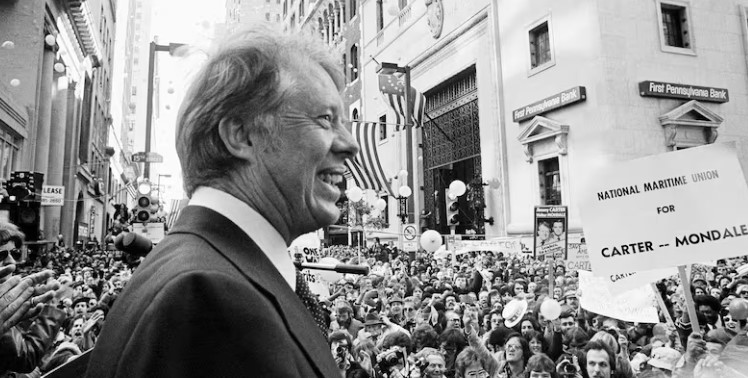
And the real-time relevance of history and place exploded in my face during that trip. I was there near the end of the presidential campaign; the first time the people would have a voice after the upheavals of Watergate. Jimmy Carter was scheduled for a massive downtown rally late in the week. Several classmates and I wedged our way into the tens of thousands of people who filled four streets that came together at the intersection where the candidate would speak.
My heart raced as I heard the roars for that now-familiar Southern lilt coming from a man who in a few short days would be president-elect. My mind thrilled as I realized that here I was, in the city where the concept of a government, deriving powers from the consent of the governed, had its most powerful realization. Somehow, I also understood that, in casting my first vote for president, which went to President Carter, I would soon be a part of what Abraham Lincoln noted was the ongoing fight to see if a nation dedicated to the proposition that “all men are created equal” can long endure.
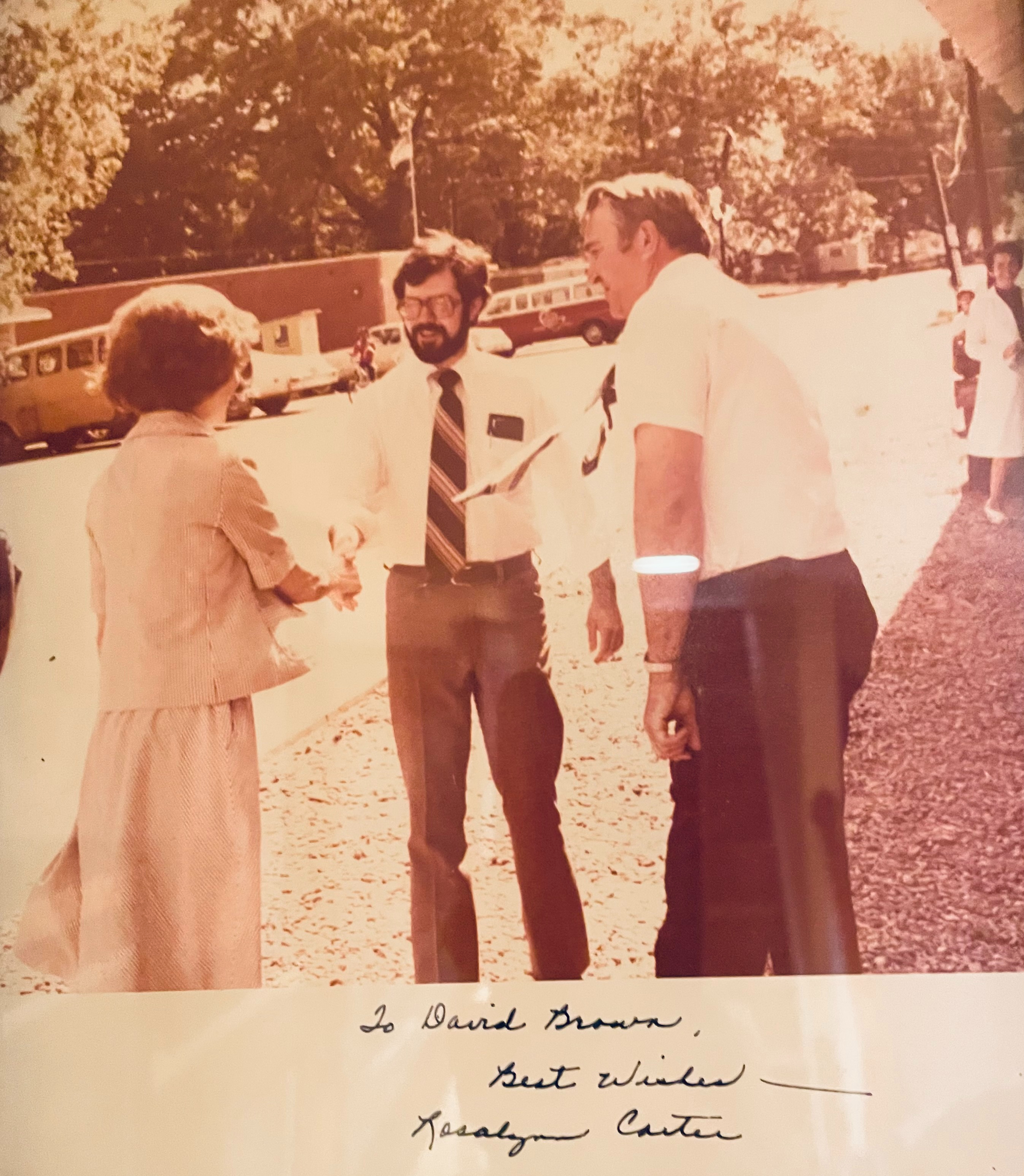
Two years later I was living in Americus, Georgia, just ten miles from Carter’s hometown of Plains. I was the first historic preservation planner in a joint program between what were then called Area Planning and Development Commissions and the state historic preservation office. I had moved to a place with a complex history, as histories usually are.
I spent two years of the Carter presidency living near Plains. In his book The Outlier, Kai Bird describes South Georgia’s racial inequality, the poverty, the patriarchy, the over-the-top religious piety that was part of the atmosphere but that could also serve up deep hatred towards the interracial Christian Koinonia community. As someone who lived there in the 1970s, it all rang true. Jimmy Carter was shaped by those forces and also reacted against them.
And as we celebrate Jimmy Carter today, let’s remember the many and varied accomplishments of the Carter administration. On the domestic side Carter began the deregulation of American business that brought everything from lower airline prices to the emergence of craft beer. His energy policies saw a decline in foreign oil imports and led to investments in solar, wind, and other renewable energy sources. Consumer regulations from automobiles to pharmaceuticals led to the saving of thousands of American lives each year. We ended his administration with cleaner water and air along with the protection of valuable parts of the country’s wilderness. Inflation was whipped at a steep political cost and the judiciary saw its first large influx of women and minorities. Foreign policy achievements included the ratification of the Panama Canal and SALT II treaties, normalization of relations with China, and the Camp David agreement between Israel and Egypt.

Jimmy Carter was a complex man who lived a very consequential life.
Rest in peace, Mr. President. May your life of service inspire other leaders to follow your pragmatic yet hopeful belief in the ideal of America.
More to come . . .
DJB
For other MORE TO COME posts on President Carter, see:
Jimmy Carter lying in state at the U.S. Capitol on January 8, 2025. Photo in the public domain from the U.S. Military via Wikimedia Commons.
 MORE TO COME...
A wonderful tribute to President Carter, David. And I loved hearing about your casting your first Presidential vote for him (and the great photos of you with dark hair AND a beard!).
Thanks, Sandy. Jimmy Carter was a consequential president. And yes, I kept my beard through my 20s, but as it started to become spotted with white hair, I shaved it off. Once I retired, I realized that it was now all white . . . and I could grow it back! Also fun to see how slim I was back then in my early 20s! Thanks for reading and writing. DJB
Pingback: Observations from . . . December 2024 | MORE TO COME...