
Winter arrived with a vengeance this week.
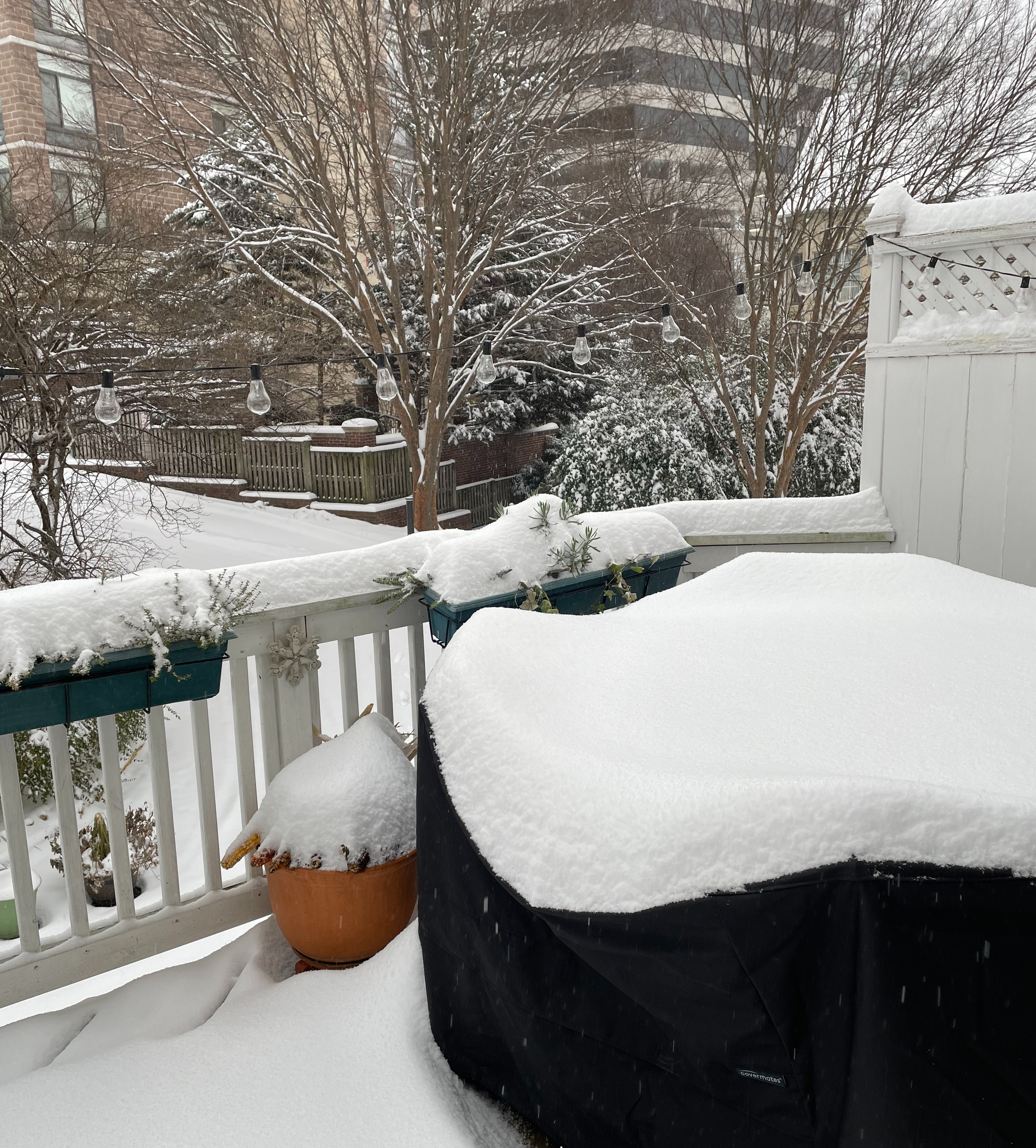
We had our first significant snowfall of the season in the region on Monday. With an Arctic vortex bearing down, the temperatures will stay below freezing for the foreseeable future, meaning that the six-ten inches or so of snow that arrived isn’t going anywhere soon. Minnesotans know how to live with this weather and enjoy it. For those of us raised in the South, not so much.
Winter can be difficult. We may feel isolated as friends hunker down in their homes. The cold itself can be a challenge, something I’m finding to be true as I age. To others, the apparent death of life—as nature drops its spring/summer/fall finery and turns within itself for sustenance—can bring on depression.
We’re also facing the existential dread (or so it seems) of another four years of political madness and folly. And it’s not even February, which—I believe—is the longest month of the year.
How do we cope and find hope in difficult and troubled times?
Katherine May writes in Wintering that these months are necessary and a good time to step back. They are also a metaphor for the idea of retreat. Winter, you see, “is not the death of the life cycle, but its crucible.”
Parker Palmer takes on the same theme in Seasons.
“. . . winter has an even greater gift to give. It comes when the sky is clear, the sun brilliant, the trees bare, and the first snow yet to come. It is the gift of utter clarity … Winter clears the landscape, however brutally, giving us a chance to see ourselves and each other more clearly, to see the very ground of our being.”
Clarity and hope
Clarity in troubled times is important. Difficulties require clear thinking. But at the same time it is important that we not give up hope. As Rebecca Solnit reminds us, hope demands things that despair does not. “Hopefulness is risky,” writes the historian, author, and activist, “since it is after all a form of trust, trust in the unknown and the possible, even in discontinuity.”
We have to understand that “to be hopeful is to take on a different persona, one that risks disappointment, betrayal…” And still, historians and theologians remind us that hope can carry us forward. Not the greeting card type of hope but the gritty kind “that gets up every morning and chooses to try to make the world just a little kinder (or better) in your own way.” Hope that is clear-eyed and grounded in memory. Historian Howard Zinn spoke of how important hope is in difficult times.
“To be hopeful in bad times is not just foolishly romantic. It is based on the fact that human history is a history not only of cruelty, but also of compassion, sacrifice, courage, kindness. What we choose to emphasize in this complex history will determine our lives. If we see only the worst, it destroys our capacity to do something. If we remember those times and places—and there are so many—where people have behaved magnificently, this gives us the energy to act, and at least the possibility of sending this spinning top of a world in a different direction. And if we do act, in however small a way, we don’t have to wait for some grand utopian future. The future is an infinite succession of presents, and to live now as we think human beings should live, in defiance of all that is bad around us, is itself a marvelous victory.”
Howard Zinn from “A Power Governments Cannot Suppress”
Reenacting creation
The Friends of Silence remind us at this time of year that stillness and reflection are key to our retreat, our replenishment, our renewal.

Bill Brown was a prolific poet and beloved teacher from Dyersburg, Tennessee. Chapter 16 recently referenced one of his poems that speaks to the possibilities of winter—and hope.
In Praise of Winter Trees
A closed heart can’t greet
a winter sky. Even a rain puddle
is filled by it, and a horse trough,
and the slow current of creeks.
Winter trees, sycamore and oak,
reach for the sky to offer praise –
stark, hard praise, born from all
those rooted years of bearing
the sky’s weight. Some nights
an open heart is filled with vast
spaces between stars the mind
can’t grasp. The thought of heaven
is not so much mammothed by
the sky’s grandeur, but mystified
beyond our silly notions. Winter
trees aren’t arrogant; they praise
no flags, no denominations,
they owe allegiance to the soil.
My sister, when she was younger,
awoke in winter to hold her arms
up to the sky, shiver in the wholeness
of it, let shadows of winter trees
dance sunlight across her face.
Oak, beech, sycamore, maple, and gum,
reenact creation, drop their seeds
from the sky, make their homes
in star dust, and reach back
toward heaven. Trees suffer
drought and freezing rain, accept
Bill Brown from the collection “Late Winter” (2008)
the annual tilt toward shorter days.
Some ancient hope, like winter light,
is allied with the gravity of stars.
Here’s wishing you a period of retreat, clarity of vision, and the sustenance of hope during this time of winter.
More to come . . .
DJB
Winter landscape from Pixabay.
 MORE TO COME...
Alice Smith Duncan
Alice, the text of your comment didn’t come through. Thanks, as always, for reading. Best to you and Chris.
A lovely reflection, David. I started reading Marilyn McEntyre’s Midwinter Light: Meditations for the Long Season, during Advent. It is a series of 39 reflections on poems about winter, and while there are some references to Advent, for the most part the essays simply deal with the silence, reflection, and yes, hope, winter brings if only we will look and listen. Since there are fewer than 39 days in Advent, I am just now reading the final reflections (I have been reading one a day). You might like the book.
Sandy
Sandy,
Many thanks for the recommendation. It sounds like just the right type of book for this time of year. Take care.
DJB
Pingback: Observations from . . . January 2025 | MORE TO COME...
Pingback: America remains a work-in-progress | MORE TO COME...