
Even in retirement, I generally wake up between 5 and 6 a.m. Living with two people whose internal clocks are set to function later in the day means the house is dark and quiet, allowing me to savor the calm that comes before the morning sun. I make my way to my fourth floor studio, but before I stretch and settle in to write I try and begin the day with some moments of quiet contemplation.
One of the resources I’ve called upon for this practice is the daily meditation from the Center for Action and Contemplation (CAC). Contemplation is a way of listening with the heart while not relying entirely on the head. I was not raised in a contemplative religious tradition, but I saw it modeled every day.
My father clearly understood the value of quiet time to begin the day. I have not lived out my father’s deep faith and compassion, but I try to follow his model. At the very least I have inherited his get-out-of-bed-early genes. Each morning, before waking up his five children, cooking our breakfast, and then riding his bike to arrive at work by 7 a.m. (!) he spent time at the dining room table reading, praying, writing . . . listening with his heart. Then he lived what he heard in actions large and small throughout the day.
Franciscan Richard Rohr founded the CAC in 1987 because he saw a deep need for the integration of both contemplation and action. The two are inseparable. Father Richard says that the most important word in the Center’s name “is the word and.”
Contemplation and action.
I came to appreciate the importance of the word “and” when I first read a meditation on loss, love, and cherishing life. In her memoir, Kathryn Schulz devotes the final portion of the book to the word “and” as she considers the passage of time that takes place around the liminal transitions of losing a parent and finding a life partner’s love. In our deepest grief, life goes on. As we experience the initial joys of love, life goes on. I returned to reread the book this week.
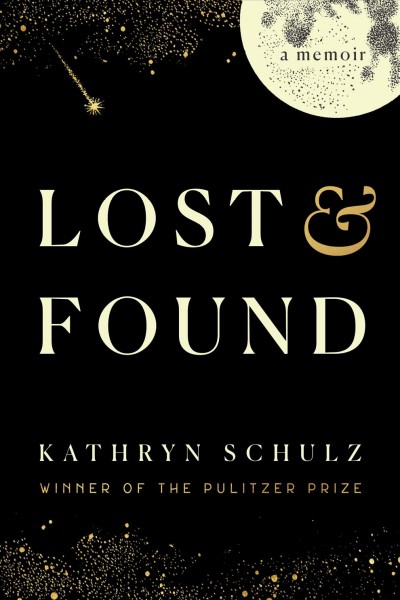
Lost & Found: A Memoir (2022) by Kathryn Schulz is a tender, searching meditation on love and loss and what it means to be human. Schulz, an exquisite writer, knows that there is both a wonder and fragility to life. While many feel small and powerless in the face of that reality, it is also easy to feel amazed and fortunate to be here. Schulz is clearheaded in her exploration of the mixed experiences and motives we encounter. As she moves through life, Schulz notes that her days are exceptional even when they are ordinary. “We live remarkable lives,” she writes, “because life itself is remarkable.”
“The world is full of beauty and grandeur and also wretchedness and suffering; we know that people are kind and funny and brilliant and brave and also petty and irritating and horrifically cruel…. As Philip Roth once put it, ‘Life is and.’”
Many grieve at the seeming loss of values—freedom, honesty, truth, empathy—that we thought the majority in our country held dear. Schulz notes that grief of any kind will age you, “partly from exhaustion but chiefly from the confrontation with mortality.” In times like these we can feel “at a loss—a strange turn of phrase, as if loss were a place in the physical world, a kind of reverse oasis or Bermuda Triangle where the spirit fails and the compass needle spins.”
For many, the compass needle is spinning. We are seeking transformation of our personal bodies and spirit as well as our body politic and the communal spirit of civility.
Rohr has named transformation as the fruit of an authentic spiritual path. If we are truly focused on listening from the heart we will—over time—be transformed. And Rohr asserts that we see that transformation through action.
“Through service toward the depths, the margins, toward people suffering or considered outsiders. Little by little we allow our politics, economics, classism, sexism, racism, homophobia, and all superiority games to lose their former rationale. Our motivation foundationally changes from security, status, and control to generosity, humility, and cooperation.”
The transformed mind lets us see how we process reality. It allows us to step back from our personal perceptions so we can be more honest about what is really happening. Transformation isn’t merely a change of morals, group affiliation, or belief system—although it might lead to that—but a change at the very heart of the way we receive and pass on each moment.
But we need the “and” to transform attention and contemplation towards action and service. We can’t reach our full potential only through contemplation or only through action.
This is a difficult time. But almost all times are difficult. If we are honest with ourselves, we don’t only want to live long lives, but we seek happy and useful lives. The secret to living a long life is pure luck. We may work at our diet and exercise but then be hit by an inattentive driver the next time we cross a street.
But . . . the secret to living a happy and useful life is entirely within our control. How we respond is important. That’s the core of response-ability: the ability to respond.
Recognizing that we have the potential to live and respond with opposites—contemplation and action—helps us navigate the paradox at the heart of life. That recognition helps us respond to these times which—like all the days of our lives—contain both strife and harmony. Concern and contentment. Fragility and wonder. Suffering and beauty. Darkness and light. Shock and amazement. Cruelty and braveness. Tears and laughter.
Grief and gratitude. Loss and love.
Death and life.
Schulz ends her generous and perceptive work by noting that disappearance reminds us to notice, transience to cherish, fragility to defend. “We are here to keep watch, not to keep.” Those words have become something of a mantra for me as I navigate the “and” of life.
More to come . . .
DJB
Photo by Denise Johnson on Unsplash
 MORE TO COME...
Pingback: Observations from . . . February 2025 | MORE TO COME...
Pingback: From the bookshelf: February 2025 | MORE TO COME...
Pingback: The year in books: 2025 | MORE TO COME...