
In recent days Joy is a fine initial act of insurrection was trending again on MORE TO COME. That 2017 post examined three collections of essays written by historian and activist Rebecca Solnit as a trilogy for our times. Hope in the Dark, the first of the series, finds Solnit writing about the demands of hope before noting that joy is a way to support the work which hope demands.
“Joy doesn’t betray but sustains activism. And when you face a politics that aspires to make you fearful, alienated, and isolated, joy is a fine initial act of insurrection.”
Solnit has long been a favorite for her clear-headed analysis, pragmatic takes, and hopeful outlook on the crises of our times. I was thrilled to discover that she recently launched a newsletter, and even though I have been intentional in pulling back from some of the worst of the newsfeeds, it only took a minute to decide to subscribe.
Do not surrender to morally and imaginatively impoverished billionaires

Meditations in an Emergency is Solnit’s response to the authoritarian “attack on the long emergence of a new society.” Solnit is writing out of the belief “that there are possibilities in the face of this would-be dictatorship. There always are. I’m here to explore them and act on them with you.”
Time does not run backward. And Solnit reminds us that we do not have to surrender to “morally and imaginatively impoverished billionaires” who do not expect or imagine or understand consequences.
“In 2018, Michelle Alexander wrote a powerful essay that’s stayed with me as a touchstone. She wrote that we are not the resistance, they are. She used the metaphor of rivers and dams, to say we are not trying to dam the river of change they are: ‘Donald Trump’s election represents a surge of resistance to this rapidly swelling river, an effort to build not just a wall but a dam. A new nation is struggling to be born, a multiracial, multiethnic, multifaith, egalitarian democracy in which every life and every voice truly matters.’ . . . I’m with [Alexander]. You can dismantle the institutions, violate the law, attack the vulnerable. But you can’t convince most of us we don’t deserve our rights or our democracy; you can’t convince us to forget what we know.”
I want to quickly share two of her recent essays and encourage you to take a deeper dive into her newsletter.
The misery of those who have a lot and can never have enough

Solnit asserts that “No One Knows How This Will End (But I Do Not Think It Will End Well for Them)” (February 16th). She begins with the “sulky arrogance of [JD] Vance’s performance” at the Munich Security Conference, perfectly nailing the reality of that sad spectacle.
“Only a few days after being rebuked by the pope himself for getting his theology wrong during a week in which he also got rebuked by legal scholars for a tweet in which he got his Constitutional law wrong, he was reveling in the power to be an asshole while getting his facts about European politics wrong and weakening his own and his country’s actual power.”
Then Solnit turns her gaze to the false belief that underpins the actions of these men who would be our oligarch masters.
“These three horsemen of the MAGA-tech-bro apocalypse are in the position of penthouse dwellers who think their top floor apartment doesn’t rest on all the floors underneath, or so it looks to me as they rush about wrecking things with an apparent conviction that they’re immune to the impact . . . that they have defeated everything including cause and effect . . .
I don’t know where Trump, Musk, and Vance’s story ends, but I know it doesn’t end with them in power, and I don’t think it will end particularly well for them, though my main concern—and yours, I presume—is trying to prevent damage along the way. And I’m convinced that if we take action, we get to write some of the chapters and maybe revise or erase some of what they’re trying to impose.”
Destruction at the intersection of hideous and heartbreaking

Solnit is the first to admit that this is a very hard time, but people are comforting others, in the best sense of the word.
“Everywhere I went it felt like people were trying harder than usual to show up, to connect, to be their best selves. This is emergency behavior. This is how people behave when their city is bombed or flooded or burning down, this extra care, this extra presentness, this best self connecting with other best selves. Then, online, an actual pastor I knew reminded me that the word comfort means to fortify (com– as in with; fort as in fortress, fortitude, and fortify), maybe to fortify with kindness. We were fortifying each other with what we had to offer, which was ourselves, by really being with each other.”
Do the work
Sadness is certainly not going to stop Solnit. Not with her long history of activism. To say she’s sad is to describe how she feels, not what she thinks.
“The job isn’t to be happy, sad, angry, unfeeling, or anything else; it’s to do the work to oppose this destruction. But taking care of yourself so you don’t fall apart or wear out or aggravate you allies too much is how you stay capable of doing it. One thing I find useful is the distinction between feelings and commitments—you can feel despair or grief or exhaustion and not let go of your commitments or principles. Emotions are the weather that swirls around and changes and changes again. Commitments, principles, are the mountain on which the sun and the rainstorm fall, and it remains a mountain. Pay attention to your storms and rays of light and pay attention to the mountain on which all those things fall.”
I believe we are seeing signs and pushback, suggesting that the “inevitability” of American authoritarianism isn’t all there is to the story. To that end, I came across this reminder from another author which focuses on the work we will be facing today . . . and always.
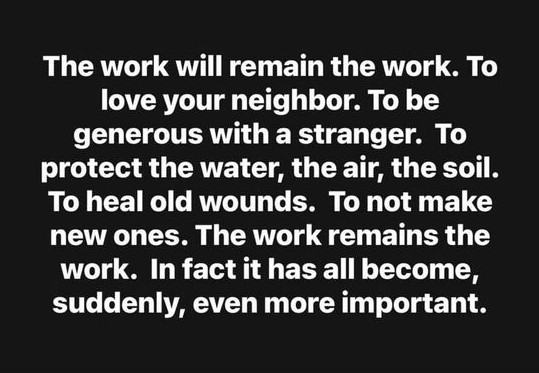
This is work that our oligarchs, who have it all backwards, do not understand. As Solnit asserts, they confuse coercion with power and cooperation with weakness. The opposite is actually where the truth lies.
“Kindness is seen as a weakness, but it’s a strength, both in its ability to care for others and in its recognition of the ways we’re all connected. I wish you the fortress in comfort, the kinship in kindness, and the courage in encouragement, in both what you give and what you receive.”
More to come . . .
DJB
Photo by Kenny Eliason on Unsplash
 MORE TO COME...
Pingback: Observations from . . . February 2025 | MORE TO COME...