Far too often those who see a new way forward envision a modernity that breaks with the past. We’re told that to reach new ways of thinking and living we must “grab the pick-axes, the hatchets, the hammers and demolish, demolish without pity” our venerable cities, governments, social systems, religions. It is an impulse as old as the ancients and as modern as today’s news.
A century ago, this narrative of rupture between past and present was active not only in rapidly growing political movements but also in the fields of city planning and architecture. Modernists such as Filippo Marinetti (he of the pick-axes and hatchets), Le Corbusier, and others drew sharp lines between historic and modern cities. Into this battle stepped Gustavo Giovannoni (1873-1947), recognized during his lifetime as the central figure in the architectural culture of Italy in the first half of the twentieth century. His insistence on placing the conservation of the historic city in its entirety at the center of a comprehensive preservation philosophy—and not just focusing on isolated monuments—led to today’s regard for Giovannoni as a founder of the modern conservation movement.
Now, a century later, his timely work and writings are reaching new audiences thanks to the Getty Conservation Institute.

New Building in Old Cities: Writings by Gustavo Giovannoni on Architectural and Urban Conservation (2024) edited by Steven W. Semes, Francesco Siravo, and Jeff Cody is a highly relevant and richly illustrated book of the largely forgotten architectural work of an important early advocate for the conservation of historic cities. Because Giovannoni’s works had not been translated into English, his approach to architectural restoration and rehabilitation based on the “simultaneous consideration of the historical, technical, environmental, social, and aesthetic dimensions of ‘monuments’ and ordinary buildings” was not widely known internationally. From his base in Rome, Giovannoni urged the education of the “complete architect” who would be “multidisciplinary, practical designers capable of advancing an integrated vision of the city in all its spatial and temporal dimensions.”
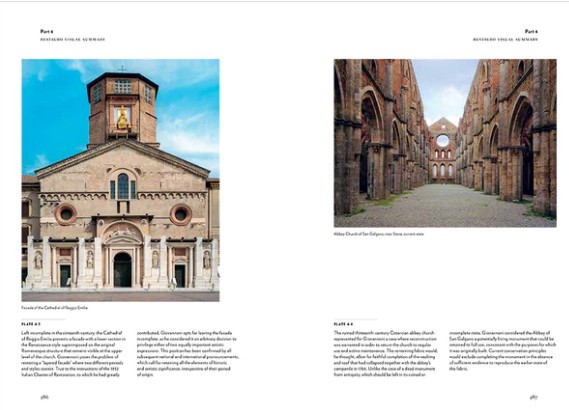
This anthology includes the seminal writings of Giovannoni. Thirty readings, including the original illustrations, are organized into sections that correspond with key concepts in his conservation theory: urban building, respect for the setting or context, incremental interventions in the urban fabric, conservation and restoration treatments, the grafting of the new upon the old, and reconstruction after World War II. The editors also include insightful introductions for each section along with an illuminating synopsis for each reading. Plate sections follow at the end of each grouping, further illustrating the readings’ main concepts and themes.

New Buildings in Old Cities is an impressive, wide-ranging, and thoughtful work as we consider the future of the historic city in modern times. I was delighted when the editors agreed to answer my questions about this new book.
DJB: Welcome Jeff, Steven, and Francesco. Let me begin by asking why you decided to focus on Gustavo Giovannoni, an architect working in Italy over 100 years ago, and why are his works and views on conservation still relevant in the 21st century?


JC, SWS, and FS: We chose to focus on Gustavo Giovannoni because he was one of the first to understand the historic city not as a collection of isolated monuments but as a coherent, living organism—a complete system whose value lies as much in its ordinary fabric as in its landmarks. His work established an integrated approach to urban conservation that remains highly relevant today.
Giovannoni introduced concepts that have since become foundational to the field: the importance of vernacular architecture (what he called edilizia), the need to respect the ambient character of historic areas (ambientismo), and the idea of incremental urban renewal (diradamento) as an alternative to both neglect and wholesale demolition. He also pioneered the concept of innesto, or grafting new architecture into old settings in a way that is respectful and compatible—a concern that continues to shape debates on adaptive reuse and context-sensitive design.
At a time when conservation practices are evolving to meet the challenges of climate change, social equity, and sustainable development, Giovannoni’s thinking offers valuable guidance. His humanist vision—integrating scientific, technical, historical, environmental, and aesthetic concerns—anticipated the multidisciplinary nature of today’s best practices in preservation and urban design.
His relevance is further underscored by how many of his insights have been vindicated in recent decades, from the typological studies of Muratori and Caniggia, to conservation plans in Bologna and beyond, and even to current approaches in cities where urban conservation must balance heritage value with contemporary needs.
At the turn of the twentieth century, Paris was widely viewed as the model of the modern city. Giovannoni, however, frequently held it up as a model not to be emulated in Rome or other large cities in Italy. What about Paris in particular, and the Modernist movement in general, did he find objectionable?
Giovannoni regarded 19th-century Paris—with its sweeping boulevards, symmetrical axes, and deliberate isolation of monuments—as a cautionary example rather than a model to follow. He considered the Haussmannian approach to urban renewal, based on massive clearances and the imposition of geometric street grids, as antithetical to the organic development of traditional cities like Rome. In his view, these interventions severed the historical continuity of urban environments, reducing their richness to staged set-pieces dominated by axial views and isolated landmarks.

He was particularly critical of the idea of sventramento—or gutting the urban core—which had become a dominant tool in modern planning. Such practices, he argued, sacrificed the social, spatial, and architectural complexity of historic quarters in favor of abstract visual order and circulation efficiency. He opposed the “liberation” of monuments when it resulted in their decontextualization—turning vibrant, lived spaces into sterilized museums of urban grandeur.
Giovannoni also viewed Modernism with scepticism, especially where it imposed a tabula rasa approach and dismissed traditional building types and materials. Although not opposed to modern architecture per se, he insisted that any new intervention in a historic setting must respect the scale, character, and atmosphere (ambientismo) of the existing city. He saw the uncritical adoption of Modernist planning models—often imported from different cultural contexts—as a form of erasure rather than progress.
In contrast to the rationalist and mechanistic visions exemplified by the Plan Voisin of Le Corbusier or the boulevard schemes of Haussmann, Giovannoni promoted a conservation-led model that prioritized continuity over rupture, adaptation over demolition, and complexity over simplification. His ideas anticipated many of today’s concerns with context-sensitive development, heritage integration, and sustainable urbanism.
Giovannoni asserted the impossibility of fixed principles in conservation, instead defining a set of values to be balanced. Why did he take that approach and how did it play out in real life situations in the urban context?
Giovannoni became an architect at a time—as the 20th century dawned—when “fixed principles in conservation” were far from clear-cut. For example, Ruskin’s ideas about conservation were at odds with those of Viollet-le-Duc. Furthermore, many cities were reeling from the complexities of industrialization and, on the horizon, the role of the automobile within historic urban contexts. As he witnessed his cherished Rome being nearly massacred by new technologies (to the point that an early master plan for the city proposed transforming the Piazza Navona into a traffic artery), Giovannoni embraced the need to find a balancing middle ground between seemingly opposing tendencies.
One way that played out in Rome was how Giovannoni helped design a new bypass directing around rather than through Piazza Navona—the Corso del Rinascimento—to accommodate the needs of the modern city for open space and ease of movement, with the needs of already established residents for streets, squares, and intimate urban spaces at the scale of pedestrians. Giovannoni’s ideas concerning diradamento were also key to the changes he advocated (and were implemented) along the Via dei Coronari in Rome’s historic core.

In the book, we also provide examples in four other Italian cities—Bergamo, Bari, Bologna, and Orvieto—where students or followers of Giovannoni implemented his transactional balancing of needs and values tested by differing urban realities. Sometimes, though, his mediating tendencies did not prevail, as was seen in the construction of the Via della Conciliazione, (which he opposed) linking the Tiber River with St. Peter’s Basilica.
Writing in 1946 after the defeat of Fascism, Giovannoni salutes the vernacular urban fabric as “the democracy of architecture.” What does he mean and how does it affect his approach to conservation?

Giovannoni had inherent respect for what he sometimes called either the architettura minore or the ambiente cittadino of the city—as a necessary complement to the monumentality of larger-scale icons, such as major churches or ancient ruins. The synergy that he espoused between protecting what I would call the “democratic majority of the vernacular” and the “autocratic minority of the Monument” was a hallmark of his conservation approach. As he wrote near the end of his life, “the major monuments of the city not only have intrinsic value, but are linked with the urban setting that the evolution of the times has altered without transforming them radically.” The “radical” changes being promoted by Le Corbusier, CIAM, and others in the so-called Modern Movement were antithetical to Giovannoni’s concern for finding a middle way between embalming historic architecture in a timeless straightjacket while allowing that architecture to breathe, evolve, and thrive in the context of inevitable change.
Giovannoni considered a neighborhood or a city as “a complex organism that has its arteries and its nerves but also its spirit and its character.” In this, he sounds very much like the contemporary Southeast Asian conservation specialist Laurence Loh whose writing Jeff and Francesco highlight in a 2019 book for the Getty: Historic Cities: Issues in Urban Conservation. How does this book build on that earlier volume and what are a few of the key insights on urban conservation we can recognize in comparing the two?
One way in which the Giovannoni book grew out of Historic Cities was because we discovered that almost no English translations of Giovannoni’s insightful writings were available. This major absence helped us argue (with my Getty Conservation Institute colleagues) for a separate volume exclusively devoted to Giovannoni’s work, so that not only Italian speakers could understand his significance to contemporary conservation practice.
Historic Cities sought to make the case for more successful urban conservation based on observations and examples from a wide diversity of perspectives and cultural contexts. New Building in Old Cities, which derives its “visual summaries” and other aspects of format and structure from the previous volume, drills down deeply into one key individual, his prescient ideas about urban conservation practice in Italy from nearly a century ago, and how these ideas relate to conservation challenges today.
In terms of key insights from the two related books, I’m reminded of something we wrote in the preface of Historic Cities: “. . .[Our] common urban past, far from being the result of an undifferentiated historical continuum, is in reality a historically determined, finite resource, with formative characters that are distinct, unique, and unrepeatable. As such, it requires methods of interpretation, planning, and management that are markedly different from those applicable to the contemporary city.” More specifically, the two books suggest that it is imperative to train practitioners who have a comprehensive and sensitive understanding of the totality of the urban built environment (the “historic urban landscape” in today’s jargon). We need “complete architects” (what Giovannoni called “architetti integrali”) who can find architectural and planning solutions based on holistic civic engagement and the balancing of aesthetics with other societal needs. If such practitioners are in place more broadly, then we might better protect the fragile historic places that remain so challenged worldwide—for so many reasons—and we might then achieve more effective urban conservation, which embraces both the management of inevitable change and the management of cultural continuity.
Gentlemen, congratulations and many thanks.
You’re welcome.
More to come . . .
DJB
UPDATE: I had a book review of this work in the January issue of the Journal of Architectural Education.
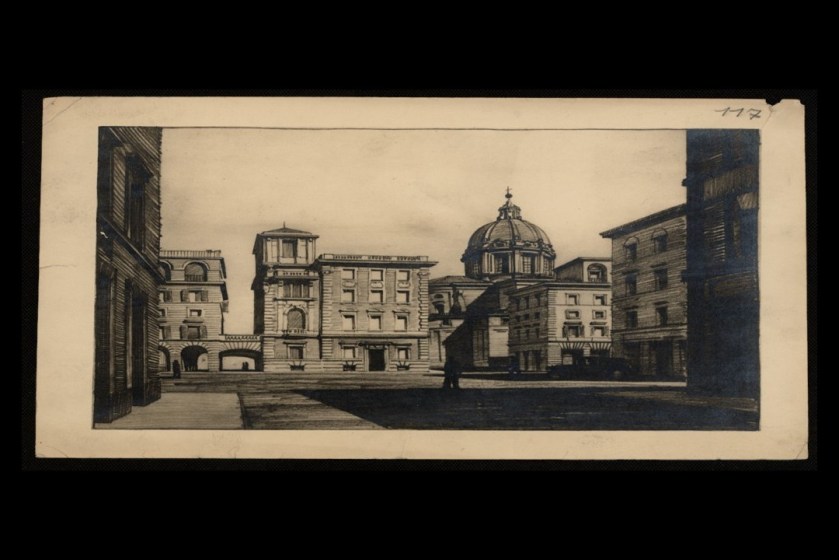
Image: Gustavo Giovannoni rendering of Palazzetto Torlonia, Rome (1908–09)
 MORE TO COME...
David,
Although not directly analogous, the principles outlined in this piece reminded me of what Jim and I were told in Cologne about the restoration of the city after WWII. As you probably know, Cologne at its center has both the remains of a Roman town and a Medieval walled city. The area within what had been the Medieval walls (and which, to this day constitutes “downtown”) was 90 percent destroyed during the war.
In planning the reconstruction afterwards, the city decided to keep the basic “feel” of the old city by not widening or changing the pattern of the streets or altering the permitted height of buildings. This preserved the feeling of the old walled city, although most of the commercial buildings were not reconstructed but newly built to house modern shops, etc. and many of the streets were turned into pedestrian ways. What were restored were buildings of community importance – the famous cathedral (of course), the Renaissance City Hall, the Gothic festival hall (the Gurzenich, sometimes called the “parlor” of the city), and the twelve Romanesque churches within the old city, all of which were considered key to the city’s history and identity. Most (if not all) the Romanesque churches were transformed into other functions – as museums, small concert venues – and one was left as a shell, with stabilized ruins within which rests Kathe Kollowitz’ “grieving parents” sculpture, open to the air and a reminder of what had happened.
Arriving to live in Cologne less than 30 years after the end of the war, the reconstruction was not yet complete, although it was when Jim and I returned for a visit 30 years later. I have strong memories of how scarred – physically and otherwise – the city was by the war, and the memories of how the citizens chose to rise above their past stay with me.
Sandy
Sandy,
Thank you for sharing this wonderful story. I will want to talk with you some more about it the next time I see you.
All the best,
DJB
David –
This was a wonderful interview. And thank you for introducing this book – I am anxious to get a copy and read it. I’m trying to get caught up on your recent writings as they always inspire me.
Nick
Many thanks, Nick. I had never heard of this Italian architect but I gather I wasn’t alone. My friend Jeff Cody told me he was working on this book and he facilitated the conversation. Thanks, as always, for reading.
DJB
Pingback: Observations from . . . April 2025 | MORE TO COME...
Pingback: From the bookshelf: April 2025 | MORE TO COME...
Pingback: Pull up a chair and let’s talk | MORE TO COME...
Pingback: The year in books: 2025 | MORE TO COME...
Pingback: Readers choice: The best of the 2025 MTC newsletter | MORE TO COME...