
Sometimes the serendipity of life is too wonderful to imagine.
A little over two weeks ago we had barely landed in Amsterdam when we set out to visit the imposing Portuguese Synagogue. Standing in the middle of the former Jewish Quarter of the city, it was for many years the largest synagogue in the world. The spacious and airy interior features pinewood floors and is filled with gleaming brass chandeliers and candlesticks which take several thousand candles. They are still the only source of illumination after all these years.
We were awestruck by the sacredness of this space.
The Portuguese Synagogue

Jews weren’t initially allowed to build houses of worship in Amsterdam, but when the law changed in the mid-17th century new synagogues soon appeared. Gerrit Berckheyde’s View of the Great and Portuguese Synagogues in Amsterdam (1675-1680), a painting on display across the street at the Jewish Museum, featured the two most prominent in the Quarter.

To the left in the painting is the Great Synagogue, built in 1671 by Ashkenazi Jews from Central and Eastern Europe. This is now the home to the Jewish Museum. On the right is the Portuguese Synagogue, built by Sephardi Jews from Spain and Portugal. In this painting the Portuguese Synagogue is newly completed: the shed on the far right is the construction site cabin.
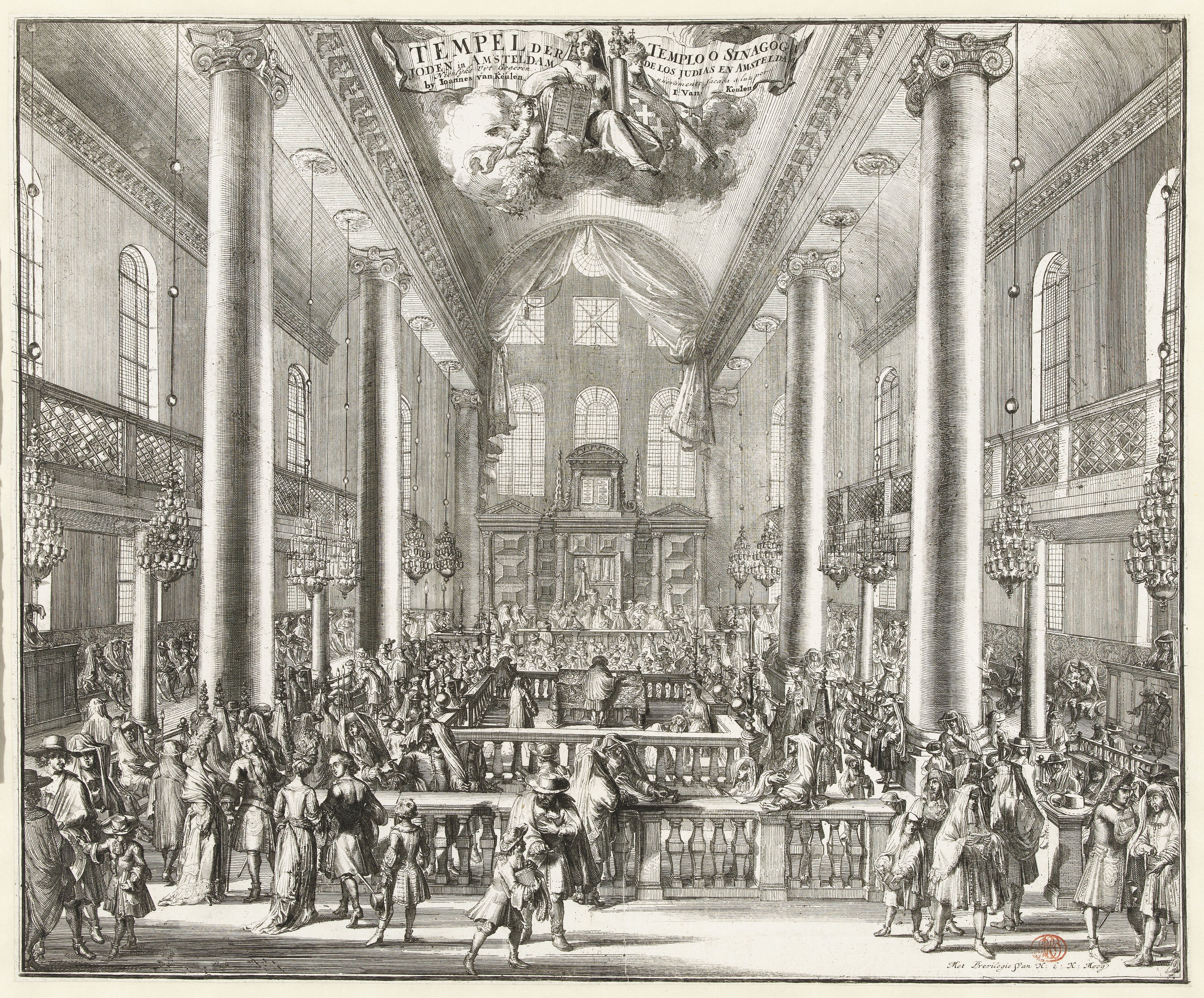

The pews, the platform from which services are led (tebah) and the pinewood floor all date from 1675. Fine sand on the floor absorbs the footsteps as well as dirt and damp from the street. The furthest candle on the chandelier nearest the hechal (which houses the Torah scrolls) is the eternal light, which burns continually.

The magnificent hechal stands against the wall in the direction of the Temple in Jerusalem. While working on the ark in 2022, renovators came across a hidden storage space below. There they found rolls of original linen wall hangings with superb prints from 1740-1760. These wall hangings can now be seen in the synagogue treasure chambers.
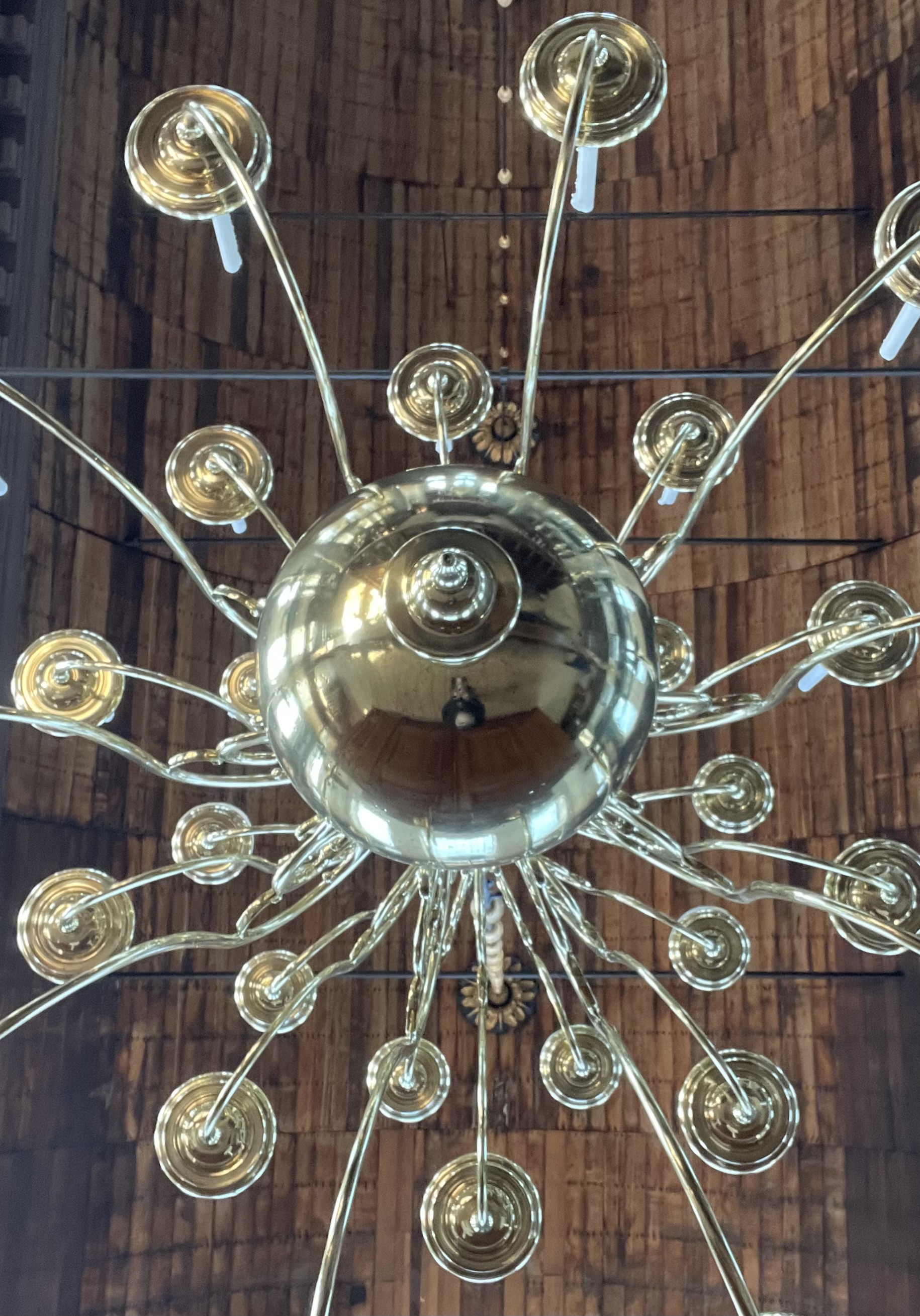
During the Nazi campaign to systematically murder Jews in the Holocaust, the synagogue was slated to become a deportation center. A teenaged firefighter—Leo Palache—and a team of volunteers managed to dissuade the Nazis from this plan. Instead, the building concealed Jewish ritual items for deported Jews in the sanctuary ceiling and attic floor. The World War II diary of executive director Salomon Coutinho was discovered in Amsterdam and details the synagogue’s works and efforts to protect the building during the war.
The synagogue remains an active house of worship while also welcoming guests to what has been called Amsterdam’s best kept secret. One visitor left the following quote, which perfectly sums up our experience.
“Its size intimidating, its rest calming, its purpose magical, and its history poignant and impressive. No one leaves the Portuguese Synagogue unmoved.”
Music in the synagogue . . . and a personal connection
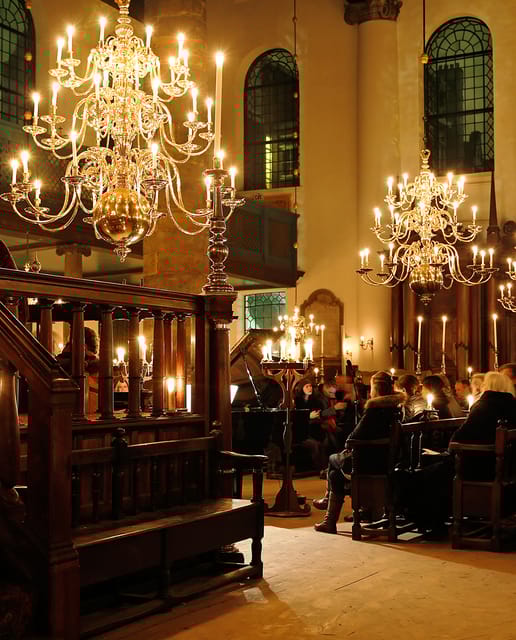
As we were visiting we heard about the importance of music to worship in the synagogue. Monthly candlelight concerts continue this tradition for all visitors.
It was only as we were texting pictures of this landmark to our children that we discovered that our son, the tenor Andrew Bearden Brown, is slated to sing the Song of Dedication concert for the 350th anniversary of the Synagogue with the Washington Bach Consort on May 2nd and 3rd.
Here’s the description from the Bach Consort website:
“From the 17th century until World War II, the Portuguese Israelite Synagogue of Amsterdam served as the heart of the Western Sephardic diaspora. This program commemorates the synagogue’s 350th anniversary with music written for or by this unique community, drawn from the archives of the Ets Haim Library of Amsterdam—the oldest active Jewish library in the world—alongside other gems of 18th-century European Jewish music.
An architectural marvel, the Esnoga stood as a striking symbol of religious freedom for Jews in a Protestant republic, unparalleled anywhere in Europe. This concert will also feature the North American premiere of Shir Hanukat Beth Hamiqdash. Reconstructed and sumptuously set by musicologist Alon Schab for the Jerusalem Baroque Orchestra, the piece is based on vocal music preserved in the manuscripts of 18th-century Rev. Hazzan Joseph ben Isaac Sarfati. With an inauguratory text by the Portuguese-born Rabbi Rev. Isaac Aboab da Fonseca, it stands as a lasting testimony to tolerance, the Dutch Golden Age, and the resilience of the Portuguese Jewish community.“
Included among the works to be performed are Synagogue Cantatas by Cristiano Giuseppe Lidarti (1730-1795). This aria from Lidarti’s oratorio “Esther” will be included in the Bach Consort program, giving you a flavor of some of the music we’ll hear in Washington next week to take us back to the magnificent Portuguese Synagogue.
Yes, serendipity is alive and well.
The Jewish Quarter
There were, of course, two synagogues in close proximity to each other in Amsterdam’s Jewish Quarter. The Great Synagogue was built in 1671 by Ashkenazi Jews from Central and Eastern Europe. It was badly damaged during World War II and has now been partially restored to serve as the Quarter’s Jewish Museum.
One of the Museum’s finest exhibits is the silver Rintel chanukiah, named after Sara Rintel.
“She donated this magnificent candelabrum to the Great Synagogue in 1753. A chanukiah is for the eight-day festival of Chanukah. Each day, one extra light is lit. The Rintel chanukiah is over a meter tall and a meter and a half wide (!), and was made specially for the Great Synagogue.”
While the Great Synagogue is now home to the Jewish Museum, the Rintel stands where it always stood for over two hundred years.

We spent a couple of hours touring the exhibits, and I even had time to take a quick spin through the provocatively named exhibition Sex, which looked at perspectives on sexuality in Jewish culture. Certainly wasn’t expecting that, but hey, its Amsterdam.

Most of the exhibits focused on personal stories, unique objects and art to allow the visitor to explore Jewish religion, history and culture. After several hours at the Portuguese Synagogue and the Jewish Museum, I came to appreciate the exhibit title about how we sanctify time by pausing to think. Abraham Joshua Heschel has written:
“Judaism is a religion of time aiming at the sanctification of time . . . Judaism teaches us to be attached to holiness in time, to be attached to sacred events, to learn how to consecrate sanctuaries that emerge from the magnificent stream of a year. The Sabbaths are our great cathedrals; and our Holy of Holies is a shrine that neither the Romans nor the Germans were able to burn; a shrine that even apostasy cannot easily obliterate.”
As is true about so much I saw on that visit, this bit of wisdom from the elders remains with me to this day.
More to come . . .
DJB
Photo of Portuguese Synagogue in candlelight by Massimo Catarinella via Wikimedia Commons
 MORE TO COME...
Fascinating, David. Very well done.
Many thanks, Chuck.
Thank you, David. Forwarding to friends.
You’re welcome. Glad it resonated.
Pingback: Exploring the Dutch waterways | MORE TO COME...
Pingback: Observations from . . . April 2025 | MORE TO COME...
Pingback: The beauty and challenges of our landmarks | MORE TO COME...
Pingback: Oh, the places we’ve seen! | MORE TO COME...