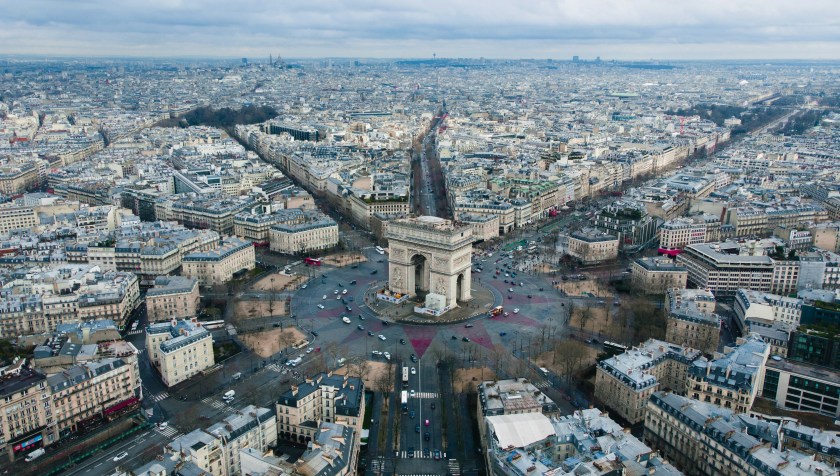
There have been volumes written celebrating Paris, the City of Light. However, too few of the accounts have been by professional historians; one of the best recent ones being a rather long single volume by Colin Jones. Wanting to dig into the history of the city in a year when we’ll be spending time in Paris, imagine my delight to discover a concise history of the city so many people visit and love. And I was even more pleased to have the opportunity to include this work as the most recent installment of my Author Q&A series.

Paris: A Short History (2024) by Jeremy Black, MBE is a succinct and incisive look at how the city, founded in the first century BCE, was shaped by cultural circumstances and then grew to have impacts across the country, Europe, and the world. Black is emeritus professor of history at the University of Exeter and the author or editor of over 100 books, many of which concern aspects of eighteenth century British, European and American political, diplomatic and military history. He brings that deep experience and understanding to this look at Paris as he explores and explains how a small Gallic capital was transformed into a flourishing medieval city full of spectacular palaces and cathedrals. Black brings the illustrious reigns of Louis XIV and XV—a time when Paris became one of the most beautiful and cosmopolitan capitals in the world—to life. And his chapters on the Revolution, the reigns of Napoleon and Napoleon III, and the shifting fortunes of France during the 18th through the 20th centuries are among the strongest in what is already a vibrant book.
Black ends by considering present-day Paris and the opportunities and challenges which lie ahead for the city. As others have noted, this history of Paris is about more than just a city: it is the history of a culture, a society, and a state that has impacted the rest of the world through centuries of changing fortunes.
In addition to this work on Paris, Black has also published France: A Short History (2021) as well as A Brief History of London (2022). I was delighted when Jeremy agreed to answer a few questions about this latest book in the series for our readers. Knowing of his deep expertise with maps, we began our conversation there.
DJB: Jeremy, each section of the book has a map showing the evolution of the city. What do maps in general contribute to understanding the history of a place, and what key points did you take away from these maps you included?

JB: I have written very widely about maps notably in Maps and Politics and Maps and History. Maps reveal and also direct you to particular features, the latter sometimes overly simplistically described as misleading. The maps I have selected for this book illustrate the developing shape and increasing shape of Paris which are important aspects of its history.
Conversely other maps could also be reproduced, as for other cities, both to show the detailed topography of the city and, very differently, to indicate its relationship to broader geographical patterns, and notably so in communications and politics.
I was intrigued by the point-of-view in your history. What do you think North American readers (and specifically readers in the U.S.) could gain from reading a history of Paris from the perspective of a British historian?
The question about points of view is a fascinating one because it implies, as do most reviewers, that people think primarily in national terms. This is not the case. There are many perspectives, contexts and paradigms including religious, class, gender, age et al. There are also major differences in expertise and interest. Plus the particular conventions, tropes and issues of scholarship.
So it is useful to look at places and periods from inside and outside. The latter is especially necessary for scholars: I obviously do not live in the Eighteenth Century. I do not so much see myself as a Brit commenting on Paris but rather as a dixhuitianist (i.e., eighteenth centuryist) trying to offer a broader perspective. Bright Americans do not need history served up in nationalised dollops.
Jeremy, I agree completely with that last statement.
Throughout the book you sprinkle these wonderful vignettes about people, events, and places that help bring Paris to life: for instance the wartime activities of Coco Chanel and the introduction of American fast food into Parisian life. What stories like this surprised you as you researched the history of Paris, and do you have a favorite?
The period about which I knew the least was that prior to 1000, as it is not full of anecdotes especially for the Roman and pre-Roman periods. But the saint carrying a decapitated head is striking. As Christianity began replacing the imperial pantheon of gods there were martyrdoms along the way. Saint Denis, first bishop of Paris, was allegedly beheaded on the hill of Montmartre around 250, during the persecution of Christians carried out by the emperor Decius (r. 249-51). It was said that he picked up his decapitated head and walked for some distance, preaching as he went.
For those traveling to Paris in the near future, what are the places off the beaten track that you would recommend for someone wanting to know more about the history and essence of the city?
The Canal and its route from Arsenal via Stalingrad; Asnieres as example of a swallowed community; Vincennes for history that few visit; mint tea at the main Mosque. Also, I recommend a visit to the Hotel de Sens for its late medieval splendour.
Thank you, Jeremy.
More to come . . .
DJB
Photo of Arc Triomphe by Rodrigo Kugnharski on Unsplash
 MORE TO COME...
Pingback: Paris. A Short History | Jeremy Black
I was just digging into this discussion when…it ended! More, please.
Thanks, Anna. I’m hoping to do another conversation with Jeremy around his new book on the Civil War. So like they say, there will be … more to come!
Funny, just before I read this conversation, I was chatting with a friend about why Americans say “City of Lights,” while the direct translation from French is “City of Light” in the singular. Apparently we are referring to the twinkling lights of the nightscape, while the phrase really refers to The Enlightenment. Well, maybe I’ll find out if that’s the case when I dip into the book this weekend!
This description from the Guggenheim-Bilbao might be helpful.
So interesting! So maybe we’re right – it’s the lights!
Perhaps…but I decided to go with the “original.”
Pingback: Observations from . . . August 2025 | MORE TO COME...
Pingback: From the bookshelf: August 2025 | MORE TO COME...
Pingback: Pull up a chair and let’s talk | MORE TO COME...
Pingback: The year in books: 2025 | MORE TO COME...